
QuasarEdge Acquisition Corp: Merger Execution, SPAC Economics, and the Stakes of the Robseek Deal
QuasarEdge Acquisition Corp faces a pivotal transition as it pursues a merger with Robseek Intelligence Inc. Recent financial disclosures show positive net income but reveal little about underlying operations, placing heightened weight on successful transaction execution and post-merger integration. The business’s future now hinges on the realization of its SPAC mandate and the strategic fit of its chosen target.
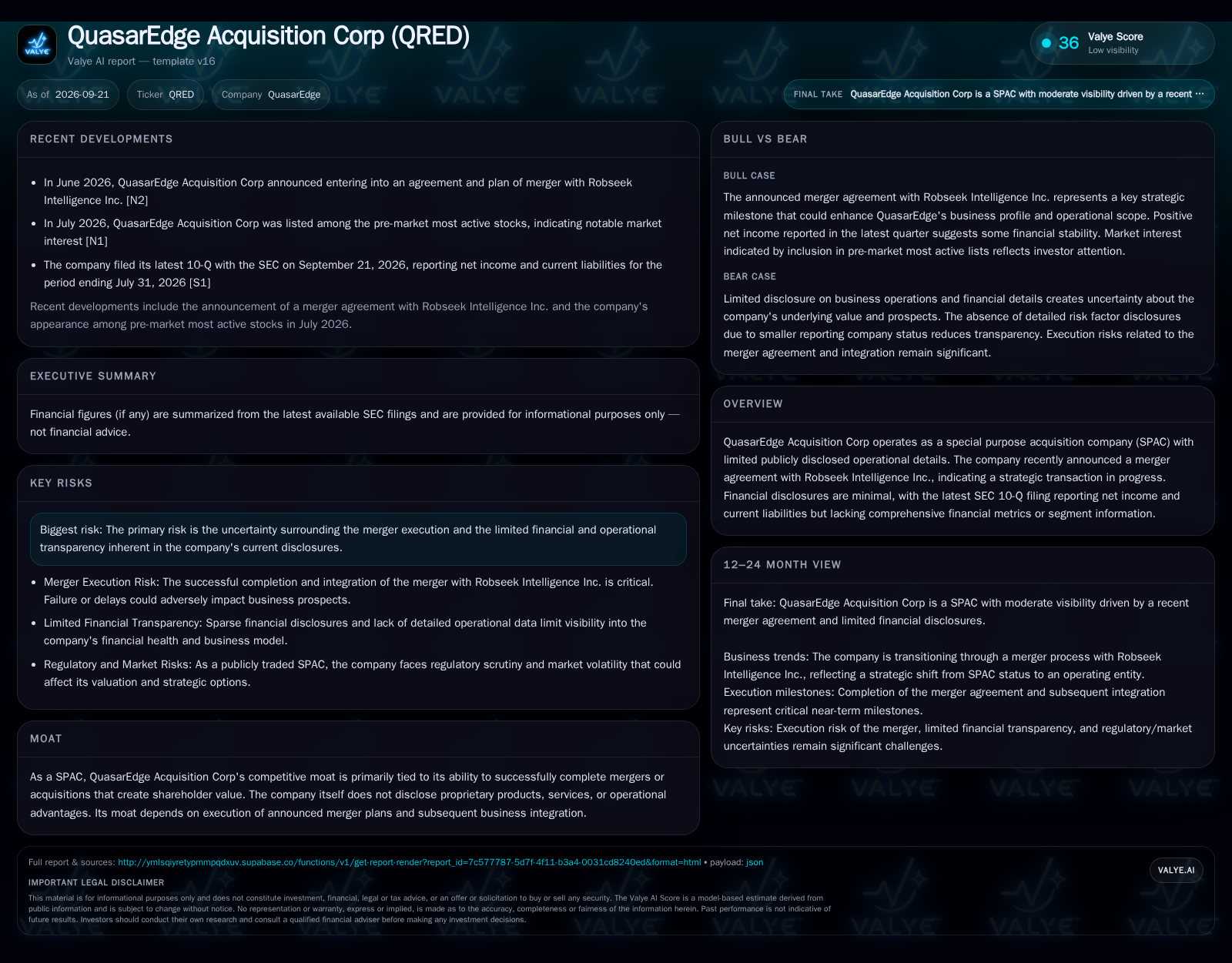
QuasarEdge Acquisition Corp has reported positive net income and recently entered into a merger agreement with Robseek Intelligence Inc. However, minimal operational disclosure and the inherent risks of SPAC execution mean the company's long-term value will depend on the completion and integration of the Robseek transaction. The lack of detailed financial or business information makes near-term milestones—especially merger closure and clarity on Robseek’s business—critical to the thesis. [S1] [N2]
QuasarEdge Acquisition Corp stands at a crossroads. As a recently IPO’d SPAC with positive net income but minimal operational detail, its future is now tied to the announced merger with Robseek Intelligence Inc. This pending transaction will test the company’s ability to transition from financial shell to business operator, with limited current transparency placing additional pressure on execution. The coming quarters will reveal whether QuasarEdge can deliver on its promise to investors and what the true economic potential of the Robseek combination will be.
Recent Financials and the Robseek Merger Set the Stage
QuasarEdge Acquisition Corp reported net income of $581,631 for the period ending July 31, 2026, alongside current liabilities of $199,018. However, the company did not disclose its cash or equivalents, and its cash ratio is reported as zero due to this omission. This leaves the true liquidity position unclear. The most consequential development is the June 2026 announcement of a merger agreement with Robseek Intelligence Inc. As of the latest filing, no transaction had closed, so QuasarEdge remains a blank check company with no operating business. These facts matter because the company’s entire future—and its ability to generate sustainable revenue or profits—now depends on executing and integrating this merger. [S1] [N2]
SPAC Economics: Incentives and the Post-Merger Transition
QuasarEdge’s current business model is that of a SPAC: it raised $115 million in gross proceeds from its April 2026 IPO and over-allotment, plus $2.85 million from private placements to its sponsor. All activity to date has been focused on identifying and negotiating a business combination. The economic structure of a SPAC creates a strong incentive to close a deal, as sponsors and finders are typically compensated primarily through equity or success fees contingent on transaction closure. In QuasarEdge’s case, a finder’s fee of $1.5 million and 6 million ordinary shares will be paid only if the target’s pre-money valuation exceeds $500 million and the merger closes. [S1]
If the Robseek transaction is completed, the economic profile of QuasarEdge will fundamentally shift. The company will need to rapidly establish operating revenue streams, manage integration costs, and possibly raise additional capital if the acquired business is not immediately cash generative. Until then, the company’s fixed cost base is relatively low, but post-merger operating leverage and capital requirements will depend entirely on the nature and scale of Robseek’s business. Without disclosure of Robseek’s financials or commercial mechanics, it is unclear whether the combined entity will have recurring revenue, high gross margins, or require significant reinvestment to scale.
Strategic Position Hinges on Robseek’s Business Profile
At present, QuasarEdge does not have a proprietary product, service, or operational advantage; its competitive position is purely financial and transactional. The company’s moat, if any, will be determined by the success of the Robseek merger and the strategic characteristics of Robseek’s business. If Robseek operates in a sector with high barriers to entry, scalable technology, or strong customer relationships, QuasarEdge could inherit some degree of defensibility. Conversely, if Robseek is in a fragmented or highly competitive industry, post-merger value creation will be harder to achieve.
SPACs compete for attractive targets and for investor confidence; post-merger, the competitive set will shift to include direct peers in Robseek’s sector. The ability to articulate a differentiated value proposition, demonstrate operating traction, and retain key personnel will become crucial. Without more detail on Robseek’s business, it is not possible to assess the sustainability of any competitive advantage at this stage.
Integration Success and Operating Momentum Could Unlock Value
A favorable outcome for QuasarEdge would involve the timely completion of the Robseek merger, followed by disclosure that Robseek is a rapidly growing, profitable business with scalable economics. If Robseek brings proprietary technology, sticky customer contracts, or high-margin recurring revenue, the combined entity could command a premium valuation and attract additional investor interest. Evidence supporting this scenario would include robust post-merger financials, clear go-to-market strategy, and positive guidance from management.
Confirmation of this scenario would require: (1) closing of the merger on agreed terms, (2) publication of detailed financials showing strong revenue growth and margin profile for Robseek, and (3) indications that integration is proceeding smoothly with minimal disruption to customers or key staff. Falsification would occur if the merger fails to close, if Robseek’s financials reveal weak or declining performance, or if integration issues lead to value destruction.
Transition to Operating Company Brings Growing Pains and Disclosure
The most plausible path is that QuasarEdge completes the Robseek merger but faces a typical post-SPAC transition: increased scrutiny, growing pains as two organizations integrate, and a period of volatility as the market digests new disclosures. In this scenario, Robseek may be a credible business but without dramatic outperformance; the combined company will need to invest in reporting systems, investor relations, and operational scaling.
Confirmation would come from timely merger closure, publication of full financial statements for the combined business, and evidence of sequential operating improvement. Falsification would be delayed or renegotiated merger terms, persistent lack of disclosure, or early signs of integration trouble (e.g., executive departures, customer churn, or missed financial targets).
Merger Failure or Post-Deal Underperformance Threatens Value
The adverse scenario is that the Robseek transaction fails to close, in which case QuasarEdge would revert to its status as a cash shell, facing a shrinking time window to find another target or return funds to shareholders. Alternatively, the merger could close but Robseek’s business might prove far weaker than anticipated—unprofitable, cash-burning, or unable to scale. In either case, investor confidence could erode, leading to redemptions or sustained trading below trust value.
This scenario would be confirmed by official termination of the merger agreement, disclosure of negative financial surprises post-closing, or signs of major integration setbacks. Persistent lack of transparency or regulatory delays would also support the downside case.
Milestones and Disclosures That Will Define QuasarEdge’s Post-Merger Trajectory
Closure of the Robseek merger by the agreed-upon deadline, with confirmation of all material terms. [N2]
Initial post-merger financial disclosures, including revenue, gross margin, cash flow, and customer concentration for the combined entity. If disclosed, these will be essential for assessing operating viability.
Any changes to the merger agreement, including valuation adjustments, additional equity issuance, or extension of closing timelines.
Management commentary on integration planning, retention of key Robseek personnel, and realization of anticipated synergies. A useful metric would be voluntary attrition rates post-merger.
Evidence of new customer wins or contract renewals attributed to Robseek, if disclosed, as an early signal of market acceptance.
Trading volume and redemption rates around the merger closing date, which may indicate shareholder confidence or skepticism.
Regulatory clearances or delays, particularly if Robseek operates in a sector subject to heightened scrutiny.
Updates to sponsor and finder compensation structure, which may signal renegotiation or shifting incentives.
Disclaimer: This is research-only, informational analysis and not investment advice. It may include AI-generated interpretation and general industry context. Always verify important details using primary sources.

Comments