
Advanced Oxygen Technologies: Customer Dependence, Supply Chain Fragility, and the Limits of Micro-Scale Foreign Operations
With all revenue sourced from Danish subsidiaries—one anchored to a single customer, the other reliant on a sole vendor—Advanced Oxygen Technologies faces a business model defined more by concentration risk than by scale or diversification. The challenge is not operational survival, but the sustainability and scalability of such a narrowly constructed enterprise.
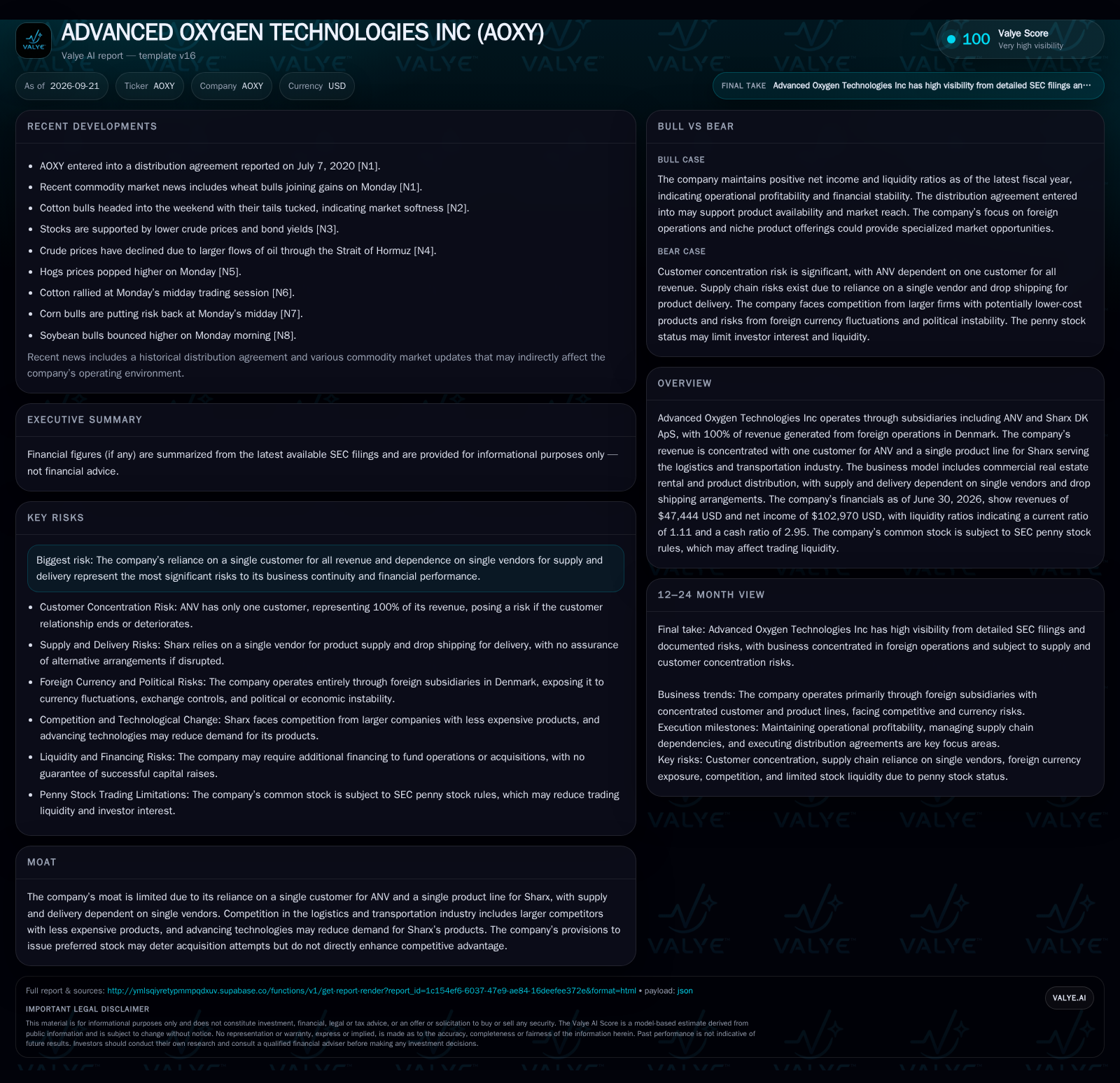
AOXY’s latest filings reveal a profitable but precarious business: all revenue is foreign, ANV depends entirely on one customer, Sharx relies on a single logistics-industry product and vendor, and both are exposed to supply, currency, and competitive risks. [S1] [S2]
Advanced Oxygen Technologies Inc (AOXY) is an archetype of microcap concentration risk: its entire revenue base flows from two Danish subsidiaries, with one wholly dependent on a single customer and the other on a single product, vendor, and industry vertical. In an environment where even minor disruptions could threaten the business, the central question is not whether AOXY can survive another quarter, but whether its narrow structure can deliver sustainable value or strategic optionality.
AOXY’s 2026 Financials: Profitability Amid Structural Concentration
As of June 30, 2026, Advanced Oxygen Technologies reported $47,444 in total revenue and $102,970 in net income, translating to basic and diluted earnings per share of $0.03. 100% of AOXY’s revenue is generated through Danish subsidiaries: ANV, which relies entirely on a single customer, and Sharx DK ApS, which distributes a single product to the logistics and transportation industry via a sole vendor and drop shipping. The company’s common stock remains subject to SEC penny stock rules, restricting trading liquidity and broad investor participation. [S1] [S2]
Economics of a Narrow Revenue Base: High Margins, Limited Scalability
AOXY’s business model is characterized by extreme concentration: ANV’s revenue depends entirely on one customer, while Sharx’s sole product is sourced and delivered through a single vendor. This setup can create superficially attractive margins—as evidenced by positive net income on modest revenue—but it also severely limits operating leverage and scalability. Fixed costs are likely low, but so is the company’s ability to absorb shocks or scale up without new customers, products, or vendors.
Revenue mix is entirely foreign, exposing all earnings to currency fluctuations and economic conditions in Denmark. The commercial real estate component offers potential for stable, recurring income if tenant relationships are durable, but the lack of diversification increases the risk that a single event could sharply impact results. The company may require additional financing to fund new initiatives or acquisitions, but its penny stock status and small scale could make capital raises expensive or dilutive. [S1]
The concentration inherent in AOXY’s revenue streams also constrains its bargaining power with both customers and suppliers. When a significant portion of income depends on a single entity, the company faces limited leverage to negotiate favorable terms, potentially compressing margins over time. Conversely, the sole vendor relationship in Sharx’s supply chain may limit the ability to switch suppliers quickly or seek cost reductions, especially if the vendor holds a unique position or proprietary product. This dynamic increases operational risk and reduces flexibility to respond to market changes or cost pressures, thereby limiting the company’s capacity to improve profitability through scale or efficiency gains.
Structural Weaknesses in Market Position and Defensibility
AOXY lacks significant competitive advantages: its moat is limited by dependence on a single customer and product, with no proprietary technology or network effects. In the logistics and transportation sector, Sharx faces competition from larger, better-capitalized firms that can undercut on price or offer more comprehensive product lines. Customer and supplier switching costs appear low—if a competitor offers a better deal, either major relationship could be lost.
Foreign operations add complexity: currency risk and potential regulatory or political changes in Denmark could impact both operating performance and repatriation of profits. Meanwhile, the company’s penny stock status reduces its visibility and credibility with institutional investors, further constraining strategic flexibility. In summary, AOXY’s position is defined by vulnerability rather than defensibility. [S1]
AOXY’s foreign operational footprint, while offering access to specific markets, also introduces layers of complexity that can impede strategic agility. Regulatory environments in foreign jurisdictions often evolve unpredictably, and compliance costs can rise, especially for smaller players lacking economies of scale. Additionally, currency volatility can erode margins or create earnings unpredictability, complicating financial planning. These factors collectively diminish the company’s ability to build durable competitive advantages, as resources must be allocated to managing external risks rather than innovation or market expansion. The absence of proprietary technology or differentiated offerings further exacerbates vulnerability to competitive encroachment.
What Could Shift the Trajectory: New Contracts or Product Expansion
An upside scenario would require AOXY to diversify its customer and supplier base, expand Sharx’s product offerings, or secure additional commercial real estate tenants. If the company could leverage its existing distribution agreement to win new contracts—either in Denmark or adjacent markets—revenue growth and operating leverage could improve. Alternatively, if Sharx’s product proves uniquely suited for evolving logistics needs, and the sole vendor relationship is stable and cost-effective, the company could carve out a defensible niche.
Confirmation of this scenario would come from announcements of new customers for ANV, new products or vendor relationships for Sharx, or evidence of recurring, multi-year contracts. Increased revenue diversification and a reduction in concentration risk would be key signals that AOXY is moving beyond survival toward sustainable growth.
Persistence of the Status Quo: Low-Scale Operations, Ongoing Fragility
The most plausible scenario is continued operation at current scale, with revenues and profits fluctuating based on the stability of existing relationships. AOXY may maintain modest profitability as long as ANV’s sole customer and Sharx’s vendor relationship remain intact. However, the business will remain vulnerable to any disruption—whether due to customer loss, supply chain interruption, or adverse currency movements.
Confirmation would come from continued single-customer and single-vendor disclosures, flat or modestly variable financials, and absence of material news about new contracts or product lines. Falsification would require evidence of meaningful diversification or loss of a key relationship.
Maintaining the status quo also implies persistent exposure to external shocks without sufficient buffers. For example, fluctuations in foreign exchange rates could unpredictably impact reported earnings, especially if hedging strategies are limited by scale or cost. Similarly, any operational hiccup in the supply chain—such as delays or increased costs from the sole vendor—would disproportionately affect Sharx’s product availability and profitability. Without strategic moves to diversify or scale, AOXY’s financial performance may continue to oscillate within a narrow band, limiting investor confidence and curtailing access to growth capital. This scenario underscores the fragility embedded in the company’s current operating model.
Breakdown of Key Relationships: Rapid Earnings Deterioration
The most acute risk is the loss of ANV’s sole customer or disruption in Sharx’s supply chain—either could result in a sudden and severe drop in revenue, with little prospect for immediate recovery. Given the lack of diversification, such an event would likely drive the company into operating losses, force asset sales, or necessitate dilutive emergency financing.
Downside confirmation would be a disclosed termination of the ANV customer relationship, vendor disruption, or inability to secure new financing. Significant negative swings in quarterly revenue or net income, absent offsetting new business, would also signal this scenario.
Factors That Will Define AOXY’s Strategic Viability
Any disclosure of new customers for ANV would be a critical indicator of reduced concentration risk and improved revenue durability.
Updates on Sharx’s product portfolio—such as the addition of new products, vendors, or industry verticals—would help test the company’s ability to diversify and scale.
Material changes in foreign currency rates or Danish political/economic conditions could directly impact financial performance and should be monitored.
Evidence of successful capital raises, partnerships, or acquisitions would signal increased strategic flexibility and growth potential.
If disclosed, the average duration and terms of commercial real estate leases would clarify the stability and visibility of this income stream.
Quarterly or annual trends in customer retention and supplier reliability, if reported, would provide early warning of impending disruptions.
Announcements related to compliance with penny stock rules or uplisting efforts could affect trading liquidity and investor perception.
Any change in the company’s ability to repatriate foreign earnings or respond to regulatory shifts in Denmark would be material to ongoing operations.
Disclaimer: This is research-only, informational analysis and not investment advice. It may include AI-generated interpretation and general industry context. Always verify important details using primary sources.

Comments