
Pinnacle Acquisition Corp: SPAC Timelines, Liquidity Pressure, and the Strategic Stakes of the Initial Business Combination
Pinnacle Acquisition Corp, a newly listed NYSE SPAC, must complete a business combination by May 2028 (extendable to August 2029) or face delisting.
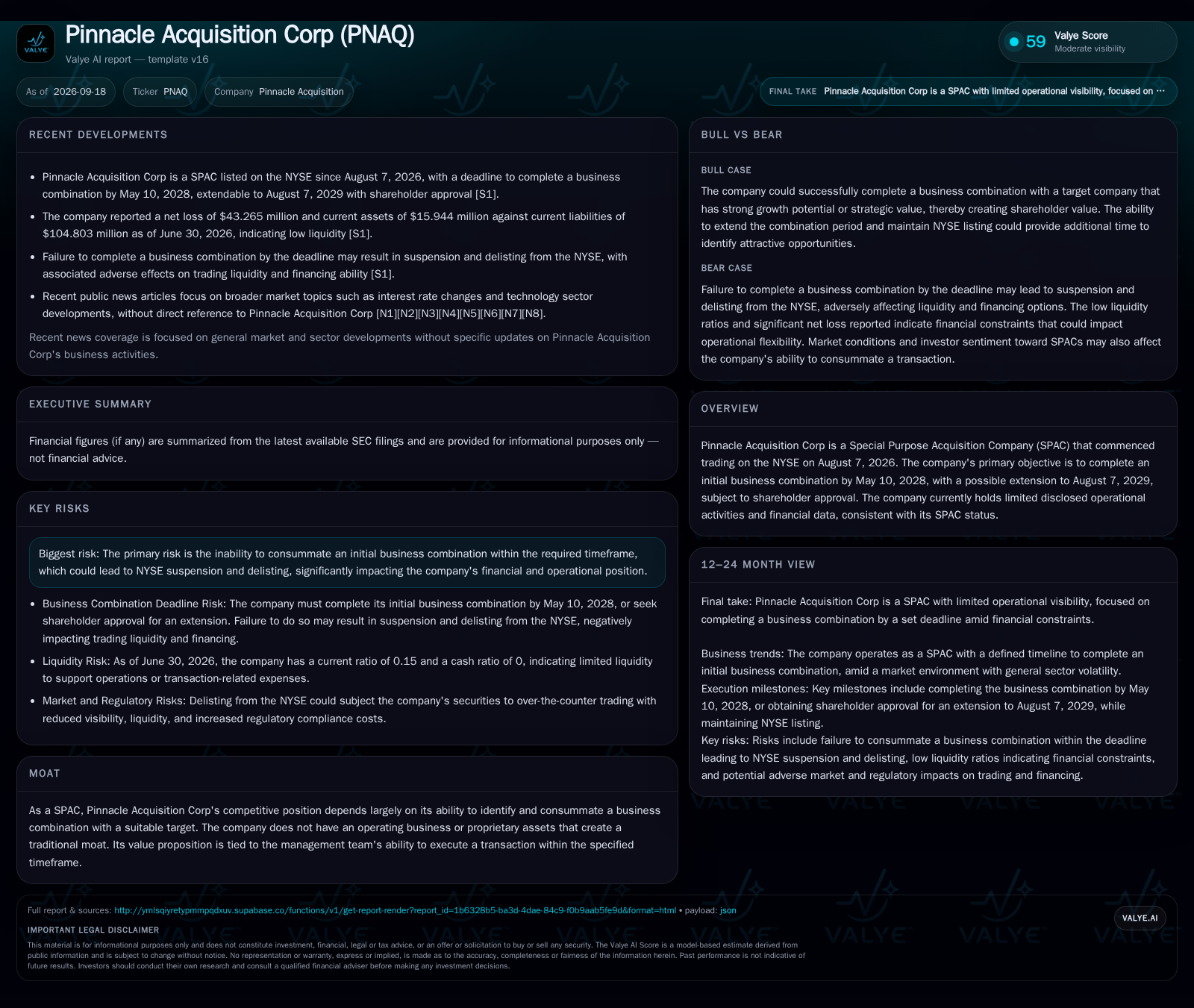
Pinnacle Acquisition Corp, a newly listed NYSE SPAC, must complete a business combination by May 2028 (extendable to August 2029) or face delisting. With current assets of $15.9M versus $104.8M in current liabilities and a recent net loss of $43.3M, liquidity is severely constrained. The company’s future hinges on sourcing and closing a compelling acquisition within the deadline—failure would trigger trading and financing risks, while success could unlock value if a strong target is secured. [S1]
Pinnacle Acquisition Corp’s journey exemplifies the high-wire act facing SPACs in the post-2024 cycle: a finite window to find and merge with a promising target, mounting operational costs, and intensifying scrutiny from both regulators and public markets. With a sharply negative liquidity profile and a looming business combination deadline, the company’s entire value proposition now hinges on the quality and timing of its inaugural deal. Success could position Pinnacle for value creation and continued NYSE listing, while failure would likely relegate it to the ranks of delisted, post-SPAC shells.
Imminent Deadlines and Liquidity Strain Define Pinnacle’s Strategic Moment
Pinnacle Acquisition Corp is a recently listed NYSE SPAC with a mandate to consummate its first business combination by May 10, 2028; this deadline can be extended to August 7, 2029 only with shareholder approval. The company reported a current ratio of 0.15 for the period. The company also recorded a net loss of $43.265 million for the quarter ended June 30, 2026, reflecting the high cost base typical of a SPAC pre-acquisition. If Pinnacle fails to complete a qualifying transaction within the allotted timeframe, it risks NYSE suspension and delisting, which would severely impair trading liquidity and access to public capital. [S1]
SPAC Economics: Trust Accounts, Sponsor Incentives, and the Cost of Delay
Pinnacle’s economic model follows the classic SPAC structure: capital is raised via IPO, proceeds are placed into a trust account, and the sponsor team is incentivized to secure an attractive acquisition—typically by receiving founder shares or warrants contingent on closing a deal. In this case, Pinnacle’s IPO generated $200 million in gross proceeds, with an additional $2.25 million from a private placement, all initially placed in a restricted trust account. These funds are generally inaccessible for operating expenses, which must be covered by separate working capital or sponsor loans. The company’s current asset and liability profile suggests that most of its trust capital remains locked away, while operational and transaction costs are mounting.
The SPAC structure creates a sharp fixed-cost burden: administrative, legal, and diligence expenses accumulate regardless of deal progress, while the inability to generate operating revenue pre-merger means ongoing net losses. If a business combination is achieved, the economics shift dramatically: the combined entity may access the trust capital (less redemptions and expenses) and potentially new PIPE (private investment in public equity) funding, but only if market sentiment and the deal’s perceived quality are favorable. Until then, Pinnacle’s runway for covering costs outside the trust is dictated by its limited non-trust liquidity and the willingness of sponsors or affiliates to provide bridge financing.
SPACs in a Crowded Field: What Could Set Pinnacle Apart?
Pinnacle Acquisition operates in a SPAC market that remains highly competitive, with dozens of blank-check companies vying for a limited pool of attractive targets. SPACs compete not only with each other, but also with private equity, strategic buyers, and traditional IPO routes. In this environment, differentiation often depends on the sponsor team’s sector expertise, deal-sourcing network, and reputation for executing complex transactions.
Pinnacle’s stated focus on targets with growth platforms and strong management teams aligns with the prevailing SPAC playbook, but does not by itself confer any moat or proprietary sourcing advantage. The lack of an operating business or proprietary asset base means Pinnacle’s competitive edge—if any—will come from the credibility and connections of its sponsor group, its ability to move quickly, and the flexibility it can offer target companies in terms of deal structure and post-merger capitalization. In a market wary of underwhelming SPAC deals, the bar for both quality and transparency is higher than ever.
Unlocking Value Through a High-Quality, Accretive Acquisition
The most constructive scenario for Pinnacle is the identification and successful closing of a business combination with a high-growth or strategically valuable private company. This could unlock the trust capital (less redemptions), attract PIPE investors, and provide a public listing for the target. If Pinnacle’s sponsor team is able to source a deal in a sector with strong secular tailwinds—such as AI, next-gen healthcare, or clean energy—and structure terms that align incentives for both shareholders and the acquired company, the merged entity could command a premium valuation and sustained investor interest.
Evidence that would confirm this scenario includes a timely LOI (letter of intent) or definitive agreement with a credible, growth-oriented target; PIPE commitments or anchor investors expressing support for the deal; and limited redemption rates at the merger vote. Conversely, delays in deal announcement, lack of PIPE interest, or high redemptions would undermine the upside thesis.
Most Plausible Trajectory: Race Against Time, Uncertain Deal Quality
In this scenario, the sponsor team may succeed in signing a business combination, but the quality or fit of the target may be suboptimal—potentially due to a scarcity of high-quality candidates or unfavorable negotiating leverage as deadlines loom. The deal could face high shareholder redemptions, reducing available cash for the post-merger entity, and the market may react with skepticism absent a compelling growth story or clear path to profitability.
This base case would be confirmed by a late-stage deal announcement, tepid PIPE participation (if disclosed), and a merger vote with high redemption levels. If the company is forced to seek an extension, the need for additional sponsor or affiliate funding could dilute post-merger economics or signal execution risk.
Failure to Secure a Deal: Delisting, Redemptions, and Erosion of Value
The critical risk for Pinnacle is the inability to close a business combination by the required deadline. If no deal is consummated and shareholders do not approve an extension, the company faces NYSE suspension and delisting. In this event, trading liquidity would collapse, public shareholders would likely redeem their shares for a pro rata share of the trust account (subject to redemptions and expenses), and any residual value for sponsor shares or warrants could be wiped out.
This scenario would be confirmed by missed interim milestones (such as failure to announce a deal or file a proxy by early 2028), lack of extension support from shareholders, and regulatory notices regarding NYSE compliance.
Milestones That Will Determine Pinnacle’s SPAC Outcome
Announcement of a letter of intent (LOI) or definitive agreement for a business combination, including disclosed target sector and financials.
Disclosure of PIPE (private investment in public equity) commitments, anchor investors, or backstop arrangements—if any.
Trends in shareholder redemption rates at the merger vote, which will determine the net cash available for the post-merger entity.
Any requests for deadline extension and associated shareholder approval process.
Updates to the company’s current asset and liability position, especially any changes in non-trust liquidity or new financing arrangements.
NYSE communications regarding continued listing status or compliance warnings.
Sponsor or affiliate loans to cover ongoing operational costs, if disclosed.
Market and regulatory developments affecting the broader SPAC sector, which could influence investor sentiment and deal execution.
Disclaimer: This is research-only, informational analysis and not investment advice. It may include AI-generated interpretation and general industry context. Always verify important details using primary sources.

Comments