
Magnitude International: Navigating Market Access Crisis Amid Ongoing Project Backlog in Singapore Electrical Services
Magnitude International, a Singapore-focused electrical installation contractor, faces an existential challenge as a Nasdaq trading halt and delisting threat overshadow its operational backlog.
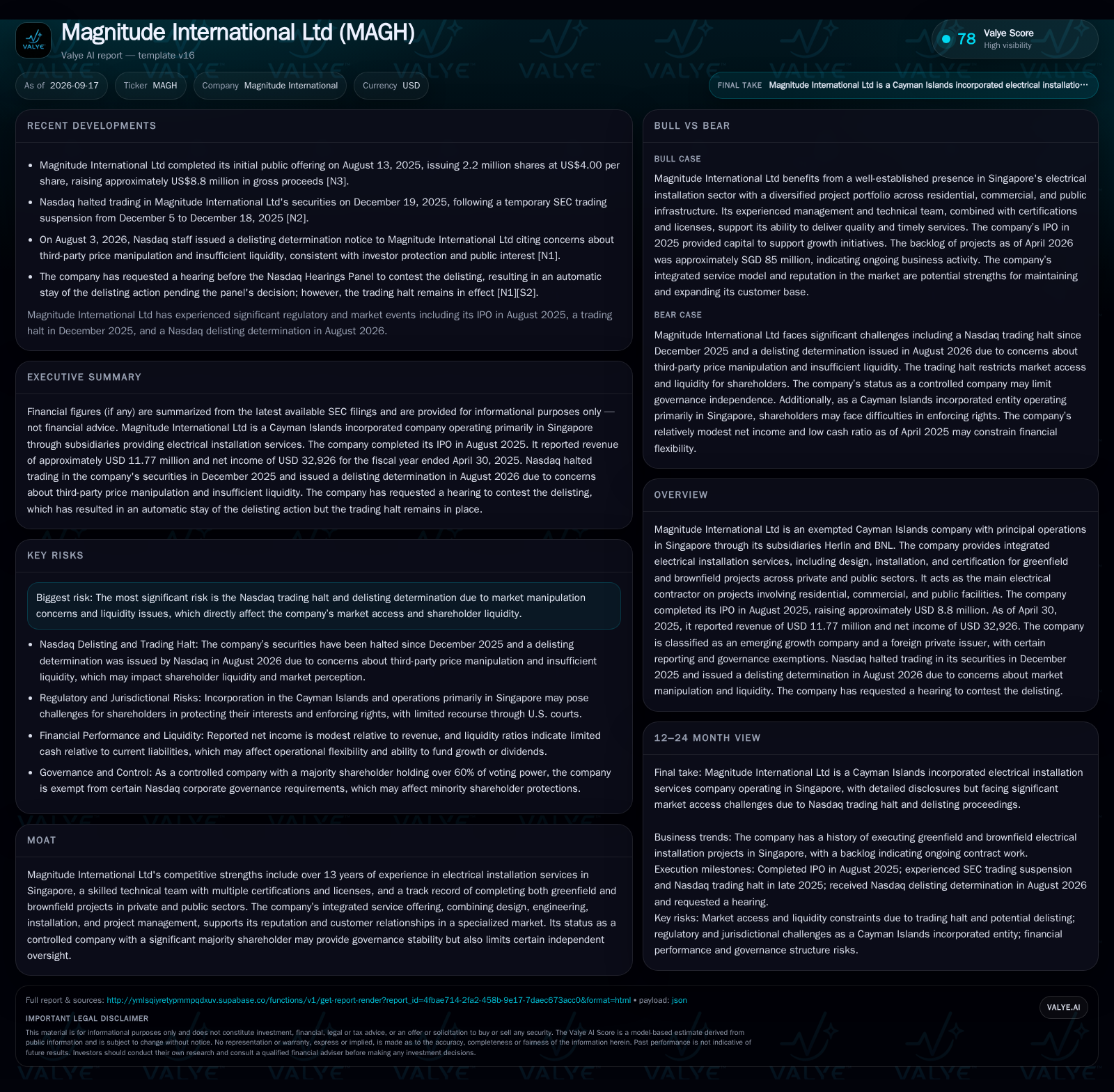
Magnitude International, operating primarily in Singapore’s electrical installation sector, reported an $11.77 million revenue and marginal net income for FY2025. Following its August 2025 IPO, Nasdaq halted trading in its shares in December 2025 and issued a delisting determination in August 2026 due to alleged price manipulation and low liquidity. The company’s ability to maintain market access and potential financial flexibility now stands as the central uncertainty, despite an ongoing project backlog and established operational capabilities. [S1] [N1] [N2] [S2]
Magnitude International Ltd, a Singapore-based electrical installation contractor, finds itself at a crossroads. The company’s operational base remains intact, with a history of delivering complex greenfield and brownfield projects, but its capital market access is now severely compromised. Following an IPO in August 2025, the company was hit by a Nasdaq trading halt and a subsequent delisting determination over concerns about price manipulation and low liquidity. With modest profitability, limited cash, and a majority-controlled governance structure, Magnitude’s future will hinge on whether it can restore investor confidence and maintain business continuity despite its present market access crisis. [S1] [N1] [N2] [S2]
Trading Suspension and Delisting Threat Overshadow Operational Progress
Magnitude International’s operational momentum is now dominated by external market access events. The company reported $11.77 million in revenue and only $32,926 in net income for the fiscal year ended April 2025, with thin margins reflecting the competitive and cost-sensitive nature of electrical contracting. More pressingly, Nasdaq suspended trading of Magnitude’s shares in December 2025, citing concerns over third-party price manipulation and insufficient liquidity, and issued a formal delisting determination in August 2026. The company has requested a hearing to contest the delisting, triggering an automatic stay, but its shares remain halted, effectively freezing shareholder liquidity and undermining public market confidence. [S1] [N1] [N2] [S2]
How Project-Based Revenue and Cost Structure Drive Profitability—and Vulnerability
Magnitude’s core business model is traditional project contracting: it serves as the principal electrical contractor for new builds (greenfield) and retrofits (brownfield) in Singapore's private and public sectors. Revenue is typically recognized on a project-completion or percentage-of-completion basis, with cash inflows tightly linked to milestone payments from clients. Cost of goods sold is dominated by labor, materials, and sub-contractor expenses, with gross margins naturally thin due to competitive tendering and limited pricing power in a fragmented market.
Operating leverage is inherently low; most costs scale with project volume, and the company’s modest net income margin for FY2025 suggests limited buffer for cost overruns or project delays. The company reported cash and liquidity metrics for the period; these figures do not by themselves establish operating runway, investment capacity, financial flexibility, or financing capacity. [S1]
Future economics will depend on Magnitude’s ability to continuously secure new contracts, manage execution risk, and avoid prolonged gaps in the project pipeline. Any disruption—whether from macroeconomic slowdown, regulatory shifts, or reputational damage from market access issues—could translate rapidly into cash flow stress.
The project-based nature of Magnitude’s revenue recognition inherently introduces variability in cash flow timing, which can complicate liquidity management. Since payments are milestone-dependent, any delays in project progress or client approvals can postpone cash inflows, potentially creating short-term funding gaps. This dynamic underscores the importance of maintaining robust project management and client relationships to ensure timely milestone achievement and payment collection. Additionally, the company’s reliance on subcontractors and suppliers means that negotiating favorable payment terms is critical; extended payables can provide temporary liquidity relief but may strain vendor relationships if prolonged.
Specialized Capabilities in a Crowded Singapore Market: Differentiation Versus Commoditization
Magnitude’s competitive position is grounded in its integrated service model, technical certifications, and a history of project delivery in Singapore. The company’s technical team, licensed professionals, and sector certifications enable it to win contracts requiring compliance and reliability—especially in public infrastructure and complex commercial projects. This operational credibility could help retain business with institutional clients, developers, and government agencies.
However, the Singapore electrical contracting market is characterized by numerous local and regional players, many with similar technical capabilities. Price-based competition remains intense, and barriers to entry are moderate for smaller-scale projects. Magnitude’s ability to maintain or expand market share may hinge on its reputation for timely delivery, safety record, and ability to handle larger, integrated projects. Yet, without clear evidence of recurring revenue streams, proprietary technology, or unique contractual arrangements, the company’s competitive differentiation is likely modest and vulnerable to downward price pressure.
The trading halt and delisting threat further erode any public-market-based reputational advantage, potentially affecting customer and supplier confidence and making it harder to attract new business or top technical talent.
Restored Market Access Unlocks Operational Leverage and Strategic Optionality
A favorable trajectory would see Magnitude successfully contesting the Nasdaq delisting, leading to reinstatement of trading and restoration of public market access. This could improve shareholder confidence, enable future capital raises, and enhance the company’s credibility with customers and suppliers. If Magnitude can leverage its reported project backlog (approximately SGD 85 million as of April 2026, per report context) into steady revenue conversion, and maintain execution discipline, it could improve profitability and working capital over time.
Confirmation of this scenario would come from a positive Nasdaq Hearings Panel decision, resumption of trading, new contract wins, evidence of sustained or growing backlog, and improving cash flow metrics. Falsification would be rapid if the delisting is upheld, trading remains suspended, or if backlog conversion stalls and cash balances erode.
Business Continuity Amid Market Access Limbo: Operations Continue, But Flexibility Remains Constrained
The most likely scenario is that Magnitude continues project operations in Singapore while its public market status remains unresolved. The company may be able to execute on existing contracts and maintain its technical workforce, relying on its operational reputation and backlog to support revenue.
Evidence supporting this scenario would be continued project announcements, stable or modestly growing revenue, and no further deterioration in liquidity. Signs of stress would include shrinking backlog, delayed payments, staff departures, or adverse customer disclosures.
Delisting and Prolonged Trading Halt Trigger Erosion of Stakeholder Confidence and Business Deterioration
In this adverse pathway, Nasdaq upholds its delisting determination and Magnitude’s shares remain untradeable, eliminating access to U.S. capital markets and further damaging the company’s reputation among customers, suppliers, and employees. This could trigger a negative feedback loop, with clients reluctant to award new contracts, key technical staff departing for more stable employers, and suppliers demanding stricter payment terms.
If liquidity continues to tighten and backlog fails to convert into cash-positive projects, Magnitude may face operational disruptions, project delays, or even insolvency risk. Evidence of this scenario would include persistent trading suspension, worsening liquidity ratios, project cancellations, and negative disclosures from customers or regulators.
Milestones That Will Determine Magnitude’s Market Access and Operational Trajectory
Nasdaq Hearings Panel decision on Magnitude’s delisting appeal and any subsequent update on trading status. [N1] [S2]
Changes in reported backlog size, composition, and conversion rate to revenue—if disclosed in future filings or announcements.
New contract wins or renewals, especially in the public sector or with repeat institutional clients, would help test long-term demand and reputation.
Quarterly or interim cash flow and liquidity updates, particularly trends in cash conversion from backlog and receivables management, if disclosed.
Retention and turnover rates among licensed technical professionals—a useful metric would be voluntary departures or hiring freezes.
Any disclosure of project execution issues, cost overruns, or delays that could affect margins and customer confidence.
Changes in supplier payment terms or evidence of tightening credit from vendors, signaling perceived counterparty risk.
Announcements of alternative financing, private placements, or strategic partnerships that could provide new capital or operational support.
Disclaimer: This is research-only, informational analysis and not investment advice. It may include AI-generated interpretation and general industry context. Always verify important details using primary sources.

Comments