
Aeluma, Inc.: Transitioning Photonic Innovation from R&D to Commercialization in High-Value Sensing and Communications
Aeluma’s proprietary integration platform for compound semiconductors on large-diameter substrates positions it at the intersection of next-generation photonics and high-growth end markets. The company’s capital-efficient approach and recent customer engagement mark early commercial progress, but significant hurdles remain in scaling production, securing recurring revenue, and competing with entrenched industry players.
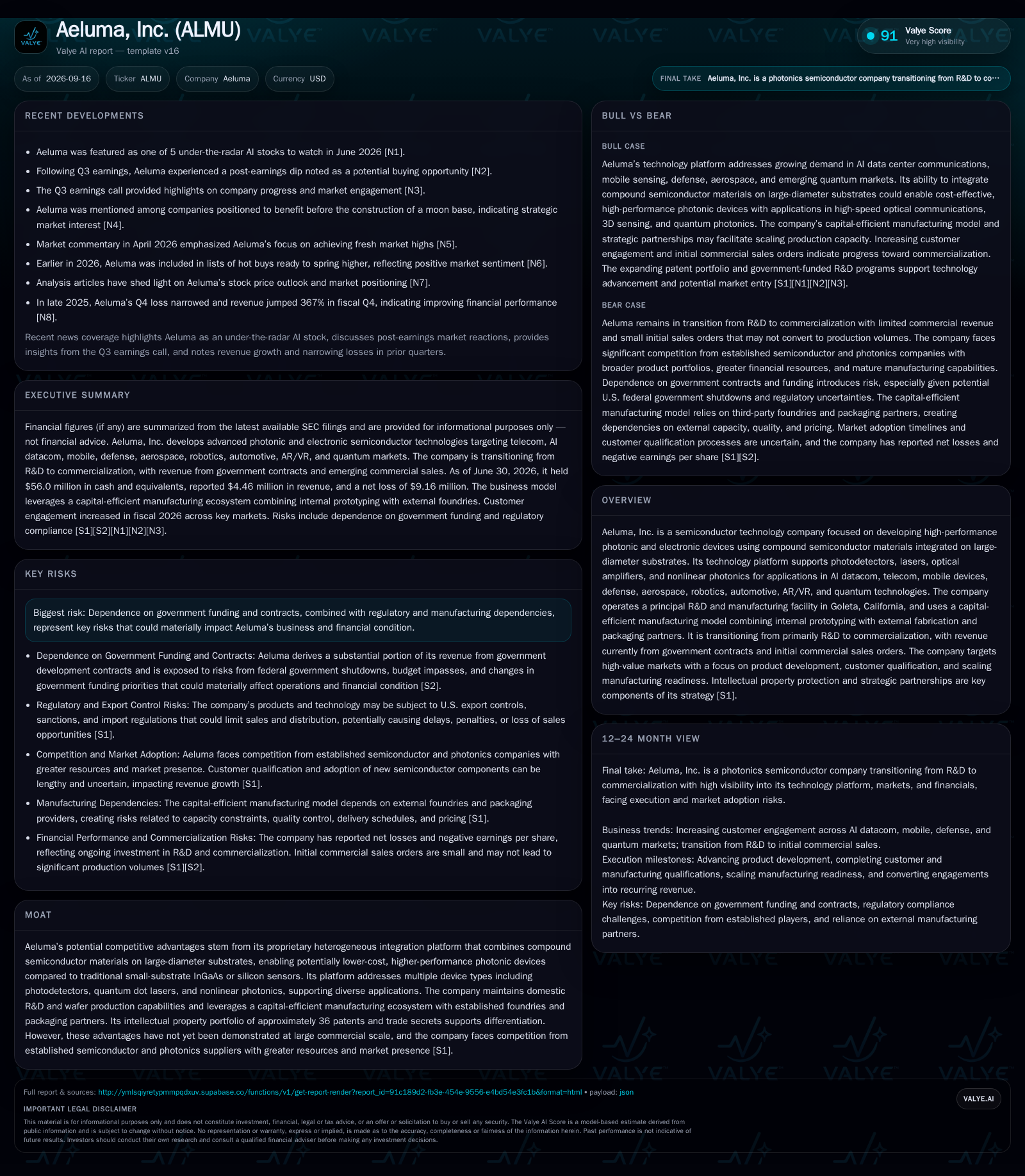
Aeluma, Inc. is moving from R&D to initial commercialization with proprietary photonic technologies targeting AI datacom, defense, and emerging quantum applications. While initial sales and growing customer engagement mark progress, revenue is still limited and net losses continue. The company’s capital-efficient model and IP portfolio are potential advantages, but dependence on government contracts and external manufacturing partners, plus intense competition, add uncertainty to the path toward sustainable commercial scale. [S1] [S2]
Aeluma, Inc. sits at a pivotal moment: having invested years in developing proprietary photonic technologies for high-growth markets such as AI datacom, defense, and quantum sensing, the company is now making its first steps toward commercial revenue. Its approach—leveraging compound semiconductors integrated on large-diameter substrates—could yield lower-cost, higher-performance devices than traditional silicon-based sensors. However, the journey from government contract R&D to meaningful commercial scale is fraught with execution risks, competitive threats, and the challenge of converting initial customer interest into recurring, high-volume sales. The next 12–24 months will test Aeluma’s ability to deliver on its promise and secure a foothold in rapidly evolving photonic markets.
Recent Commercial Progress and Financial Position Define the Inflection Point
Aeluma reported $4.46 million in revenue for fiscal 2026, up from prior R&D-focused periods, with the mix shifting from government contracts toward initial commercial sales. However, these sales remain small, and the company posted a net loss of $9.16 million, or -$0.52 per share [S1].
Customer engagement increased across core markets—AI datacom, mobile, defense, aerospace, and quantum—with the company accepting its first commercial sales orders during the year [S1].
Aeluma’s financial snapshot as of June 30, 2026, shows $56.0 million in cash and equivalents, a current ratio of 30.32, and a cash ratio of 29.63, reflecting a well-capitalized position for ongoing R&D and commercialization efforts [S1].
The company expanded its internal test and prototyping capabilities during 2026, which could enhance speed and flexibility in product development [S1].
How Commercialization Could Alter Aeluma’s Revenue Quality and Cost Structure
Aeluma’s revenue model is currently a blend of government development contracts and emerging commercial product sales, with the latter representing a nascent but strategically critical shift. Government contracts typically offer predictable, milestone-driven cash flows but are subject to funding cycles and regulatory risks. Commercial product sales—especially if they transition to recurring orders—could offer higher margins and scalability, but require successful customer qualification and ramp-up.
The company’s capital-efficient manufacturing model—internal wafer production and prototyping, external foundry and packaging—reduces up-front capex but introduces variable costs and third-party dependencies. This hybrid approach can limit fixed cost absorption benefits unless volumes scale, and may expose Aeluma to margin pressure if external partner pricing or capacity changes.
Operating leverage is possible if Aeluma can achieve meaningful commercial volume, as R&D and prototyping costs are largely fixed at this stage. However, the high gross margins typical of differentiated photonic devices are not assured until the company demonstrates manufacturing yields, quality, and cost competitiveness at scale.
The company reported cash and liquidity metrics for the period; these figures do not by themselves establish operating runway, investment capacity, financial flexibility, or financing capacity.
Positioning Against Legacy Players and Next-Gen Entrants in Photonics
Aeluma targets markets dominated by established suppliers of CMOS image sensors, InGaAs-based devices, and silicon photonics, as well as a cohort of emerging quantum photonics start-ups [S1]. Incumbents benefit from long-standing customer relationships, mature manufacturing, and product breadth, making it difficult for new entrants to displace them without clear performance or cost advantages.
The company’s potential edge lies in its proprietary heterogeneous integration platform—compound semiconductors on large-diameter substrates—which could enable better performance and lower costs than traditional small-wafer InGaAs or silicon solutions. If validated at scale, this could be a disruptive advantage in markets where performance (e.g., low-light sensitivity, NIR/SWIR detection) or integration with existing silicon infrastructure is critical.
However, switching costs in photonics are high due to qualification cycles, reliability requirements, and ecosystem integration. Customers—especially in defense, datacom, and mobile—are risk-averse and may require extensive testing before committing to volume production. Meanwhile, Aeluma’s reliance on external foundries and packaging partners could be a competitive disadvantage if competitors internalize these steps or achieve better cost control.
The IP portfolio (36 issued/pending patents) and domestic R&D/manufacturing capabilities offer some insulation from low-cost overseas competition and provide a foundation for strategic partnerships, but have yet to yield commercial moat at scale [S1].
Early Customer Wins Translate Into Volume Ramp and Strategic Partnerships
A favorable scenario sees Aeluma’s initial commercial sales orders converting into recurring, higher-volume contracts with major customers in AI datacom, defense, or mobile sectors. The company’s technology proves out in customer qualification cycles, demonstrating superior performance or lower TCO (total cost of ownership) versus incumbent solutions.
Strategic partnerships or co-development agreements with system integrators or Tier-1 suppliers accelerate market entry and de-risk scaling by leveraging partner manufacturing, distribution, or integration capabilities.
Gross margins improve as production volumes rise and variable external manufacturing costs are spread over a larger revenue base. Aeluma’s capital-efficient model allows for rapid scaling without significant incremental investment.
Evidence supporting this scenario would include: (1) disclosure of multi-year or multi-million-dollar commercial contracts, (2) repeat orders from existing customers, (3) visible ramp in product revenue (as opposed to government contract revenue), and (4) new partnerships or joint development announcements with established industry players.
Gradual Commercial Progress Amidst Extended Qualification and Adoption Cycles
The most plausible trajectory is that Aeluma continues to make incremental progress: customer engagement deepens, more prototypes are qualified, and small commercial orders increase, but the transition to large-scale recurring revenue takes longer than optimists hope.
Commercial revenue grows, but at a measured pace, with the company dependent on a handful of early adopters and subject to lengthy qualification cycles typical in photonics and defense markets.
The capital-efficient production model allows Aeluma to manage burn rate, but margins remain volatile due to reliance on external partners and lack of volume leverage. Net losses persist, but the company maintains sufficient cash runway to invest in product development and customer qualification.
Commercialization Stalls and External Risks Compound Losses
In an adverse outcome, Aeluma’s technology encounters challenges in customer qualification—whether due to performance, reliability, or price competitiveness—resulting in initial commercial orders failing to scale. Customer adoption stalls, and the company remains heavily reliant on government contracts, which are themselves vulnerable to budget cuts or federal shutdowns [S2].
External manufacturing partners introduce delays, quality issues, or cost overruns, eroding the capital-efficiency advantage and leading to margin compression or delivery failures. Competitive responses from incumbents—such as price cuts, bundled offerings, or accelerated roadmaps—further limit Aeluma’s ability to win market share.
Cash burn accelerates as R&D and SG&A remain high relative to slow-growing revenue. Without clear commercial traction, the company may be forced to delay investment, seek dilutive financing, or restructure operations.
This scenario would be supported by: (1) declining or flat commercial revenue, (2) negative gross margins or rising losses, (3) loss of key government contracts, (4) disclosure of customer qualification setbacks, or (5) adverse developments with external manufacturing partners.
Concrete Markers for Gauging Aeluma’s Commercialization and Competitive Position
The volume, value, and renewal rate of commercial sales orders—if disclosed—would provide direct evidence of market traction and repeatability.
The mix and trend of revenue between government contracts and commercial product sales will help assess the pace of transition to a scalable business model.
Gross margin percentage and its trajectory as commercial revenue grows would indicate whether the capital-efficient model is delivering cost and scale benefits.
Major customer wins (e.g., Tier-1 suppliers, system integrators, or large government contracts) or strategic partnership announcements would validate the technology’s competitive appeal.
Manufacturing yield, quality, and delivery metrics—if disclosed—would help test the scalability and reliability of the external production model.
Updates on the intellectual property portfolio (new patents granted, licensing, or litigation) could signal defensibility and potential for monetization.
Cash burn rate relative to runway, especially if revenue growth is slower than forecast, will be critical for assessing financial sustainability.
Any disclosures of customer qualification setbacks, lost contracts, or issues with external manufacturing partners would serve as early warnings for execution risk.
Disclaimer: This is research-only, informational analysis and not investment advice. It may include AI-generated interpretation and general industry context. Always verify important details using primary sources.

Comments