
InnSuites Hospitality Trust: Asset Monetization, Competitive Pressures, and the Search for Sustainable Value
With only two core hotel assets and a recent return to net losses, InnSuites Hospitality Trust faces a pivotal period. The company’s thesis now hinges on extracting value from potential hotel sales, managing competitive and regulatory headwinds, and leveraging its consistent dividend track record to retain investor interest.
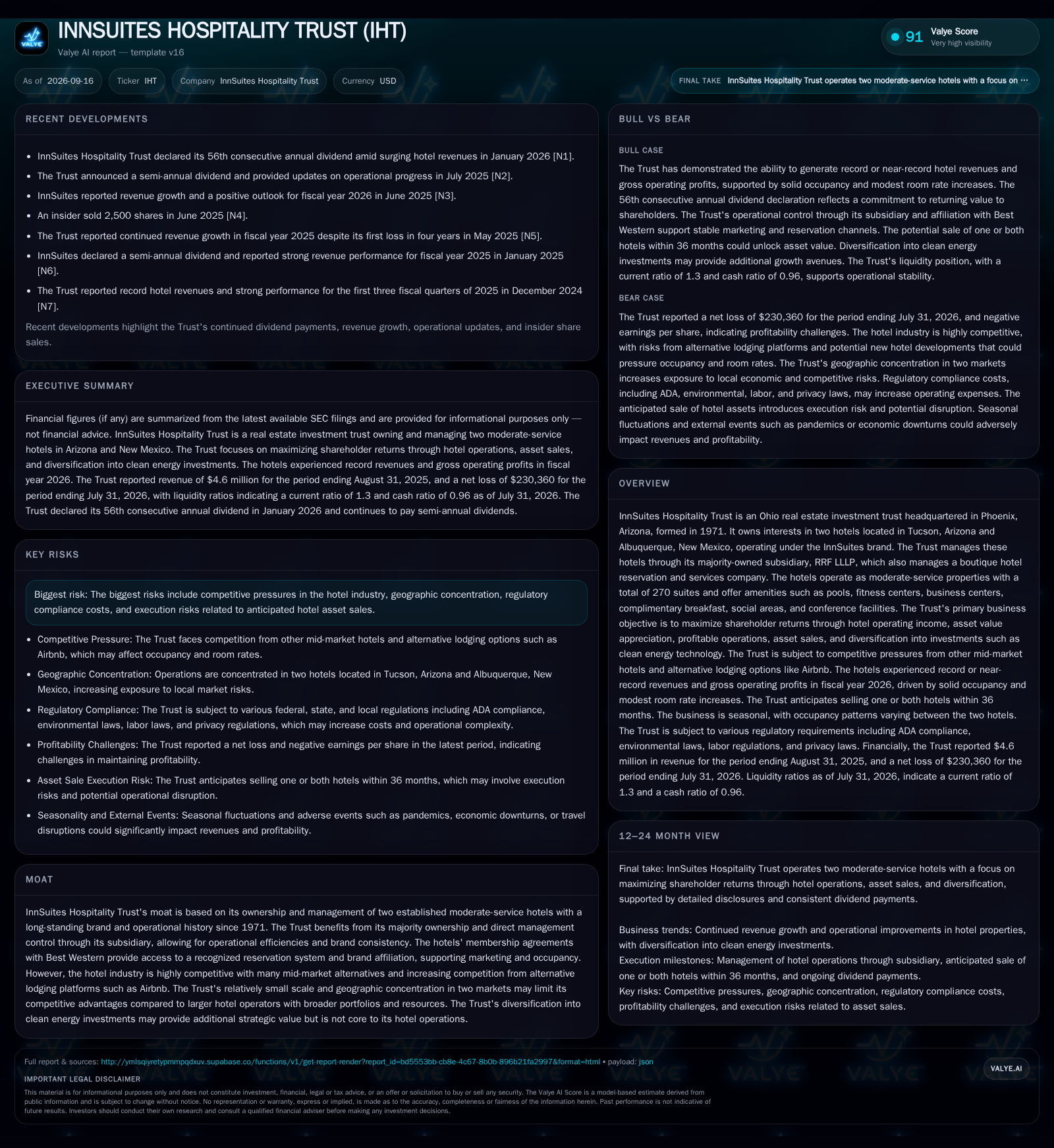
InnSuites Hospitality Trust, operating two moderate-service hotels in the Southwest, recently posted record revenues but slipped into a net loss as of July 2026. The Trust’s focus is shifting toward monetizing assets within 36 months, while maintaining dividend payments and exploring clean energy investments. Competitive intensity, geographic concentration, and execution risk on asset sales are central to the evolving story. [S2] [N1]
InnSuites Hospitality Trust stands at a transitional crossroads. After achieving record revenue performance at its two moderate-service hotels, the Trust reported its first net loss in four years, reflecting the mounting pressures of a competitive hospitality landscape and the inherent volatility of a geographically concentrated portfolio. The cited source reports dividend-related activity; that disclosure alone does not establish dividend-policy continuity, management confidence, or a material constraint on capital flexibility. This analysis explores how InnSuites’ asset-light ambitions, evolving industry dynamics, and strategic uncertainties could define outcomes for investors.
Recent Financials and Strategic Direction: Record Revenues, Net Losses, and Asset Sale Plans
InnSuites Hospitality Trust reported record or near-record hotel revenues and gross operating profits in fiscal year 2026, suggesting that its two core hotel properties—located in Tucson, Arizona, and Albuquerque, New Mexico—have benefited from solid occupancy and modest room rate increases. Despite these top-line gains, the Trust posted a net loss of $230,360 for the period ending July 31, 2026, marking its first loss in four years. [S2] This inflection is material, as it signals that cost pressures, competitive dynamics, or one-time factors may be eroding profitability even as headline revenues improve.
The cited source reports dividend-related activity; that disclosure alone does not establish dividend-policy continuity, management confidence, or a material constraint on capital flexibility. [N1] More structurally, management has disclosed plans to monetize one or both hotel assets within 36 months—a move that could reshape the Trust’s business model and capital allocation priorities, but also introduces execution, valuation, and reinvestment risk. [S2]
The company reported a current ratio of 1.3 for the period. [S2]
Earnings Power, Cost Structure, and Monetization Levers in a Two-Hotel Portfolio
InnSuites’ core economics are shaped by its ownership and management of two moderate-service hotels with a combined 270 suites, supplemented by a boutique hotel reservation and services company. Revenue is driven primarily by room occupancy, modest rate increases, and ancillary services (such as conference facilities and amenities), with seasonality introducing meaningful quarterly swings—high winter occupancy in Tucson, high summer in Albuquerque. [S1]
The Trust operates under management agreements that pay it 5% of room revenue plus accounting fees, but these agreements are cancellable on 30 days’ notice, potentially limiting long-term fee visibility. [S1] The hotels also pay marketing and reservation fees to Best Western, supporting occupancy but compressing net margins relative to independent operations.
Fixed costs—property maintenance, labor, regulatory compliance, and franchise fees—are significant relative to the scale of the asset base. This constrains operating leverage, especially when occupancy dips or competitive pricing pressure intensifies. The recent net loss despite record revenues suggests that incremental revenue has not translated into higher profits, likely due to rising expenses or a deteriorating revenue mix.
Looking ahead, the anticipated sale of one or both hotels could be the primary value realization event. If the assets can be sold at or above book value, the Trust may unlock shareholder value and redeploy capital, but this depends heavily on market conditions, asset quality, and the timing of transactions. Diversification into clean energy investments, such as its stake in UniGen Power, Inc., offers optionality but is not yet a material contributor to cash flow or valuation. [S2]
Competitive Dynamics: Moderate-Service Hotel Squeeze and Alternative Lodging Disruption
InnSuites operates in the fiercely competitive mid-market hotel segment, facing direct competition from regional and national hotel brands, local independents, and increasingly from alternative lodging platforms such as Airbnb. The affiliation with Best Western provides access to a recognized brand and reservation system, which likely supports occupancy but comes at the cost of franchise fees and reduced pricing flexibility. [S1]
The geographic concentration in Tucson and Albuquerque leaves the Trust vulnerable to local demand shocks, new hotel supply, or shifts in regional travel patterns. Larger hospitality players benefit from portfolio diversification and economies of scale in marketing, procurement, and loyalty programs—advantages that InnSuites cannot easily replicate.
The rise of alternative lodging platforms exerts downward pressure on both occupancy and achievable room rates, particularly for moderate-service hotels that lack strong differentiation or unique destination appeal. The Trust’s ability to maintain or grow RevPAR (revenue per available room) in this environment is not established by current disclosures, but remains a critical variable for future performance.
Unlocking Asset Value and Strategic Reinvestment: Pathways to Shareholder Upside
The most compelling upside scenario involves InnSuites successfully executing the sale of one or both hotel properties at valuations that exceed their carrying value, enabling a substantial return of capital to shareholders or redeployment into higher-growth ventures. If the Trust can leverage its affiliation with Best Western and recent record revenue performance to command premium pricing from buyers, the monetization event could crystallize value that is not currently reflected in operating earnings. [S2]
Upside could also materialize if management’s diversification efforts—in particular, investments in clean energy innovation—begin to generate meaningful returns, providing a new growth vector and reducing dependence on the cyclical hotel business.
Evidence that would confirm this scenario includes announced asset sales at favorable multiples, special dividends or buybacks funded by sale proceeds, or material cash flow contributions from non-hotel investments. Sustained improvements in hotel margins or occupancy, despite industry headwinds, would also support the case for underlying asset quality and management execution.
Operational Stability Amid Execution Risk: What a Typical Period Looks Like for InnSuites
Revenue performance may remain solid—supported by occupancy and rate discipline—but profitability is likely to remain under pressure from rising costs, competitive pricing, and franchise fees.
The asset sale process could be protracted, with execution delays, valuation gaps, or regulatory hurdles elongating the monetization timeline. Clean energy investments may provide diversification but are unlikely to move the needle on earnings or cash flow in the near term.
Evidence to the contrary would include a sharp deterioration in occupancy, a dividend cut, or successful asset sales that shift the Trust’s business model.
Asset Sale Friction and Operational Strain: How the Thesis Could Unravel
The adverse scenario for InnSuites involves one or more of the following: failure to execute timely or value-creative hotel asset sales, further erosion of operating margins due to competitive pricing or rising costs, or an external shock (such as a local economic downturn or adverse event) that materially reduces occupancy.
If asset sales are delayed or completed at distressed valuations, the Trust could face a shrinking capital base and diminished ability to fund dividends, eroding investor confidence. Intensifying competition from both traditional hotels and alternative lodging could force further rate concessions or capital expenditures to maintain market share, compressing profitability.
Milestones and Variables That Will Shape InnSuites’ Value Realization Story
Announcement and terms of any hotel asset sale, including sale price relative to book value and use of proceeds.
Quarterly RevPAR (revenue per available room) and occupancy rates, if disclosed, to gauge pricing power and market share resilience.
Gross operating profit margins and expense trends, particularly labor and franchise fees, as indicators of operational leverage.
Material updates or cash flow contributions from diversification investments, especially UniGen Power, Inc.
Changes in the structure or terms of management agreements for the two hotels, including fee rates or notice periods.
Competitive developments in the Tucson and Albuquerque hotel markets, such as new hotel supply, major renovations, or significant changes in local demand drivers.
Disclaimer: This is research-only, informational analysis and not investment advice. It may include AI-generated interpretation and general industry context. Always verify important details using primary sources.

Comments