
Ispire Technology: Proprietary Coil Innovation Confronts Scale, Margin, and Regulatory Trials
Ispire Technology’s IP-driven vaping hardware ambitions span nicotine and cannabis markets, but persistent losses, capital constraints, and operational scale-up risks test the durability of its product and distribution edge.
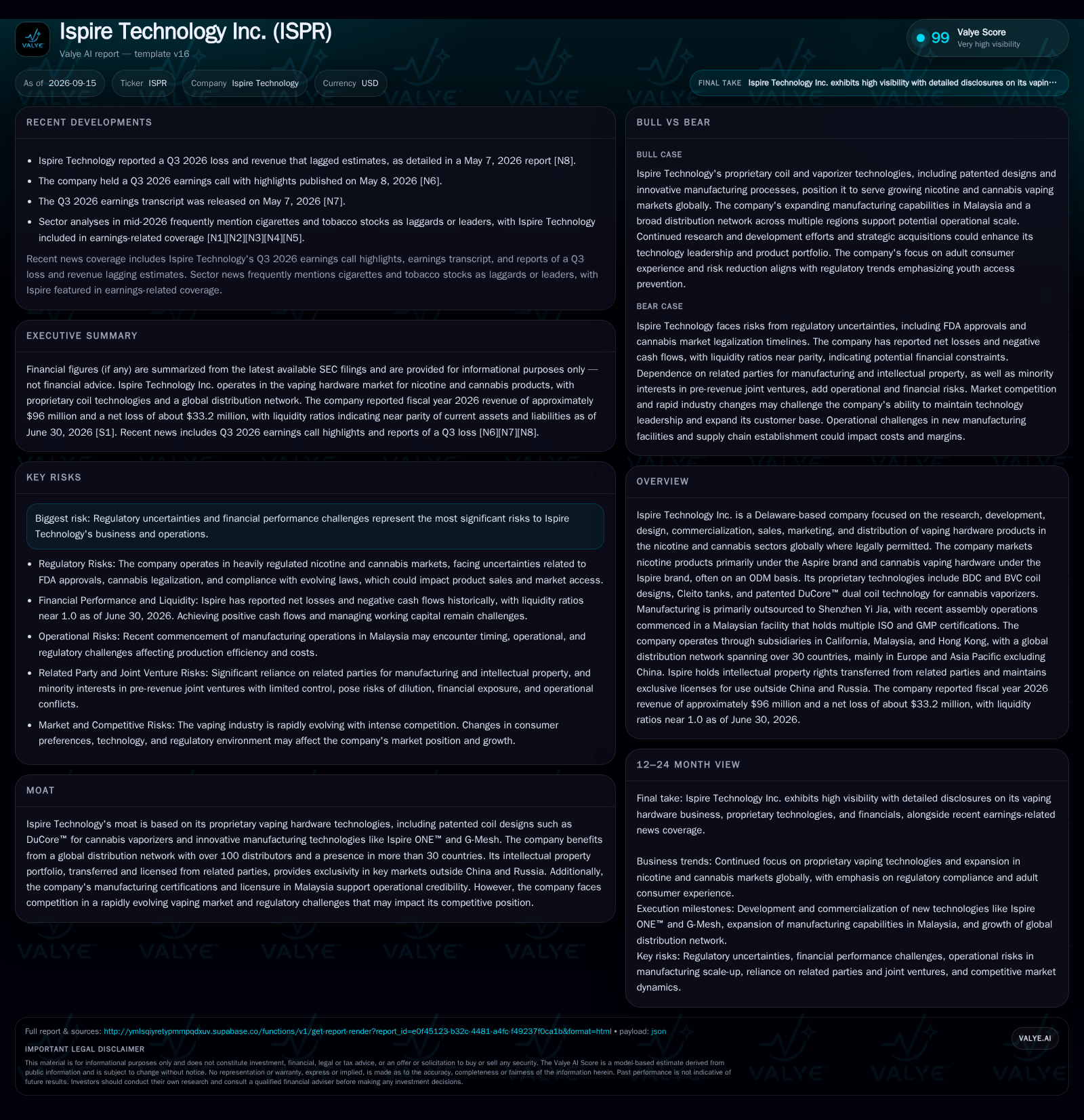
Ispire Technology reported $96 million in FY2026 revenue but a net loss of $33.2 million, reflecting ongoing negative cash flows and a current ratio near parity. The company’s proprietary coil technologies and recent expansion of manufacturing in Malaysia offer scale and margin potential, yet execution risk remains high amid regulatory headwinds, dependence on related parties, and limited potential financial flexibility. The critical question is whether Ispire’s technology differentiation and global reach can drive sustainable profitability before capital constraints or intensified competition erode its edge. [S1] [N8]
Ispire Technology stands at a pivotal junction: its proprietary coil and vaporizer technologies give it credible technical differentiation in the nicotine and cannabis vaping hardware markets, where performance, safety, and regulatory compliance are increasingly prized. Yet, despite $96 million in revenue for fiscal 2026, Ispire remains unprofitable and cash-strained, with negative cash flows and a wafer-thin liquidity buffer. The company’s recent move to Malaysian manufacturing and its broad distribution network could unlock scale and margin improvements, but heavy reliance on related parties, regulatory volatility, and the slow-burning pace of cannabis legalization threaten to expose operational and financial vulnerabilities before the innovation engine can deliver self-sustaining growth. [S1] [N8]
Recent Performance Underscores Persistent Losses and Liquidity Limits
Ispire Technology reported approximately $96 million in revenue for fiscal year 2026, but posted a substantial net loss of $33.2 million, translating to basic and diluted EPS of -$0.58. The company’s cash and equivalents stood at $19.3 million as of June 30, 2026, with current assets of $45.4 million and current liabilities of $44.6 million, yielding a current ratio of 1.02 and a cash ratio of 0.64. These figures highlight that, despite a global footprint and proprietary technology, Ispire continues to operate with negative cash flows and minimal liquidity cushion, leaving little margin for error in the face of execution or regulatory setbacks. The most recent quarter saw revenue lagging estimates and continued net losses, reinforcing the urgency of achieving both operational scale and financial discipline. [S1] [N8]
Hardware Economics: Scale Ambition Meets Margin Pressure
Ispire’s fundamental economics hinge on hardware sales in the nicotine and cannabis vaporizer segments. Proprietary coil technologies—such as DuCore™ and Ispire ONE™—are designed to command premium pricing and potentially improve gross margins through performance and reliability differentiation. However, hardware-centric models in the vaping sector often face intense pricing pressure, high fixed costs in R&D and compliance, and limited recurring revenue unless complemented by consumables or aftermarket sales.
The company’s ODM approach for cannabis hardware and global distribution of branded nicotine devices could offer high-volume leverage, but profitability depends on manufacturing efficiency, defect rates, and regulatory compliance costs. The recent shift toward Malaysian ISO/GMP-certified assembly aims to improve quality control and margin structure, possibly reducing reliance on related-party manufacturing in China. Still, capital intensity remains a risk: scaling manufacturing, maintaining global inventory, and funding R&D all require cash outlays that a company with negative cash flows and a modest liquidity buffer may struggle to sustain without external financing or a rapid move toward profitability. [S1]
Technology Edge Faces Established Brands and Regulatory Complexity
Ispire’s competitive position is grounded in its proprietary coil and vaporizer technologies, which seek to address pain points such as leakage, flavor consistency, and user safety—areas where regulatory scrutiny is intensifying. The company’s global distribution network, spanning over 100 distributors in 30+ countries, provides access to diverse end markets, especially in Europe and Asia Pacific (excluding China).
However, the vaping hardware sector is crowded with established tobacco companies, diversified consumer electronics firms, and specialized ODMs, many of whom possess greater financial resources, regulatory experience, and distribution reach. Ispire’s reliance on related parties for manufacturing and IP licensing, as well as minority stakes in pre-revenue joint ventures, introduces potential conflicts and operational inflexibility. Furthermore, regulatory barriers—especially in the US, where FDA premarket authorization is critical—create ongoing uncertainty for product launches and market expansion. The question is whether Ispire’s technology and speed-to-market can consistently outpace larger, well-capitalized rivals as the industry consolidates and compliance costs rise. [S1] [S2]
If Manufacturing Scale and Regulatory Wins Align, Margin Expansion Could Follow
A favorable outcome for Ispire would require a confluence of successful Malaysian manufacturing ramp-up, regulatory approvals (notably in the US and key cannabis markets), and sustained demand for high-performance vaping hardware. If Malaysian operations achieve cost and quality targets, Ispire could not only improve gross margins but also reduce supply chain risk and boost credibility with regulators and global partners.
Further, should Ispire’s proprietary technologies (such as G-Mesh and DuCore™) secure regulatory clearance and gain traction with ODM partners and distributors, the company could command premium pricing and capture greater share in the high-growth segments of the vaping market. Evidence supporting this scenario would include a clear inflection to positive cash flow, sequential gross margin improvement, new regulatory approvals for flagship products, and expanded distribution agreements in major regulated markets. [S1]
Steady Innovation Meets Protracted Path to Profitability
The most plausible trajectory for Ispire is continued revenue growth in both nicotine and cannabis hardware, driven by incremental market share gains and new product launches, but with persistent margin pressure and delayed break-even. Manufacturing in Malaysia may deliver operational improvements, but the benefits could be offset by the costs of scale-up, regulatory compliance, and ongoing R&D.
Cash flow is likely to remain negative in the near term, with liquidity tightly managed and working capital constraints limiting aggressive expansion or M&A. The company may achieve moderate gross margin improvement if defect rates and manufacturing costs decline, but regulatory delays or setbacks in major markets (such as the US or Germany) could cap revenue growth. Confirmation of this scenario would include continued net losses, slow improvement in cash conversion cycles, and a gradual rather than stepwise expansion of distribution reach. [S1] [N8]
Capital Constraints and Regulatory Barriers Erode Innovation Lead
A negative outcome would see Ispire’s liquidity position deteriorate further due to ongoing losses, failed manufacturing scale-up (e.g., persistent quality or cost overruns in Malaysia), or regulatory setbacks that block access to key markets. In this scenario, the company could be forced into dilutive capital raises or asset sales, especially if ODM partners or distributors defect to better-capitalized rivals or if related-party conflicts disrupt supply.
Failure to secure timely FDA or international regulatory approvals for new products could leave inventory stranded and depress revenue. Intensified price competition or commoditization of coil technologies might erode the company’s ability to differentiate on performance, pressuring margins further. Signs of this scenario would include worsening current and cash ratios, missed product launch timelines, distributor attrition, or material dilution via equity issuance. [S1] [S2] [N8]
Thesis-Testing Developments for Ispire: What Could Shift the Outlook
Sequential gross margin trends: A useful metric would be disclosed gross margin improvement or deterioration, especially as Malaysian manufacturing scales.
Cash flow from operations: If disclosed, a shift to positive or less negative operating cash flow would signal improved business model durability.
Regulatory milestones: Announcements of FDA or international approvals for new technologies or products would materially alter the risk/reward profile.
Manufacturing KPIs: Evidence of reduced defect/leakage rates, improved yield, or cost efficiencies from new facilities would test the operational thesis.
Distribution expansion: New or renewed agreements with major distributors or ODM customers, if disclosed, would support the case for volume leverage.
Related-party dependency: Any reduction in reliance on related-party manufacturing or clearer arm’s-length supply contracts would reduce operational risk.
Capital raises or financing events: Any significant equity or debt issuance, or evidence of financial distress, would affect both dilution risk and execution capacity.
Joint venture developments: Updates on the revenue contribution, profitability, or additional funding needs of IKE and Jin Wu would clarify financial exposure.
Disclaimer: This is research-only, informational analysis and not investment advice. It may include AI-generated interpretation and general industry context. Always verify important details using primary sources.

Comments