
PharmaCyte Biotech: Liquidity, Partnerships, and the High-Stakes Path to Clinical Validation
With substantial cash reserves but no current revenue, PharmaCyte Biotech faces a classic early-stage biotech dilemma: can its cell encapsulation platform and investment-driven collaborations yield clinical and commercial breakthroughs before capital runs thin?
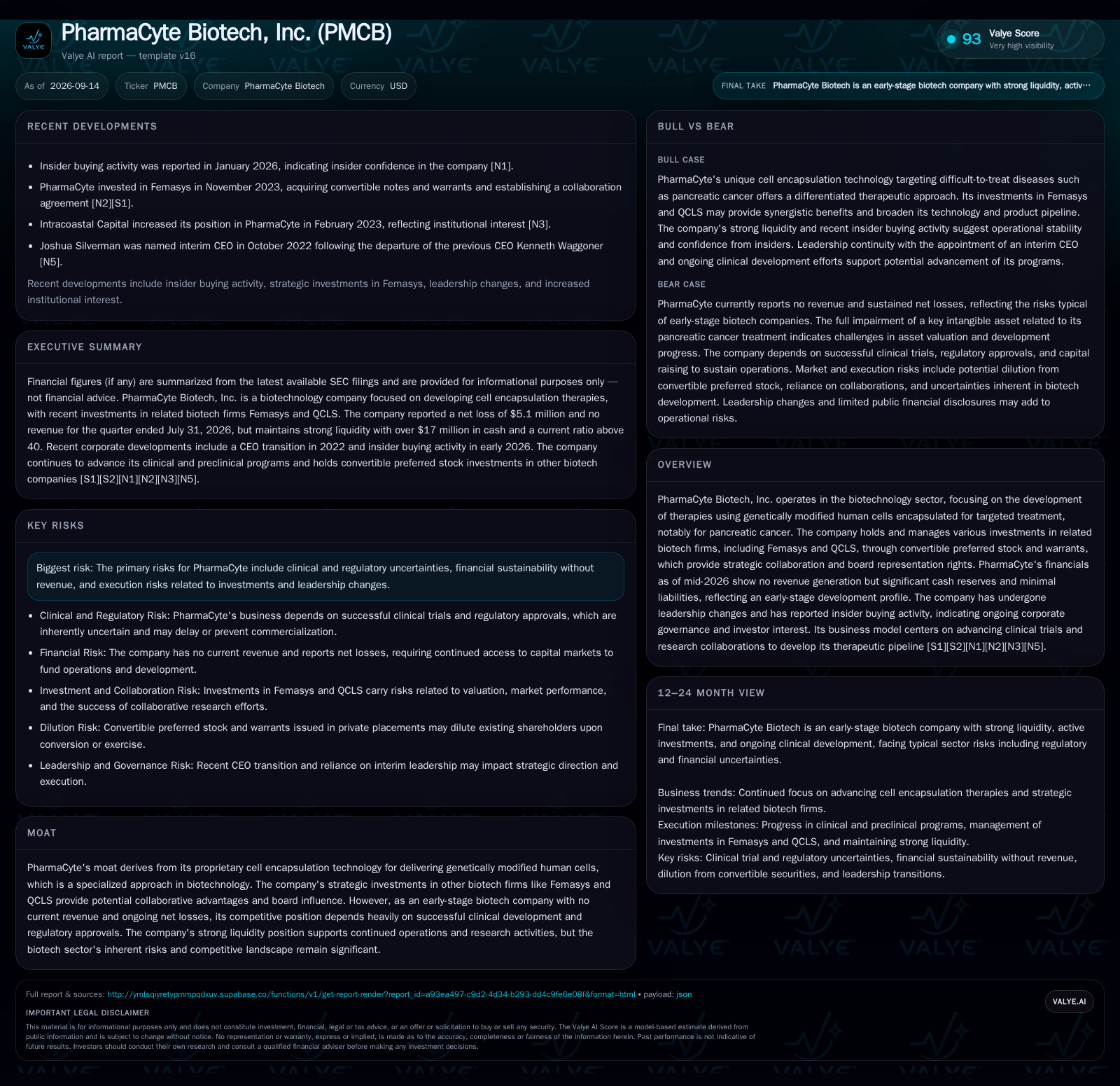
PharmaCyte Biotech, Inc. is an early-stage biotechnology company developing encapsulated genetically modified cell therapies, notably for pancreatic cancer. As of July 31, 2026, the company reported zero revenue, a net loss of $5.1 million for the quarter, and a robust cash position of $17.7 million with minimal liabilities. Strategic investments in Femasys and QCLS offer potential collaborative benefits and board-level influence, while recent insider buying suggests some confidence. The company’s future hinges on advancing its clinical pipeline and extracting value from its investment portfolio to offset the continued absence of revenue and ongoing net losses. [S1] [S2] [N1] [N2] [N3] [N5]
PharmaCyte Biotech stands at a crossroads common to early-stage biotech firms: it is cash-rich relative to liabilities but has yet to generate revenue, reporting a $5.1 million net loss for the most recent quarter. The company’s unique value proposition—a cell encapsulation platform for targeted therapies—remains unproven at the commercial and even late-clinical stage. Strategic investments in peer biotechs Femasys and QCLS, paired with collaboration agreements and board representation, suggest a broader platform-building strategy. The central question is whether PharmaCyte can convert its liquidity and partnerships into clinical progress and, ultimately, commercial traction before its cash advantage erodes. [S1] [S2] [N1] [N2] [N3] [N5]
Recent Developments Define PharmaCyte’s Risk-Reward Profile
As of July 31, 2026, PharmaCyte Biotech reported zero revenue and a net loss of $5.1 million for the quarter, underscoring its status as a pre-commercial, development-stage company. Despite this, the company maintains a significant cash reserve of $17.7 million and minimal current liabilities, yielding a current ratio of 40.3 and a cash ratio of 23.21. This liquidity offers operational runway but does not guarantee success if clinical milestones are not met or if future capital is required. [S2]
Strategically, PharmaCyte has taken minority stakes in Femasys and QCLS, acquiring convertible securities and securing collaboration agreements and board nomination rights. These moves potentially expand its technology platform and pipeline, but the commercial and clinical benefits remain to be realized. [S1] [N2]
A notable negative development is the full impairment of its in-process R&D asset for a cytochrome P450-based pancreatic cancer therapy, signaling either clinical, regulatory, or valuation hurdles in its lead program. [S1]
Recent insider buying in January 2026 and increased institutional ownership in 2023 may indicate some investor confidence, but do not resolve the underlying execution risk. [N1] [N3]
How PharmaCyte’s Model Could Generate Value—And Where It May Fall Short
PharmaCyte’s economics are, at present, entirely driven by capital raises and investment returns rather than product sales. The company’s core business model is to develop proprietary cell encapsulation therapies, with the goal of advancing candidates through preclinical and clinical trials to eventual regulatory approval and commercialization. In the absence of revenue, the company relies on cash infusions—like the $7 million Series C raise in August 2025—and prudent cash burn management. [S1] [S2]
If its encapsulation technology demonstrates clinical efficacy and safety, PharmaCyte could generate value through out-licensing, strategic partnerships, or direct commercialization. However, fixed R&D and regulatory costs dominate, with little variable cost flexibility until later-stage trials or commercialization. Operating leverage remains theoretical until revenue materializes.
Investments in Femasys and QCLS add a secondary economic layer, potentially yielding financial returns or providing access to complementary technologies. Yet, these positions are illiquid and subject to the same binary risks as PharmaCyte’s own pipeline.
The capital structure includes convertible preferred stock and warrants, which may enable future capital access but also pose dilution risks if exercised. The absence of revenue and the impairment of a lead intangible asset highlight the importance of external funding and portfolio management for survival and growth. [S1]
Assessing PharmaCyte’s Edge in a Crowded and Risk-Prone Sector
PharmaCyte’s competitive position hinges on the novelty and defensibility of its cell encapsulation platform. In theory, encapsulating genetically modified human cells for targeted therapy could offer advantages in controlled delivery, immune evasion, and reduced systemic toxicity—potentially differentiating it from conventional small molecules, antibody therapies, or gene editing approaches.
However, the biotechnology sector is saturated with well-funded competitors pursuing similar therapeutic areas, including pancreatic cancer and cell-based delivery platforms. Large pharmaceutical companies and other emerging biotechs may possess greater resources, deeper clinical pipelines, or established commercial infrastructure.
PharmaCyte’s strategic investments in Femasys and QCLS may provide access to adjacent technologies and research synergies, which could bolster its pipeline breadth or accelerate development. Board representation and collaboration agreements suggest a desire to shape and benefit from these partners’ progress, but the material impact on PharmaCyte’s own competitive moat will depend on clinical outcomes and IP integration.
The impairment of its lead intangible asset further erodes perceived competitive advantage, at least in the near term, and underscores the fragility of early-stage differentiation.
Breakthroughs in Clinical Validation and Partnership Monetization Could Transform the Outlook
The most favorable scenario for PharmaCyte involves successful demonstration of clinical efficacy and safety for its encapsulated cell therapies, particularly in areas of high unmet need like pancreatic cancer. Such progress could unlock partnerships with larger pharmaceutical firms, non-dilutive funding, or even regulatory fast-track designations. This would likely drive both direct value creation (through milestone payments, licensing, or eventual commercial revenue) and indirect value through increased investor confidence and share price appreciation.
Further upside could be realized if investments in Femasys or QCLS yield strategic or financial returns—such as via acquisition, co-development, or technology transfer agreements that feed back into PharmaCyte’s own platform.
Evidence that would confirm this scenario includes: initiation or successful completion of key clinical trial phases, partnership or licensing announcements with major pharma companies, non-dilutive funding awards, and tangible progress in monetizing minority stakes or IP assets.
Incremental Pipeline Progress and Prudent Cash Management Define the Most Likely Trajectory
The most plausible path is one of incremental milestone achievement: advancing one or more candidates through preclinical or early clinical stages, maintaining research collaborations, and carefully managing cash burn to extend runway. Under this scenario, PharmaCyte continues to report net losses and no revenue, but avoids catastrophic setbacks or urgent capital shortfalls.
The pipeline may see modest progress—such as IND filings, trial initiations, or early data releases—but not enough to attract transformative partnerships or accelerate revenue generation. Investments in Femasys and QCLS may remain illiquid and non-core, providing limited near-term financial relief.
Evidence confirming this scenario would include continued reported liquidity position, modest operational updates, and lack of major partnership or monetization announcements. Falsification would come from either a sudden clinical breakthrough or a severe capital crunch forcing emergency financing or asset sales.
Failure to Advance Pipeline or Monetize Investments Could Erode Liquidity and Strategic Optionality
The adverse scenario involves continued clinical or regulatory setbacks—such as additional asset impairments, failed trials, or inability to initiate studies—combined with an inability to monetize investments in Femasys or QCLS. In this case, cash burn may outpace prudent runway projections, forcing dilutive capital raises or asset sales at distressed valuations.
The lack of revenue, coupled with dilution from convertible securities and warrants, could further erode shareholder value. Leadership instability or loss of key scientific personnel may compound execution risk. Ultimately, the company could be forced into strategic review, asset divestiture, or even wind-down if it cannot pivot or replenish its pipeline.
This scenario would be confirmed by continued impairment charges, negative clinical news, acceleration of cash burn, or emergency financings with unfavorable terms.
Milestones That Will Determine Whether PharmaCyte Can Transition from Promise to Proof
Progress on clinical trial initiation, enrollment, and data readouts for the cell encapsulation platform—particularly any new developments following the impairment of the lead pancreatic cancer asset—will be critical.
Updates on the status of research collaborations and joint development agreements with Femasys and QCLS, including any technology integration or co-development milestones, would help test strategic synergy.
Disclosure of any new partnership or licensing agreements with larger pharmaceutical companies or non-dilutive funding sources would signal external validation and commercial potential.
Quarterly cash burn rates and updated runway projections, if disclosed, are essential to assess sustainability in the absence of revenue.
Announcements regarding the monetization or revaluation of investments in Femasys and QCLS—such as exits, dividends, or significant mark-to-market changes—would provide insight into the non-core value pool.
Any further insider buying, selling, or changes in institutional ownership could indicate evolving confidence (or concern) among those closest to the company.
Leadership continuity and the appointment of a permanent CEO, or significant changes to the scientific and clinical leadership team, may impact execution risk.
A useful metric would be the pipeline attrition rate—tracking the number of programs advancing versus being impaired or discontinued over time.
Disclaimer: This is research-only, informational analysis and not investment advice. It may include AI-generated interpretation and general industry context. Always verify important details using primary sources.

Comments