
Laredo Oil: Proprietary Recovery Ambition Meets Severe Financial Constraints
Laredo Oil’s bid to unlock stranded oil reserves with underground gravity drainage technology faces a stark liquidity deficit, operational setbacks, and industry headwinds. Execution risk is high, but commercial validation of its unique approach could shift the company’s trajectory.
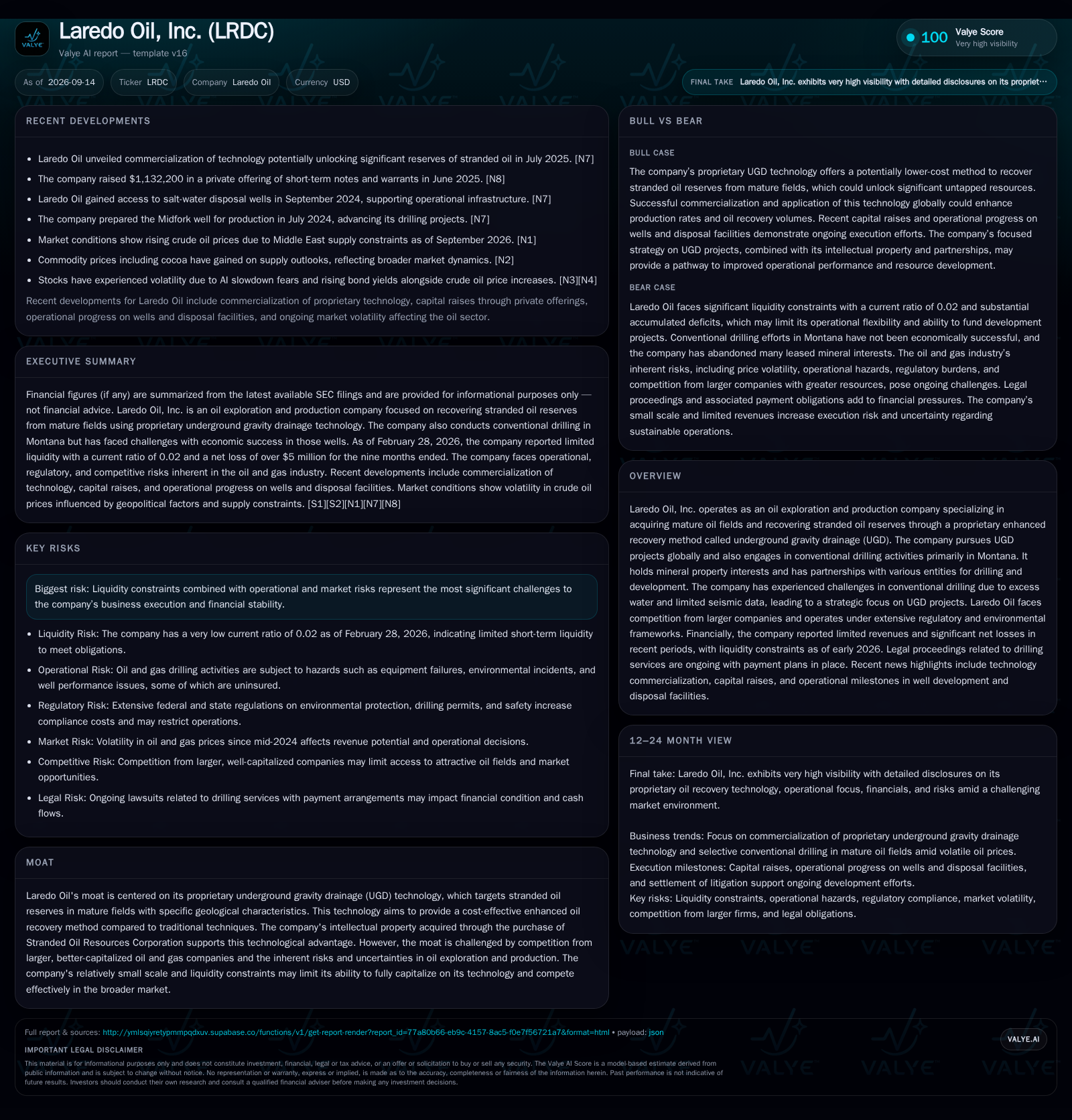
Laredo Oil, Inc. is attempting to commercialize proprietary underground gravity drainage (UGD) technology to extract stranded oil from mature fields. Despite recent progress in technology deployment and capital raises, the company faces severe liquidity constraints, persistent net losses, and challenges in conventional drilling. Its ability to prove UGD’s economic viability and secure sufficient funding will determine whether Laredo Oil can move beyond a precarious financial position and compete in a volatile, capital-intensive industry. [S1] [S2] [N7] [N8]
Laredo Oil, Inc. sits at the intersection of technological ambition and acute financial distress. The company’s proprietary underground gravity drainage (UGD) aims to recover oil left behind in mature fields—a potentially lucrative niche if proven at scale. Yet, limited cash, mounting losses, and unsuccessful conventional drilling cast doubt on its ability to execute. With recent capital infusions and operational milestones, Laredo Oil’s near-term fate hinges on validating UGD’s commercial viability and securing enough funding to survive in a volatile, capital-intensive sector. Success could unlock value from overlooked assets; failure could mean insolvency.
Liquidity Crisis, Technology Push, and Shifting Focus Define the Current Landscape
Laredo Oil’s financial position is precarious: as of February 28, 2026, it held just $264,166 in cash and cash equivalents against $14.7 million in current liabilities, resulting in a current ratio of 0.02 and a stockholders’ deficit exceeding $14 million. This signals not only immediate liquidity risk but also longer-term solvency concerns. [S2]
Operationally, the company has pivoted from unsuccessful conventional drilling in Montana—where excess water and limited seismic data undermined economic outcomes—to a strategic emphasis on its proprietary underground gravity drainage (UGD) technology. UGD commercialization, announced in mid-2025, is now the company’s central thesis for unlocking value from mature fields. [S1] [N7]
To support these efforts, Laredo Oil raised $1.1 million in a private offering of short-term notes and warrants in 2025, but this is modest relative to its liabilities and likely ongoing capital needs. [N8]
Recent operational actions include securing salt-water disposal wells and preparing the Midfork well for production, suggesting incremental progress but not yet delivering material revenue or resolving financial strain. [N7]
UGD’s Economics: High Fixed Costs, Unproven Returns, and Capital Intensity
Laredo Oil’s revenue model is fundamentally tied to the successful extraction and sale of oil reserves from mature fields. The proprietary UGD method involves significant upfront capital outlay for underground chamber construction and directional drilling—a high fixed-cost endeavor. If successful, UGD could lower per-barrel recovery costs by tapping reserves inaccessible to traditional methods, especially in fields with at least 25 million barrels of recoverable oil. [S1]
However, there is little evidence to date that UGD has generated commercially meaningful production or positive operating margins for Laredo Oil. For the nine months ended February 28, 2026, the company reported just $3,141 in revenue and a net loss of $5.4 million, underscoring the current lack of operating leverage and the challenge of covering fixed overheads. [S2]
Conventional drilling efforts have failed to achieve economic viability, with excess water production and inadequate seismic data leading to abandoned leases and a narrowed operational focus. This history raises questions about the company’s ability to accurately assess and execute on field potential.
The capital requirements for scaling UGD are substantial, and with the company’s current balance sheet, ongoing access to outside funding is critical. Should UGD prove viable, incremental production volumes could yield strong operating leverage, but the risk of further capital consumption without scale revenue is high.
Can Proprietary Technology Offset Scale Disadvantages?
Laredo Oil’s primary potential advantage lies in its proprietary UGD technology, supported by intellectual property acquired through Stranded Oil Resources Corporation. This method, if proven, could allow the company to profitably recover oil from fields that are uneconomical for conventional techniques. [S1]
However, the company operates in a fiercely competitive sector dominated by large, well-capitalized exploration and production firms. These competitors have greater access to capital, advanced seismic and drilling technology, and established operational footprints—advantages that translate to lower costs per barrel and greater resilience during commodity price swings.
Laredo Oil’s small size and financial constraints limit its ability to outbid competitors for attractive assets, weather downturns, or absorb regulatory and operational shocks. While the moat around UGD could be meaningful if the technology is truly differentiated and scalable, the absence of commercial-scale validation leaves this theoretical.
Substitute technologies—including other enhanced oil recovery (EOR) methods such as CO2 injection, steam flooding, and chemical EOR—are already in broad use and benefit from established supply chains and operational expertise. UGD must deliver a clear cost or recovery-efficiency advantage to displace these alternatives.
If UGD Unlocks Commercial Oil, Laredo Oil’s Fortunes Could Reverse
The bull case for Laredo Oil depends on successfully demonstrating that UGD can economically recover significant volumes of stranded oil from mature fields. If pilot projects yield positive results—namely, recovery rates and production costs that meet or beat industry benchmarks—this could open the door to joint ventures, licensing deals, or partnerships with larger operators seeking to monetize overlooked assets.
Evidence that would support this scenario includes: sustained, material oil production from UGD-equipped wells; positive third-party technical validation; and interest from industry partners or acquirers. A step-change in revenue, even from a single field, would help validate the business model and potentially enable further capital raises or non-dilutive financing.
Confirmation would also come from improved liquidity metrics—such as an increased current ratio and reduced net losses—alongside the ability to consistently meet debt and operational obligations without repeat emergency financing rounds.
Slow Progress Amid Ongoing Cash Strain Is the Most Likely Trajectory
Absent near-term commercial validation of UGD, Laredo Oil is likely to continue facing severe financial strain, with incremental operational progress but little relief from persistent net losses. The company may achieve modest milestones—such as preparing additional wells for production or securing incremental funding—but without a breakthrough in oil recovery, cash burn will likely outpace inflows.
In this scenario, Laredo Oil could remain dependent on periodic capital raises, potentially through dilutive equity or high-cost debt. Execution risk remains high, with legal and regulatory hurdles, operational setbacks, and commodity price volatility all threatening performance.
Falsification of the base case would require either a rapid, material increase in production/revenue (signaling UGD success) or a cash crisis leading to asset sales, bankruptcy, or effective operational shutdown. Confirmation would come from continued low revenues, high net losses, and repeated references to liquidity constraints in future filings.
Failure to Secure Funding or Prove UGD Could Force Restructuring or Liquidation
If UGD fails to deliver commercially viable results—or if the company cannot secure sufficient funding to bridge the gap to validation—Laredo Oil may be forced into asset sales, debt restructuring, or bankruptcy. The company’s current liabilities vastly exceed its liquid assets, and ongoing net losses leave little margin for error.
In this scenario, the absence of meaningful revenue growth, inability to meet payment obligations, or negative legal outcomes (such as adverse judgments or enforcement actions) could trigger a cash crisis. Regulatory or operational setbacks—such as environmental incidents or failed wells—would only accelerate the timeline.
Confirmation would come from default notices, asset divestitures at distressed prices, or bankruptcy filings. A lack of progress on UGD commercialization, coupled with deteriorating liquidity, would signal that the company’s business model is untenable in its current form.
Milestones and Metrics That Will Determine Laredo Oil’s Viability
Material oil production volumes and revenue generated directly from UGD-equipped wells—if disclosed—would provide direct evidence of commercial viability.
Changes in liquidity metrics, especially the current ratio and net cash position in subsequent filings, will indicate whether the company can meet short-term obligations.
Disclosure of joint ventures, licensing deals, or strategic partnerships with larger industry players would suggest external validation and potentially provide access to capital or scale.
Updates on legal proceedings and settlement obligations, particularly any new payment plans or judgments, will affect cash flows and risk profile.
Incremental operational milestones, such as the number of UGD wells brought online or fields advanced to production, would help test the pace of execution.
Evidence of further capital raises, refinancing, or non-dilutive funding sources will be critical, given the current deficit.
Regulatory or environmental incidents—if any—could materially impact both operational continuity and the cost structure.
A useful metric would be the realized recovery factor (percentage of estimated recoverable oil actually produced) from UGD projects, as this would benchmark the technology’s effectiveness against conventional EOR methods.
Disclaimer: This is research-only, informational analysis and not investment advice. It may include AI-generated interpretation and general industry context. Always verify important details using primary sources.

Comments