
Minerva Gold: Liquidity Strains, Diversification Gambit, and the Test of Strategic Pivot
Minerva Gold’s pivot from mineral exploration to diversified industrial design and manufacturing faces acute liquidity risk, uncertain integration prospects, and a fundamental question of business viability. Can a pending acquisition and new leadership deliver a real turnaround, or do balance sheet realities dominate the path forward?
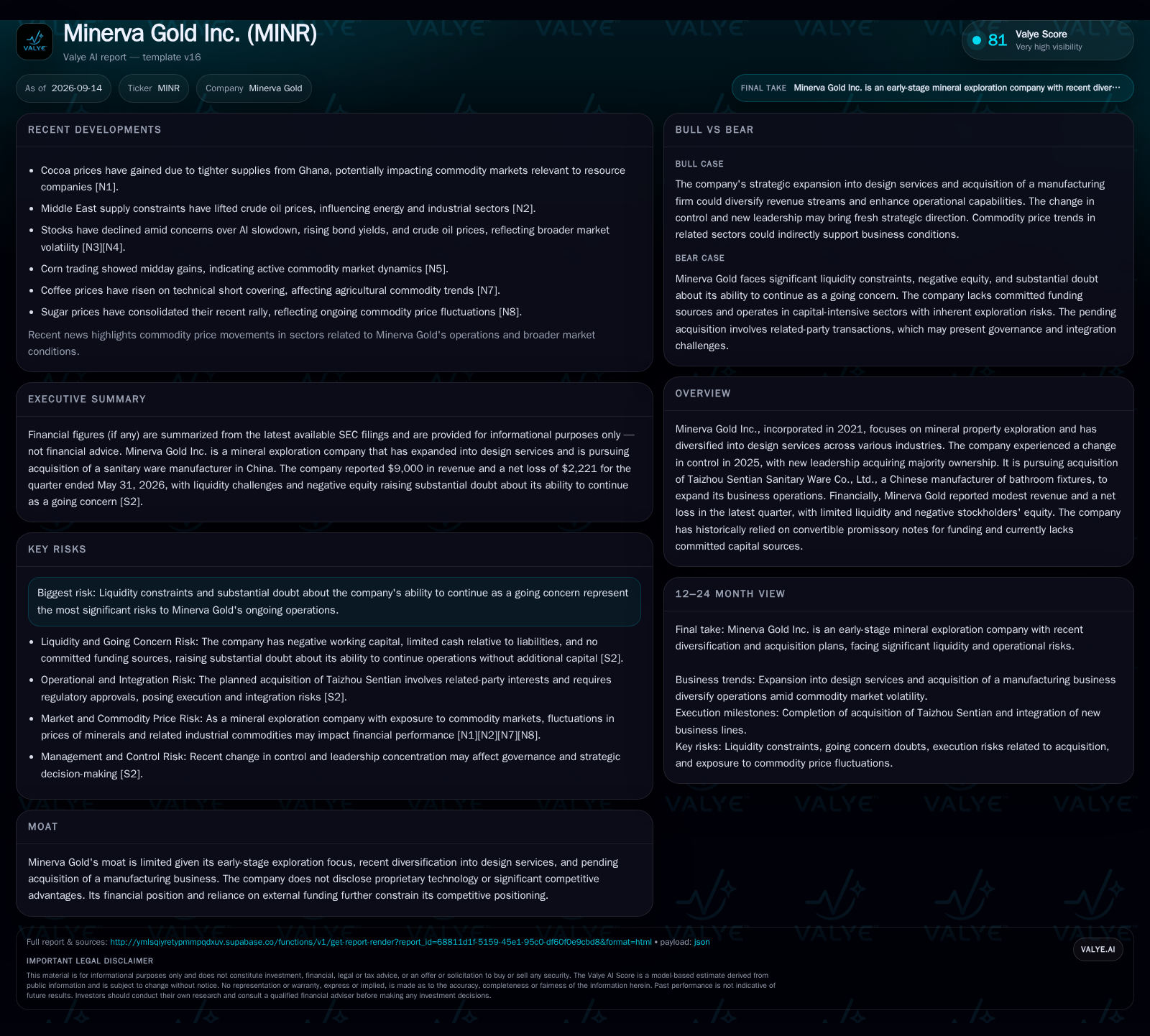
Minerva Gold Inc. is attempting a strategic transformation by expanding from mineral exploration into design services and, via a pending acquisition, into sanitary ware manufacturing in China. Despite this ambition, the company reported only $9,000 in revenue and a net loss for the latest quarter, with negative equity and a cash ratio of just 0.13, highlighting severe liquidity constraints and substantial doubt about ongoing viability. The outcome hinges on successful deal execution, integration, and rapid access to fresh capital, all under new majority ownership.
Minerva Gold Inc. stands at a crossroads, attempting to pivot from a capital-starved mineral exploration entity into a diversified industrial player by acquiring a Chinese sanitary ware manufacturer and expanding into design services. This transformation, led by new majority ownership, comes amid severe liquidity constraints, negative equity, and no committed funding pipeline. The company's fate now hinges on its ability to secure capital, close and integrate its pending acquisition, and prove that diversification can quickly drive meaningful cash flows before balance sheet pressures force harsher outcomes.
Liquidity Crunch and Acquisition Ambition Define the Current Landscape
As of May 31, 2026, Minerva Gold reported only $9,000 in revenue and a net loss of $2,221 for the most recent quarter—a signal of minimal operating scale and continued cash burn [S2]. Cash and cash equivalents stood at $7,077, dwarfed by current liabilities of $54,835, resulting in negative stockholders’ equity of $52,385 and a cash ratio of just 0.13 [S2]. The company’s own filings raise 'substantial doubt' about its ability to continue as a going concern, given the lack of committed funding sources and reliance on convertible promissory notes [S2]. Against this backdrop, Minerva Gold is pursuing a transformative acquisition: a Letter of Intent to acquire Taizhou Sentian Sanitary Ware Co., Ltd., a Chinese manufacturer, pending administrative approvals [S2]. This deal, if closed, would fundamentally reshape the company’s operations and revenue mix, but also introduces new execution and integration risks.
Can Diversification Solve Structural Cash Flow Deficits?
Minerva Gold’s legacy mineral exploration focus is inherently capital-intensive, with long lead times, high upfront costs, and uncertain revenue realization—a business model that typically demands substantial, patient capital. The recent foray into design services and the planned acquisition of a manufacturing business represent an attempt to pivot toward more immediate, potentially recurring revenue streams. However, the commercial mechanics of these new segments are not yet established: it remains unclear whether design services are project-based or recurring, and whether the manufacturing operation would be margin-accretive or require further working capital investment.
The company’s tiny revenue base ($9,000 in the latest quarter) and continued net losses suggest that neither legacy exploration nor new design services are yet delivering meaningful operating leverage [S2]. Manufacturing—especially in sanitary ware—can offer higher volume potential, but is also subject to commodity input pricing, capacity utilization swings, and the need for ongoing capital to fund inventory and receivables. Without a material capital injection, the risk is that new business lines simply add complexity and cash requirements, rather than alleviating the core liquidity strain.
Historically, Minerva Gold has relied on convertible promissory notes for funding, but lacks any committed capital pipeline [S2]. In the absence of fresh equity or debt, the company’s ability to scale new business lines or even sustain baseline operations is severely constrained.
Competitive Realities: No Moat, High Substitution, and Integration Headwinds
Minerva Gold does not currently possess a durable competitive advantage. Its mineral exploration activities are undifferentiated, lacking proprietary technology, resource rights with proven reserves, or cost leadership. The design services segment is nascent and undifferentiated, with no disclosed intellectual property, customer stickiness, or network effects.
The pending acquisition of Taizhou Sentian introduces the company to the highly fragmented and price-competitive sanitary ware market in China—an industry dominated by established players with scale, distribution, and brand advantages. Unless Minerva Gold can leverage unique design capabilities, proprietary manufacturing processes, or secure anchor customers, it will likely face intense margin pressure and low switching frictions for buyers.
Integration risk is heightened by the cross-border, related-party nature of the transaction, and by the company’s limited managerial and financial resources. In this context, the company’s competitive position remains weak, and its ability to carve out a sustainable niche is unproven.
If the Acquisition Delivers: A Path to Revenue Scale and Strategic Renewal
A constructive scenario would see Minerva Gold close the Taizhou Sentian acquisition with minimal delay and successfully integrate the business, rapidly onboarding existing customers and leveraging the manufacturing footprint for cross-sell opportunities. If the acquired entity is profitable or at least cash-flow neutral, it could stabilize the company’s financial profile and provide a foundation for scaling design services—potentially differentiating through integrated product offerings or proprietary designs.
Confirmation of this scenario would require disclosure of meaningful post-acquisition revenue growth, positive operating cash flow from the manufacturing segment, and evidence of customer retention or new contract wins in the expanded business. Securing a committed capital infusion—either from new equity, debt, or internal cash generation—would further validate the turnaround narrative.
Incremental Progress, Ongoing Strain: The Most Likely Course Absent Major Capital
The most plausible outcome is that Minerva Gold closes the Taizhou Sentian acquisition, but struggles to integrate and scale the combined business due to persistent capital constraints. Revenue may rise modestly, but negative operating leverage and additional working capital needs from manufacturing could offset gains, leaving the company still dependent on opportunistic or dilutive funding.
Evidence supporting this middle path would include slow revenue growth, continued net losses, and further reliance on short-term financing. If management cannot secure committed funding or demonstrate that the new business lines are generating positive cash flow, the company may remain in a precarious position—operational, but with ongoing doubts about long-term viability.
Acquisition Fails or Integration Falters: Pathways to Distress or Restructuring
In a negative scenario, the acquisition of Taizhou Sentian could be delayed, blocked by regulatory hurdles, or fail to close—leaving Minerva Gold with its underperforming legacy operations and no new revenue engine. Alternatively, if the deal does close but integration is poor or the acquired business is loss-making, the additional cash drain could accelerate insolvency risk.
Indicators of this scenario would include missed acquisition milestones, lack of revenue uplift post-closing, continued cash burn, and the absence of new funding commitments. Should liquidity deteriorate further, the company could be forced into asset sales, restructuring, or even bankruptcy protection if creditors press claims.
Evidence That Will Reveal Whether Minerva Gold’s Pivot Can Succeed
Completion or material progress toward closing the Taizhou Sentian acquisition, including regulatory and administrative approvals.
Disclosure of post-acquisition revenue breakdowns and segment profitability, if available.
Securing of new committed funding sources—such as equity, debt, or strategic investment—to support working capital and integration.
Sustained positive or improving operating cash flow, particularly from the manufacturing segment.
Evidence of customer wins, contract renewals, or recurring business in either design services or manufacturing (if disclosed).
Reduction in current liabilities or improvement in liquidity ratios, indicating successful balance sheet management.
Updates on leadership stability and governance, especially given the recent change in control and concentration of ownership.
Any signs of regulatory or legal complications related to the acquisition or ongoing operations.
Disclaimer: This is research-only, informational analysis and not investment advice. It may include AI-generated interpretation and general industry context. Always verify important details using primary sources.

Comments