
Pharma-Bio Serv, Inc.: Reported Liquidity Position and Experienced Leadership, but Profitability Remains Elusive
While Pharma-Bio Serv demonstrates reported liquidity position and a stable, experienced management team, its recent net loss and lack of disclosed growth drivers raise questions about the sustainability of its business model in a competitive and compliance-driven sector.
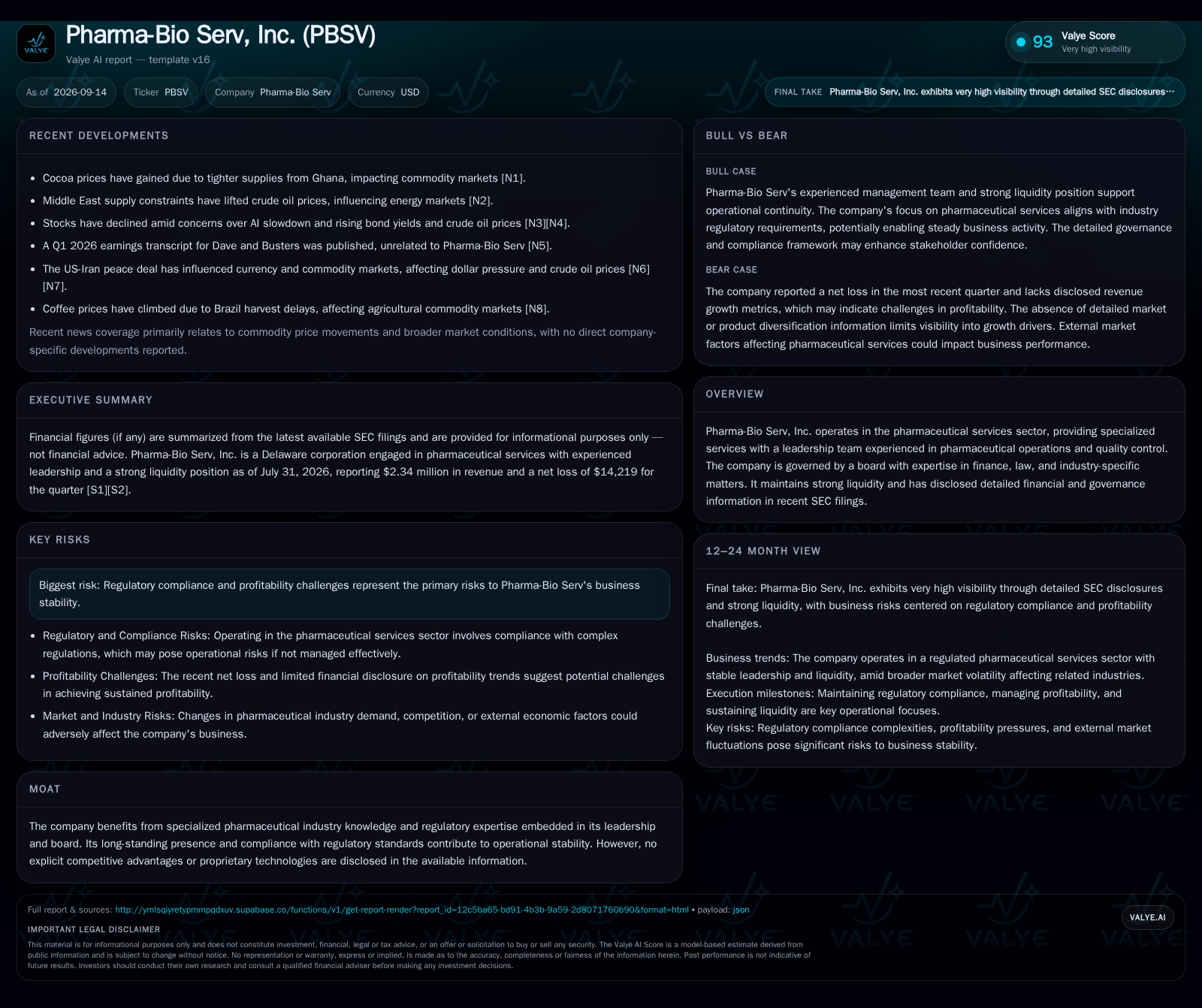
Pharma-Bio Serv, Inc. (PBSV) is a Delaware-based pharmaceutical services provider with principal executive offices in Puerto Rico. As of July 31, 2026, the company reported $2.34 million in revenue and a net loss of $14,219 for the quarter, alongside an exceptionally reported liquidity position with $2.87 million in cash, $7.06 million in short-term investments, and a current ratio of 11.3 [S2]. While its leadership is experienced and its compliance framework robust, the absence of disclosed revenue growth or market expansion details highlights ongoing profitability challenges and limited visibility into future growth levers.
Pharma-Bio Serv, Inc.stands out for its substantial liquidity and seasoned management team, both of which; these figures do not by themselves establish operating, investment, or financing capacity. Yet, its latest SEC filings reveal a persistent struggle with profitability and a lack of clear growth catalysts. With no new business developments or disclosed expansion strategies, the company’s future hinges on its ability to translate its operational strengths and compliance expertise into improved earnings and sustainable growth. Investors and observers are left to weigh a strong financial buffer against the risk of stagnation in a competitive, low-visibility market.
Recent Financials Spotlight Liquidity Strength, but Profitability Lags
Pharma-Bio Serv reported $2.34 million in revenue for the quarter ended July 31, 2026, but posted a net loss of $14,219, resulting in diluted earnings per share of -$0.001 [S2]. The balance sheet is notably robust, with $2.87 million in cash, $7.06 million in short-term investments, and a current ratio of 11.3, suggesting the company faces no immediate liquidity concerns [S2]. No material changes to risk factors or evidence of new growth initiatives were disclosed in the latest filings [S2]. The combination of reported liquidity position and persistent, albeit modest, losses raises questions about the company’s path to sustainable profitability and organic expansion.
How Pharma-Bio Serv’s Service Model Could Drive or Limit Earnings
Pharma-Bio Serv operates as a service provider to the pharmaceutical sector, likely offering quality control, regulatory compliance, validation, and consulting services. The economics of such a business typically depend on a blend of project-based and potentially retainer-based contracts, with revenues tied to volume of engagements and depth of client relationships. Gross margins in this segment can be healthy if services are specialized, but competitive pricing, client concentration, and project variability often lead to lumpy revenue streams and pressure on operating leverage.
Fixed costs are generally moderate, with labor, compliance, and professional services as key expenses. Variable costs track with project load, but the absence of disclosure on contract structure, client mix, or utilization rates makes it difficult to assess the company’s margin resilience. Operating leverage could be favorable if new business can be layered onto existing infrastructure, but the persistent net loss and lack of disclosed growth suggest limited scale efficiencies at present. The strong cash and investment position reduces immediate funding risk, but recurring losses—however small—could gradually erode this buffer if not addressed.
The balance between fixed and variable costs in Pharma-Bio Serv’s service model is critical to its ability to scale profitably. If fixed costs such as compliance infrastructure and core staff remain high relative to revenue, incremental increases in project volume may not translate into proportionate profit gains. Conversely, a flexible cost structure with scalable labor and outsourced services could enhance operating leverage, allowing the company to absorb fluctuations in demand more effectively. Understanding whether the company employs subcontractors or maintains a predominantly salaried workforce would help clarify this dynamic. Additionally, the timing and predictability of cash flows from contracts affect working capital management; contracts with milestone payments or retainers can smooth revenue recognition and reduce liquidity risk, while purely project-based billing might increase volatility.
Assessing Pharma-Bio Serv’s Defenses in a Crowded Compliance Market
The pharmaceutical services sector is characterized by intense competition, regulatory scrutiny, and client demands for reliability and industry expertise. Pharma-Bio Serv’s board and management team bring substantial experience in pharmaceutical operations, quality control, and regulatory affairs, which may provide credibility with clients and regulators [S1]. However, the company’s filings do not indicate proprietary technology, exclusive client relationships, or unique service offerings that would confer a durable competitive advantage.
Peer competition likely includes global consulting firms, specialized regulatory compliance boutiques, and large CROs (contract research organizations) that offer bundled services. Substitution risk is real: clients may insource compliance work or shift to lower-cost providers, especially if price becomes the key differentiator. Regulatory complexity may provide some barriers to entry, but without evidence of recurring contracts, switching costs, or platform effects, the company’s position appears defensible but not unassailable.
In a sector where regulatory expertise is paramount, the ability to maintain up-to-date knowledge and certifications can serve as a defensive moat if leveraged properly. Pharma-Bio Serv’s experienced leadership may facilitate compliance adherence, but sustaining this advantage requires continuous investment in training and systems to keep pace with evolving regulations. Moreover, client trust often hinges on proven track records and responsiveness; thus, service quality and reputation are intangible assets that can differentiate providers. However, absent proprietary methodologies or technology platforms, the company may face commoditization pressures, making differentiation reliant on service execution excellence. The risk of client concentration also warrants consideration, as dependence on a limited number of large clients can amplify vulnerability to contract non-renewals or pricing concessions.
Unlocking Growth: What a Turn to Sustained Profitability Would Require
An upside scenario hinges on Pharma-Bio Serv leveraging its reported liquidity position and experienced leadership to capture new business, expand service offerings, or deepen client relationships. This could involve targeting higher-margin niches, investing in specialized talent, or forming strategic partnerships to access new markets. If the company were to secure multi-year or recurring contracts—especially with large pharmaceutical manufacturers—revenue visibility and margin stability could improve materially.
Confirmation of this scenario would require disclosure of revenue growth, expanded client rosters, new service lines, or evidence of contract wins with recurring or multi-year characteristics. Margin expansion and a shift to sustained profitability, as evidenced by several consecutive quarters of positive net income, would further validate a successful inflection.
Stable but Low-Growth: The Most Likely Near-Term Trajectory
In the absence of disclosed growth drivers or major business development, the most plausible path is one of continued operational stability but limited earnings momentum. Pharma-Bio Serv may continue to serve a core set of pharmaceutical clients, maintaining compliance standards and managing costs, but with revenue growth constrained by competitive pricing and project variability.
This scenario would be confirmed by a continuation of modest revenues, small quarterly losses or near-breakeven results, and no significant changes to the company’s service mix or client base. The reported liquidity position cushions against near-term shocks, but without new business wins or margin improvement, the company risks gradually depleting its cash reserves over time.
Erosion of Financial Buffer: When Stagnation Becomes a Liability
The principal risk is that persistent unprofitability, combined with a lack of business development, leads to a slow erosion of the company’s liquidity. If revenue were to decline—due to client attrition, pricing pressure, or regulatory setbacks—fixed costs could quickly overwhelm the modest cash flow buffer, pushing the company into deeper losses.
This scenario would be confirmed by a declining cash and investment balance, rising quarterly losses, or disclosure of cost-cutting measures such as layoffs or service reductions. Further, the loss of key clients or regulatory non-compliance events could accelerate this downward trajectory, especially in a sector where reputation and reliability are critical to client retention.
Milestones That Could Shift Pharma-Bio Serv’s Outlook
Quarterly revenue trends—especially sequential growth or evidence of new client wins—would help test the company’s ability to expand its business base.
Gross and operating margin disclosures, if provided, would clarify whether scale or efficiency improvements are achievable.
Cash and short-term investment balances should be monitored to assess the sustainability of operations in the absence of profitability.
Any disclosure of multi-year, recurring, or large-scale client contracts would be a strong signal of improved revenue visibility.
Updates on service mix, geographic expansion, or entry into new compliance niches could indicate a shift toward higher-margin or less commoditized offerings.
Evidence of cost control initiatives or changes in fixed/variable expense structure would reveal management’s response to profitability pressures.
Regulatory or legal disclosures—positive or negative—could materially impact client confidence and business continuity.
Management commentary on business development pipeline or industry demand, if disclosed, would provide forward-looking context for investors.
Disclaimer: This is research-only, informational analysis and not investment advice. It may include AI-generated interpretation and general industry context. Always verify important details using primary sources.

Comments