
Helio’s Custom Space Hardware: Navigating Liquidity Strain and Customer Concentration in a Fragmented Market
Helio Corporation’s specialized deployments for NASA and commercial space missions showcase engineering credibility, but severe liquidity constraints and high revenue concentration raise fundamental questions about scalability and resilience in the evolving aerospace supply chain.
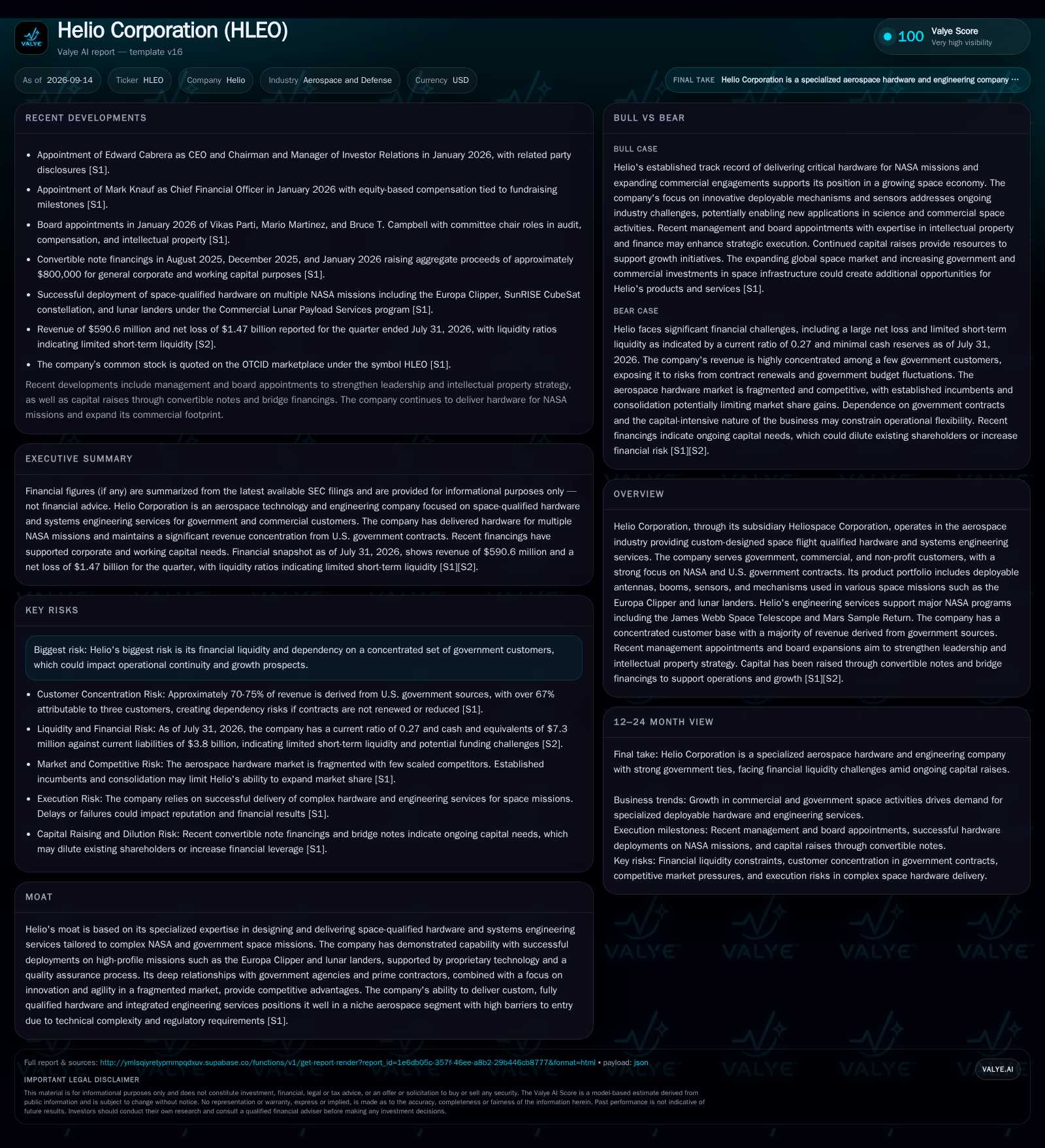
Helio Corporation delivers custom, flight-qualified space hardware and engineering services for NASA and commercial missions, with over 70% of its revenue coming from U.S. government sources and significant concentration among three customers. Despite a track record of hardware deliveries for marquee missions, the company faces a steep net loss ($1.47 billion in the latest quarter) and acute liquidity strain, with a current ratio of 0.27 and minimal cash. The company’s continued reliance on convertible note financings and bridge loans underscores persistent capital needs, even as management and board changes signal a push for strategic and operational overhaul [S1] [S2].
Helio Corporation’s proposition—delivering custom, deployable space hardware and high-touch engineering services for NASA and other space-sector clients—places it at the intersection of technical credibility and structural business risk. While hardware deliveries for high-profile missions like Europa Clipper and lunar landers validate Helio’s engineering capabilities, the company’s business model remains heavily exposed to government contract cycles, customer concentration, and acute liquidity pressures. The challenge is not whether Helio can deliver space-qualified hardware, but whether it can translate project-based technical wins into a scalable, financially resilient platform in a market defined by long sales cycles, variable funding, and entrenched incumbents.
Liquidity Squeeze and Revenue Concentration Define Today’s Strategic Backdrop
Helio’s recent financials paint a picture of both technical achievement and existential strain. As of July 31, 2026, the company reported $590.6 million in quarterly revenue but a net loss of $1.47 billion, with cash and equivalents of just $7.3 million against current liabilities of $3.8 billion. This results in a current ratio of 0.27 and a cash ratio of 0, signaling severely constrained short-term liquidity [S2].
Revenue remains highly concentrated: approximately 70-75% is sourced from U.S. government contracts, and over two-thirds comes from just three customers [S1]. This exposes Helio to abrupt funding changes, contract renewals, and budget cycles that could rapidly alter business prospects.
On the operational side, Helio has delivered hardware for more than five space missions and has three additional launches in the pipeline. While this demonstrates execution capability, these wins are project-based and do not guarantee recurring revenue or backlog visibility [S1].
Management turnover and new board appointments in 2026, alongside ongoing convertible and bridge note financings, suggest a leadership reset and a scramble to stabilize capital structure [S1].
Custom Hardware, Project Revenue, and the Economics of Space Supply
Helio’s core business centers on custom-designed, space-qualified hardware—deployable antennas, booms, sensors, and mechanisms—delivered as finished, flight-ready products. These are typically engineered to order for civil space missions, most often as contracted deliverables for NASA or NASA prime contractors [S1].
Revenue is likely recognized on a milestone or completion basis, with contracts structured around specific deliverables rather than recurring subscriptions or long-term service agreements. This creates lumpy cash flows and exposes the company to working capital risk between projects—a dynamic exacerbated by the long lead times and technical complexity of space hardware.
Variable project costs likely track material, engineering labor, and testing, while fixed costs stem from maintaining specialized facilities (clean rooms, thermal-vacuum labs), sustaining core engineering staff, and ongoing R&D. Operating leverage could be high if project volume increases, but the lack of recurring revenue and the bespoke nature of contracts limit utilization efficiency.
Recent convertible note and bridge financings illustrate a capital-intensive model: Helio must consistently raise new funds to bridge the gap between project outflows and inflows, particularly given the current low cash-to-liability ratio. Without a shift toward more predictable revenue streams or improved contract terms, persistent capital needs could either dilute shareholders or increase leverage [S1] [S2].
Engineering Niche Amidst Incumbents and Fragmented Rivals
Helio operates in a highly specialized segment of the aerospace supply chain, focused on custom hardware for civil space missions. Barriers to entry are significant: flight qualification, reliability standards, and integration with prime contractor systems all require deep technical expertise and a track record of mission success.
Its main competitors are likely a mix of established aerospace primes (for example, divisions of Lockheed Martin, Northrop Grumman, or L3Harris) and smaller specialist firms. Unlike the primes, Helio does not appear to have the scale or programmatic insulation that comes with broad portfolio relationships. Instead, it competes on agility, engineering customization, and willingness to tackle bespoke or first-of-kind challenges.
However, customer concentration—particularly with U.S. government agencies—puts Helio at a disadvantage relative to larger players who can diversify across defense, commercial, and international markets. The risk is compounded by a fragmented market structure where contract wins can be binary, and failure to deliver on a single mission can have outsized reputational impacts.
Potential substitutes include in-house engineering by primes, off-the-shelf hardware from larger vendors, or new entrants leveraging advanced manufacturing. Switching costs for customers are high only to the extent that Helio’s technical differentiation is proven and sustained through mission performance.
What a Sustainable Growth Trajectory Would Require
The bullish scenario for Helio hinges on three reinforcing mechanisms: (1) expanding project wins both within and beyond NASA, (2) converting technical reputation into long-term, multi-mission contracts, and (3) improving capital efficiency to reduce reliance on dilutive financings.
If Helio’s hardware performs flawlessly on upcoming high-profile missions, this could trigger a virtuous cycle of credibility, enabling direct awards, preferred vendor status, or inclusion in larger programs. Broadening the customer base to include more commercial and international space operators would reduce dependency on U.S. government funding cycles.
Margins could improve if the company leverages repeatable design elements or achieves economies of scale through standardization of certain components, even within a custom framework. Securing multi-year framework agreements or technology licensing deals would provide revenue visibility and working capital stability.
Confirmation would come from: a rising proportion of commercial/non-government revenue, the announcement of multi-year or recurring contracts, improved gross margins, and a meaningful reduction in the frequency or size of emergency financings.
Project-Driven Volatility and Persistent Funding Needs Likely to Persist
The most plausible scenario is that Helio continues to operate as a technically credible, project-driven supplier with episodic revenue and ongoing capital constraints. The company will likely win additional NASA or prime contractor work based on its successful track record, but revenue will remain concentrated and volatile, tied to the cadence of government space budgets and new mission awards.
Liquidity pressures are unlikely to abate in the near term without a substantial change in contract structure or customer mix. The need for frequent bridge and convertible financings will persist, potentially leading to further dilution or higher cost of capital.
Operational performance may remain strong at the engineering level, but the business model will struggle to convert technical wins into sustained profitability or cash generation unless new commercial avenues are developed or the company is able to secure more favorable contract terms.
Evidence for this scenario would be continued quarterly losses, recurring capital raises, and a customer roster still dominated by a handful of government entities.
Liquidity Crunch and Contract Disruption Could Trigger Strategic Reset
The bear case centers on a potential liquidity event—failure to secure new bridge funding or convert upcoming projects into revenue—forcing Helio to restructure operations, sell assets, or seek a strategic buyer. With a current ratio of 0.27 and minimal cash, even a modest contract delay or payment dispute could push the company into technical default or force drastic cost cuts [S2].
A loss or reduction of any of the three major customers would have an outsized impact, given the extreme revenue concentration. In a worst-case scenario, government budget cuts or mission cancellations could simultaneously dry up new awards and disrupt existing receivables.
Competitive threats could also accelerate if a prime contractor internalizes Helio’s core capabilities or if new entrants undercut on price or technology. Any reputational hit from failed hardware deployments would further erode the pipeline.
This scenario would be confirmed by missed payrolls, workforce reductions, asset sales, emergency financings on punitive terms, or abrupt changes in management structure.
What Will Determine Helio’s Resilience in the Space Hardware Market?
The evolution of customer concentration: A useful metric would be the percentage of revenue attributed to the top three customers over the next several quarters.
Backlog and pipeline disclosure: If disclosed, tracking the value and duration of awarded contracts or committed backlog would provide insight into revenue visibility.
Gross margin trends: Improvement here would indicate either pricing power, better cost management, or a shift toward higher-value contracts.
Frequency and terms of capital raises: Monitoring whether financings become less frequent or less dilutive would signal improving capital efficiency.
Proportion of commercial versus government revenue: An increasing commercial mix would reduce dependency risk and suggest broader market acceptance.
Timeliness and outcomes of upcoming mission launches: Successful deployments without technical issues would reinforce Helio’s reputation and future win rate.
Management and board stability: Continued turnover or abrupt changes could signal deeper strategic or financial distress.
Disclosure of multi-year or recurring contract structures: If announced, these would support a shift toward more predictable revenue and cash flow.
Disclaimer: This is research-only, informational analysis and not investment advice. It may include AI-generated interpretation and general industry context. Always verify important details using primary sources.

Comments