
VitaNova Life Sciences: Asset-Light Nutrition Platform Expands Into Foods, but Profitability and Differentiation Remain Unproven
VitaNova Life Sciences is leveraging an asset-light, dual-brand portfolio and recent diversification into healthy foods to address the fragmented U.S. supplements and lifestyle market. While cash levels offer operational runway, the company’s low revenue base and lack of clinical validation sharpen questions around commercial traction, pricing power, and long-term sustainable advantage.
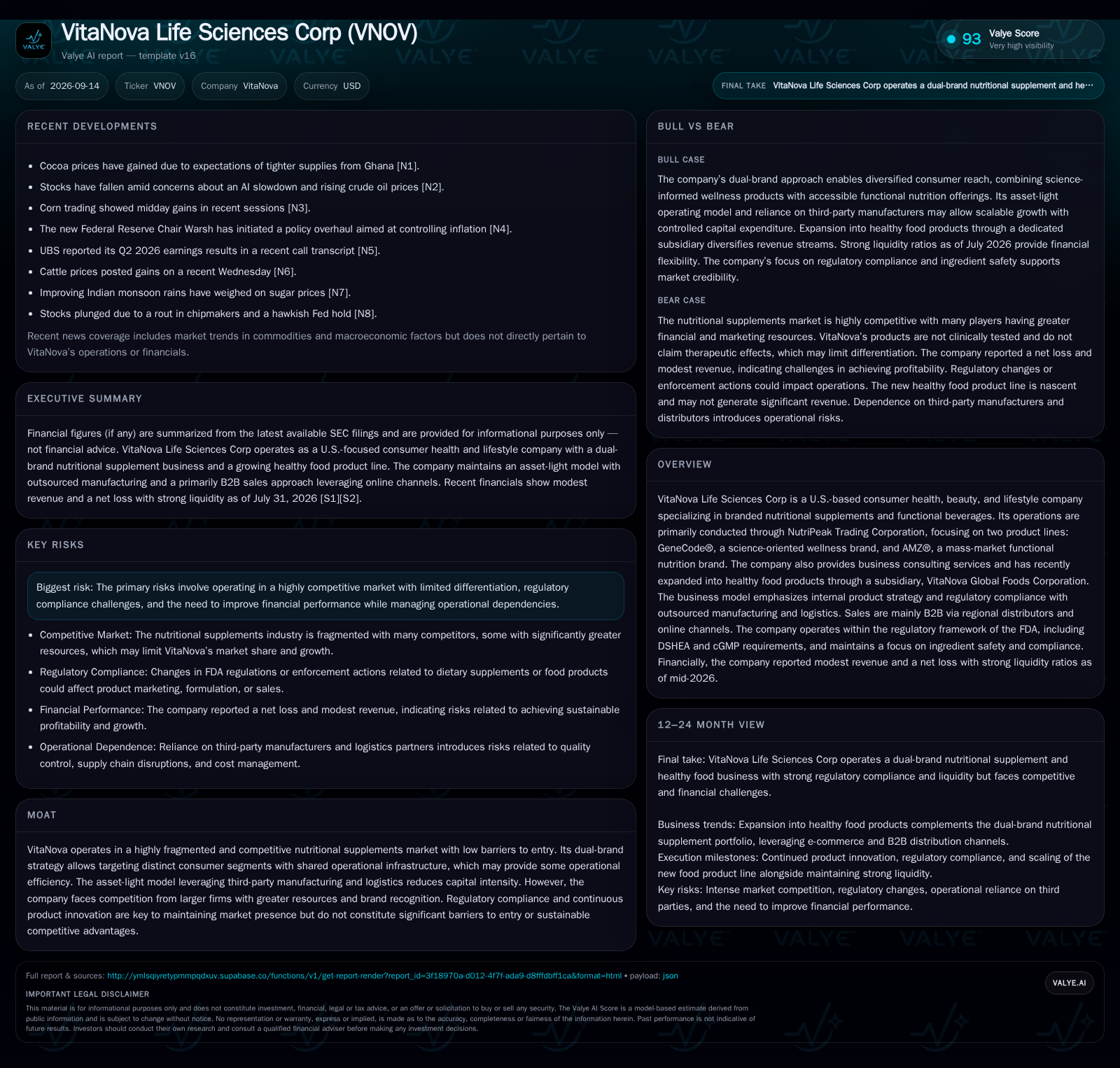
VitaNova Life Sciences operates a dual-brand nutritional supplements business with recent expansion into healthy foods, using an asset-light model and B2B e-commerce channels. Despite reported liquidity position as of July 2026, the company’s modest revenue and net loss highlight challenges in scaling and differentiating in a competitive, low-barrier market. The absence of clinical testing and dependence on third-party partners further complicate the path to sustainable profitability. Near-term outcomes hinge on the new food line’s adoption, commercial execution, and VitaNova’s ability to carve out a defensible niche.
VitaNova Life Sciences Corp is attempting to reinvent itself at the intersection of wellness, nutrition, and convenience, operating a dual-brand supplement business and recently branching into the healthy foods category. Its asset-light, compliance-focused model provides operational flexibility, but the company’s tiny revenue base and persistent losses underscore the uphill battle for differentiation and scale in a saturated market. The next phase will test whether VitaNova can translate reported liquidity position and regulatory discipline into commercial traction, particularly as it leans into new food offerings and B2B e-commerce partnerships.
Recent Moves: Reported Liquidity Position, New Subsidiary, and Persistently Low Revenue
As of July 31, 2026, VitaNova reported cash and equivalents of $808,356 and a current ratio of 7.13, reflecting a reported liquidity position relative to its obligations [S2]. However, revenue remains modest, with $26,100 reported as of January 2024 and a net loss of $123,101 for the quarter ended July 2026 [S2]. This disconnect between liquidity and operating performance is central to the company’s near-term thesis.
A significant operational development is the March 2026 launch of VitaNova Global Foods Corporation (VGFC), which began distributing healthy food products such as olive juice and aloe vera drink [S1]. This move signals an effort to diversify away from pure supplements and tap into adjacent wellness categories. The company also completed a 1-for-3 reverse stock split in January 2026 and increased authorized shares late in 2025, potentially to facilitate future capital needs or strategic flexibility [S1].
How VitaNova’s Asset-Light Model and Brand Strategy Could Drive (or Limit) Margin Expansion
VitaNova operates an asset-light model, outsourcing manufacturing, packaging, and fulfillment to third-party partners while keeping product strategy, brand management, and regulatory compliance in-house [S1]. This structure minimizes fixed capital investment and can theoretically enable rapid scaling and margin expansion if sales volumes rise. However, it also places VitaNova at the mercy of external partners for quality, cost control, and supply chain reliability—a risk amplified in the fragmented supplement and food market.
The company’s dual-brand approach segments the portfolio into GeneCode® (science-oriented, wellness-focused) and AMZ® (mass-market, functional nutrition), both positioned as dietary supplements under U.S. regulations [S1]. Neither brand’s products are clinically tested or claim therapeutic effects, relying instead on literature-driven ingredient selection and regulatory compliance. This may limit pricing power, as premium supplement brands often leverage proprietary formulations or clinical backing to justify higher ASPs.
The expansion into healthy foods via VGFC is a strategic attempt to diversify revenue and exploit cross-category synergies. However, food distribution typically carries thinner margins and greater logistics complexity than supplements, suggesting that scaling the new business line without eroding group-level gross margin will require careful execution.
Cash levels remain ample for current operations, but the persistently low revenue base and ongoing net losses highlight the importance of achieving commercial traction. Without significant volume growth or a shift toward higher-value products, the business may struggle to reach positive operating leverage.
Competing in a Fragmented, Low-Barrier Market: Differentiation and Channel Execution Are Critical
The U.S. nutritional supplements and functional foods market is highly fragmented, with numerous small players and a handful of large, well-capitalized brands. VitaNova competes against companies with far greater resources, established distribution, and brand equity [S1]. Barriers to entry are low: regulatory compliance (DSHEA, cGMP, FSMA) is necessary but not sufficient for sustainable advantage.
VitaNova’s differentiation leans on its dual-brand portfolio and regulatory discipline, but neither GeneCode® nor AMZ® offers clinical proof or true proprietary innovation [S1]. This limits the ability to command premium pricing or engender strong customer loyalty. The new food product line could help diversify the customer base, but initial traction is unproven.
On the channel side, VitaNova’s primary route to market is B2B, targeting regional distributors and leveraging e-commerce traffic channels like Douyin Cross-border and Weidian Cross-border, as well as direct-to-consumer sales in the U.S. [S1]. If the company can accelerate B2B partnerships and increase velocity through these online channels, it could partially offset brand-resource disadvantages. However, channel partners often demand trade spending, discounts, and marketing support, which can compress margins for smaller brands.
Operationally, reliance on third-party contract manufacturers and logistics providers exposes VitaNova to risks around quality, cost inflation, and supply chain disruption—challenges that can erode whatever modest advantages the asset-light model provides.
If Food Expansion and B2B Channels Deliver Volume, Operating Leverage Could Materialize
A favorable scenario for VitaNova would see the healthy foods subsidiary (VGFC) gain traction with regional distributors and online cross-border channels, driving higher sales volumes both in foods and core supplements. If the company can leverage its regulatory-compliant, literature-backed formulations to secure shelf space and digital real estate, it may achieve scale benefits without a proportional increase in fixed costs.
Evidence supporting this scenario would include a material increase in quarterly revenues, especially from new food products, and improved gross margin as the mix shifts toward higher-volume, higher-value SKUs. Signs of repeat orders from channel partners or early DTC traction would further validate the commercial model. If operating expenses remain controlled, positive operating leverage could emerge, enabling the company to narrow or eliminate net losses.
Confirmation would also come from the ability to launch new products quickly, maintain regulatory compliance, and avoid major quality or supply chain incidents despite the asset-light setup. New B2B contracts, especially in high-growth e-commerce channels, would support the thesis.
Most Likely: Slow Uptake, Persistent Losses, and Ongoing Dependence on Liquidity
The most plausible near-term outcome is that VitaNova sees incremental revenue growth from its new food products and continued supplement sales, but struggles to achieve the scale necessary for profitability. The company’s lack of clinical differentiation and reliance on generic, literature-based formulations likely limits pricing power and customer loyalty, resulting in modest volume growth and continued competition on price.
Operating expenses and the cost of supporting multi-brand marketing and compliance may continue to outpace gross profit, leading to ongoing net losses. The reported liquidity position, while supportive for now, could erode over time if commercial traction does not accelerate. The company may need to pursue additional capital raises if losses persist.
Evidence confirming this scenario would be continued low revenue growth, negative net income, and lack of clear momentum from the VGFC food line. Absence of significant new channel partnerships or repeat B2B orders would further suggest the business is treading water rather than gaining ground.
Commercial Stagnation and Margin Compression Threaten Long-Term Viability
In a negative scenario, VitaNova’s new food products fail to gain meaningful traction, and core supplement sales remain stagnant or decline amid intensifying competition. Price discounting and trade promotions required to maintain shelf space or online visibility could compress already-thin margins, especially as larger players wield greater scale and marketing budgets.
Operational risks could compound: supply chain disruptions, quality lapses from third-party manufacturers, or regulatory issues could undermine brand reputation or trigger costly recalls. If the company is forced to absorb higher input costs without the ability to pass them through via pricing, losses could accelerate.
In this case, liquidity—though currently strong—would dwindle, potentially forcing VitaNova to seek dilutive equity raises or scale back operations. Confirmation of this scenario would be declining or flat revenues, deteriorating gross margin, and negative cash flow from operations over successive quarters.
Milestones That Will Define VitaNova’s Commercial Trajectory and Strategic Viability
Quarterly revenue growth, especially attributable to the new VGFC healthy foods line, will be a primary indicator of commercial traction and product-market fit.
Gross margin trends—if disclosed—will help test whether the asset-light model and portfolio mix can support sustainable profitability as volumes scale.
New or expanded B2B distribution agreements (especially with significant regional or online channel partners) would provide evidence of successful commercial execution.
Repeat orders or growing order sizes from existing distributors would signal customer retention and channel satisfaction, both key to scaling in a B2B model.
Any disclosures on customer acquisition cost (CAC) or average order value (AOV) would clarify the economics of VitaNova’s e-commerce and DTC efforts.
Updates on operating expenses relative to revenue growth would indicate whether VitaNova is approaching positive operating leverage or facing expense drag.
Regulatory compliance events, quality incidents, or supply chain disruptions—if reported—would test the resilience of the company’s asset-light strategy.
Capital raises, share issuances, or changes in liquidity position would reveal the extent to which ongoing operations are self-sustaining versus dependent on external funding.
Disclaimer: This is research-only, informational analysis and not investment advice. It may include AI-generated interpretation and general industry context. Always verify important details using primary sources.

Comments