
HAIN Celestial’s Portfolio Reset: Can a Leaner Organic Foods Giant Overcome Financial Strains?
Amid deep losses and acute liquidity pressure, HAIN Celestial pivots to a focused core of natural and organic brands. With recent divestitures freeing up cash but narrowing its revenue base, the company’s future hinges on its ability to restore profitability, manage cash burn, and capitalize on consumer health trends—while countering operational and strategic risks.
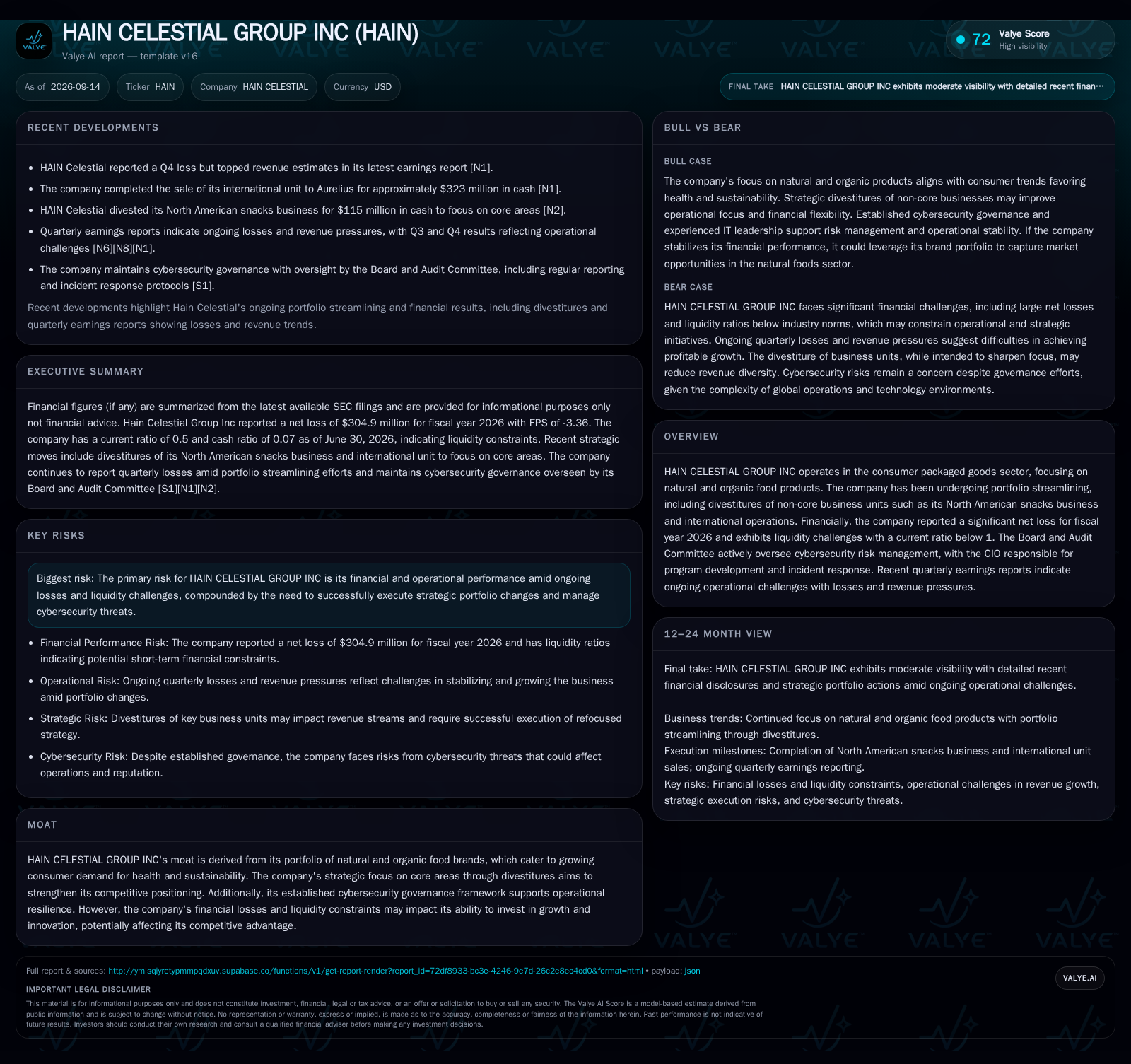
HAIN Celestial is executing a dramatic portfolio streamlining, selling its North American snacks and international units for a combined $438 million in cash. Despite these moves, it ended fiscal 2026 with a $304.9 million net loss and a current ratio of just 0.5, highlighting severe liquidity constraints. While the company continues to report quarterly losses, it topped revenue estimates in Q4. The path forward depends on successfully refocusing its brand portfolio, managing costs, and navigating tight financial conditions. [S1] [N1] [N2]
HAIN Celestial Group is at a strategic crossroads: after years of expansion, the company is aggressively pruning its portfolio, having sold both its North American snacks business and its international operations for over $438 million in cash. This streamlining marks a bid to refocus on its core natural and organic food brands, but comes at a time of acute financial strain. The company ended fiscal 2026 with a $304.9 million net loss and a current ratio of just 0.5, highlighting the urgency of restoring profitability and stabilizing liquidity. Investors now face the question: can a leaner HAIN Celestial turn operational focus into sustainable financial recovery?
Recent Divestitures and Financial Strains Define the Moment
HAIN Celestial’s most significant recent actions are the divestitures of its North American snacks business for $115 million in cash and its international unit for approximately $323 million in cash, totaling over $438 million in gross proceeds [N1] [N2]. These moves are designed to sharpen the company’s focus on core natural and organic food brands. However, the financial backdrop is severe: for the fiscal year ended June 30, 2026, HAIN posted a net loss of $304.9 million (EPS -$3.36) and closed the year with just $58.1 million in cash and a current ratio of 0.5 [S1]. Quarterly operating losses and revenue pressures persist, even as Q4 revenue topped estimates [N1]. These facts underscore a company in urgent need of both operational turnaround and financial stabilization.
Can a Focused Core Generate Sustainable Profits?
The company’s economics now depend increasingly on the performance of its remaining natural and organic food portfolio. Historically, the sector offers potential for above-average gross margins due to premium positioning and health-conscious consumer demand. However, HAIN’s recent net loss and liquidity squeeze suggest that fixed costs—including SG&A, supply chain, and brand support—may still be too high relative to its new, smaller revenue base. The divestitures provide a short-term cash buffer and reduce operational complexity, but also shrink revenue streams, potentially increasing exposure to volume swings in fewer categories.
On the revenue side, the company may seek to drive growth through product innovation, channel expansion, or premium pricing. Yet, the ability to pass through price increases or grow share is constrained by competitive intensity and consumer price sensitivity, particularly in a high-inflation environment. Variable costs, such as raw materials and logistics, could remain volatile. Operating leverage is a double-edged sword: while cost rationalization could eventually restore margins, the smaller scale amplifies the risk of revenue shortfalls triggering outsized losses. The company’s capital needs remain acute, given the low cash ratio and high current liabilities, suggesting limited flexibility for further investment or marketing until profitability improves; these balance-sheet figures do not by themselves establish operating, investment, or financing capacity.
Smaller Portfolio, Sharper Competition: Strategic Implications
HAIN Celestial’s competitive position now rests on a narrower set of brands in the natural and organic segment. This focus could enable deeper investment in brand equity, innovation, and targeted marketing. However, the company is exposed to intensified competition from both large CPG conglomerates—who are increasingly entering the natural/organic space—and agile specialty brands that can innovate quickly and capture niche trends.
Switching costs for consumers in packaged foods are generally low, with brand loyalty playing a large but fickle role. Larger competitors may have scale advantages in sourcing, distribution, and promotional spend, while new entrants can exploit digital channels and direct-to-consumer models. HAIN’s ability to defend or grow share will depend on distinctive product quality, perceived authenticity, and supply chain resilience. The strategic question is whether a leaner organization can outmaneuver larger and smaller rivals with a more focused but less diversified brand set.
If Strategic Focus Unlocks Margin and Growth
A favorable scenario would see HAIN Celestial using divestiture proceeds to shore up its balance sheet, accelerate cost reductions, and reinvest in its highest-potential brands. Success would be evidenced by stable or growing revenues in the core portfolio, improved gross and operating margins, and a return to positive EPS. This could be driven by effective product innovation, winning shelf space at key retailers, and capitalizing on consumer health trends.
Confirmation would come from sequential improvement in quarterly margins and cash flow, as well as evidence of market share gains in core product categories. Additional indicators might include successful new product launches, improved retail partnerships, and the ability to maintain or raise prices without volume loss. Falsification would be signaled by continued revenue declines, margin compression, or further liquidity deterioration despite the streamlined focus.
A Narrow Margin for Error: Stabilization, Not Transformation
The most plausible trajectory is a period of operational stabilization, with HAIN Celestial using divestiture proceeds to manage near-term liabilities and gradually rebalance costs to its new scale. Revenue may remain flat or grow modestly, but ongoing competitive and macroeconomic pressures could limit pricing power and profit margins. The company may need to prioritize working capital management and incremental efficiency gains over aggressive expansion.
In this scenario, the company’s liquidity position remains tight but manageable, provided there are no major operational missteps or external shocks. Confirmation would include a stabilized or slowly improving current ratio, narrowing quarterly losses, and steady performance in core categories. Falsification would be indicated by persistent negative cash flow, inability to cover short-term obligations, or loss of key retail placements.
Liquidity Crunch Forces Unplanned Retrenchment
The adverse outcome is that HAIN Celestial’s liquidity remains under acute pressure, forcing the company into further asset sales, emergency financing at unfavorable terms, or drastic cost cuts that erode brand value. If operational improvements fail to materialize, continued losses could trigger covenant breaches or supplier/retailer concerns, further tightening cash availability.
Evidence of this scenario would include a deteriorating current ratio, declining cash balances, delayed payments to suppliers, or negative commentary from credit counterparties. If the company is unable to arrest revenue declines or restore margins, the risk of restructuring or distressed asset sales rises, potentially further eroding the core business.
Milestones That Will Determine HAIN Celestial’s Trajectory
Quarterly gross and operating margin trends: Sequential improvement would suggest successful cost and portfolio management.
Net cash flow from operations: A shift to positive cash generation would indicate improved financial health.
Current ratio and liquidity metrics: Stabilization or improvement would reduce near-term solvency risk.
Core brand revenue growth: If disclosed, this would test whether the focused strategy is driving consumer demand.
SG&A and fixed cost reductions: Evidence of cost alignment with the smaller portfolio is critical for margin recovery.
Retail shelf presence and distribution wins: Announced agreements or expanded placements would signal competitive traction.
Market share data in key natural and organic categories: If available, this would confirm or challenge the effectiveness of brand investments.
Any new divestitures, financing arrangements, or signals of distress: These would provide early warning of further financial or operational strain.
Disclaimer: This is research-only, informational analysis and not investment advice. It may include AI-generated interpretation and general industry context. Always verify important details using primary sources.

Comments