
Glidelogic Corp.: Strategic AI Pivot Meets Acute Liquidity and Execution Hurdles
Glidelogic’s transition to AI-native platforms and compliance solutions underscores its ambition in niche AI advisory markets, but persistent operating losses, minimal revenue, and severe liquidity constraints raise urgent questions about its ability to realize this vision without near-term external capital.
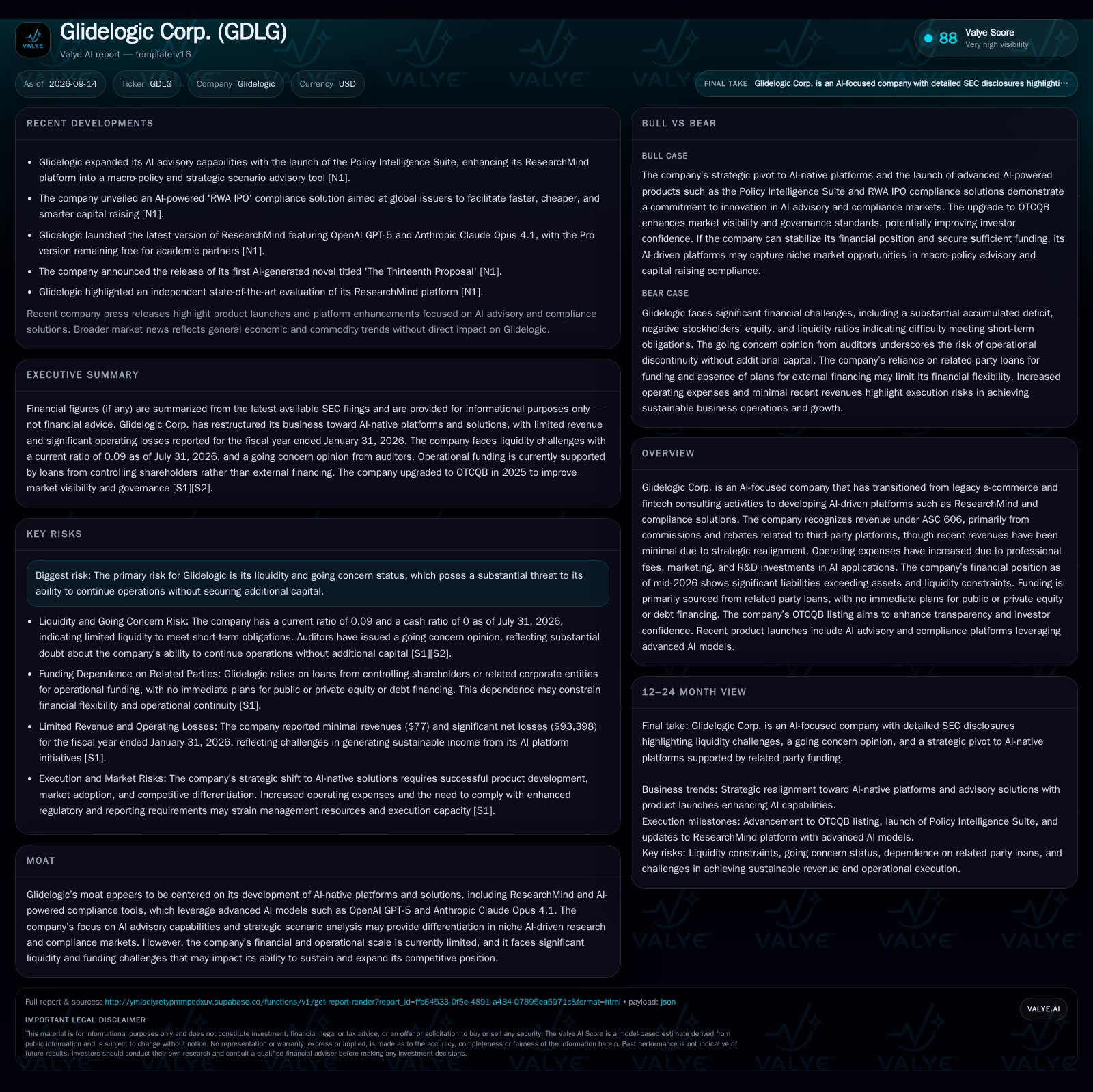
Glidelogic Corp. has refocused on AI-driven compliance and intelligence platforms, discontinuing legacy e-commerce and fintech consulting as it launches products like the Policy Intelligence Suite and ResearchMind. However, the company faces critical financial headwinds: for the fiscal year ended January 31, 2026, revenues totaled just $77 against a net loss of $93,398, with a current ratio of 0.09 and a cash ratio of zero as of July 31, 2026. Funding is reliant on loans from controlling shareholders, and auditors have issued a going concern warning, highlighting the urgent need for external capital or a dramatic ramp in revenue for the business to survive [S1] [S2].
Glidelogic Corp.’s strategic pivot to AI-native platforms, including the launch of advanced compliance and research tools, signals a bold attempt to capture value in emerging AI-driven advisory markets. However, the company’s ability to execute on this vision is sharply curtailed by its severe liquidity crunch, as evidenced by minimal revenue, substantial net losses, and a current ratio of just 0.09. Operational funding now depends entirely on loans from controlling shareholders, and the company faces a going concern warning from its auditors. This analysis explores the underlying economics, competitive landscape, and the critical milestones that will determine whether Glidelogic’s high-ambition transition can translate into a viable, self-sustaining business—or whether financial reality will force a reset.
Recent Financial and Strategic Developments Set the Stage for Survival or Reset
Glidelogic Corp. has undergone a significant transformation, exiting legacy e-commerce and fintech consulting to focus on AI-native solutions, notably the ResearchMind platform and a suite of compliance and intelligence tools [S1]. This pivot has yet to generate meaningful revenue: for the fiscal year ended January 31, 2026, Glidelogic reported just $77 in revenue and a net loss of $93,398, underscoring the costs of transition and new product development [S1]. The liquidity picture is even more acute; as of July 31, 2026, the company had $149 in cash against $131,687 in current liabilities, resulting in a current ratio of 0.09 and a cash ratio of zero [S2]. Glidelogic’s only operational funding comes from loans by controlling shareholders, with no immediate plans for external equity or debt financing [S1]. Compounding these pressures, auditors have issued a going concern opinion, flagging substantial doubt about the company’s ability to continue operations without additional capital [S1].
AI Platform Ambitions Collide with Cost Structure and Funding Realities
Glidelogic’s new business model centers on developing and monetizing AI-native platforms for compliance, research, and advisory—areas with potential for high-margin, software-driven economics if product-market fit is achieved. Revenue is recognized under ASC 606, primarily from commissions, rebates, and bonuses tied to third-party platforms, and not from direct SaaS subscriptions or enterprise contracts as far as current disclosures indicate [S1]. This revenue mix is inherently volatile and dependent on partner platform activity rather than recurring direct customer payments, limiting predictability and margin visibility.
On the cost side, expenses are driven by R&D, professional services, and marketing—typical for early-stage software ventures but problematic given Glidelogic’s minuscule revenue base. With a reported net loss vastly exceeding revenues, the company is in a highly negative operating leverage position, where incremental spending does not generate incremental revenue. The absence of external funding options further constrains the ability to invest in product development, go-to-market, or customer acquisition. Should the company secure meaningful market traction, the underlying AI software model could support scalable margins and lower variable costs, but the current funding structure and cost base are unsustainable without immediate top-line growth or a capital injection.
Niche AI Compliance and Research: Differentiation Potential and Entrant Barriers
Glidelogic’s competitive differentiation is predicated on its proprietary AI models and the integration of advanced tools like OpenAI GPT-5 and Anthropic Claude Opus 4.1 into its compliance and research platforms. In theory, this could allow for faster, more adaptive advisory solutions than traditional compliance software or consulting providers, and may attract customers facing complex regulatory or capital-raising environments. However, the market for AI-powered compliance and research is increasingly crowded, with both established enterprise software vendors and well-funded AI startups competing for share.
Major counterforces include customer risk aversion (particularly in compliance), the need for robust data security and regulatory certifications, and the challenge of convincing organizations to trust new, relatively unproven platforms. Switching costs may be low unless Glidelogic can demonstrate workflow integration or unique data/insight advantages. Without clear evidence of recurring contracted revenue, network effects, or high customer retention, the company’s current competitive position appears fragile—especially given its limited financial resources and execution bandwidth.
Rapid Market Adoption and Funding Infusion Could Transform the Trajectory
The most favorable pathway for Glidelogic hinges on a virtuous cycle: successful adoption of its AI platforms by a critical mass of compliance or advisory clients, leading to both revenue growth and greater credibility in the market. If the company can secure anchor customers or partnerships—potentially leveraging its recent OTCQB upgrade to attract institutional interest—this could catalyze further adoption and provide the commercial proof points needed to raise external capital.
Evidence that would confirm this scenario includes: a material increase in contracted revenues, customer testimonials or case studies from recognized organizations, announcements of strategic partnerships or integrations, and disclosure of recurring revenue streams. A successful capital raise (equity or strategic investment) would further validate the company’s prospects and enable sustained investment in R&D and go-to-market. Conversely, continued negligible revenue or failure to secure funding would quickly falsify this scenario.
Incremental Progress Amid Ongoing Financial Strain Remains Most Likely
The most plausible near-term outcome is that Glidelogic makes incremental improvements to its platforms and product offerings, but struggles to achieve meaningful commercial traction or financial stability. Under this scenario, the company continues to rely on shareholder loans to fund operations while seeking customer validation and small pilot projects in its target markets.
Confirmation would come from modest but consistent product updates, occasional pilot wins, and gradual revenue increases—though likely insufficient to close the operating loss gap. Ongoing liquidity strain, high burn relative to revenue, and the absence of external financing would remain persistent headwinds. Falsification would occur if the company either rapidly secures transformative customers/funding (upside scenario) or is forced to cease operations or restructure due to insolvency (downside scenario).
Acute Liquidity Crisis or Execution Failure Triggers Operational Disruption
The most adverse scenario is a forced operational reset or shutdown triggered by the exhaustion of related party funding or an inability to meet short-term obligations. With a current ratio of 0.09 and a going concern warning, Glidelogic is highly exposed to any interruption in shareholder support or unexpected cash needs [S2]. Failure to convert product launches into paying customers, or a breakdown in supplier or platform relationships, could precipitate a liquidity crisis.
Confirmation would come from missed payroll, vendor defaults, delisting warnings, or explicit disclosure of halted operations. In this scenario, the company may be forced into restructuring, asset sales, or a distressed transaction. The downside is exacerbated by the lack of alternative funding sources and the possible erosion of confidence among customers, partners, and prospective investors.
Milestones That Will Define Glidelogic’s AI Platform Viability
Disclosure of contracted or recurring revenue from enterprise or institutional customers, if disclosed, would help test whether the AI platform is gaining commercial traction.
Announcement of external capital raises—whether through equity, convertible debt, or strategic partnerships—would signal improved potential financial flexibility and investor confidence.
Updates on customer acquisition, retention, and case studies in regulated or compliance-heavy industries would provide evidence of product-market fit.
Any change in the pattern or terms of related party funding—such as the withdrawal or material increase of loans—would directly impact operational runway and strategic optionality.
Gross margin and operating expense trends, if disclosed, would clarify whether the company is moving toward a sustainable cost structure.
Product roadmap execution: timely delivery and customer adoption of new AI-powered features or compliance modules would indicate operational momentum.
Disclosures of delisting risk, vendor disputes, or missed financial obligations would be leading indicators of acute distress.
Management commentary or third-party validation regarding data security, regulatory compliance, or workflow integration would help assess competitive durability.
Disclaimer: This is research-only, informational analysis and not investment advice. It may include AI-generated interpretation and general industry context. Always verify important details using primary sources.

Comments