
American Battery Technology Co: Scaling Domestic Battery Materials Supply Amid Execution and Financing Crossroads
American Battery Technology Co (ABTC) is positioning itself to help close the U.S. critical minerals gap through integrated recycling and primary resource development. With reported liquidity position but no revenue to date, the company faces a pivotal period where operational execution, financing, and regulatory progress will determine whether its innovative approach can translate into commercial viability.
American Battery Technology Co stands at a strategic intersection: it has developed proprietary lithium-ion battery recycling technology and is advancing domestic critical minerals projects, both of which address U.S. supply chain vulnerabilities. However, as of June 2026, the company has yet to generate revenue, continues to post sizable losses, and remains reliant on reported liquidity position, federal support, and future financing. The next 12-24 months will test whether ABTC can successfully scale operations and secure the funding needed to bridge the gap from promise to sustainable business.
American Battery Technology Co is aiming to become a linchpin in the U.S. battery materials supply chain by combining novel lithium-ion battery recycling with domestic critical minerals exploration. The company’s integrated model directly addresses two of the sector’s biggest challenges: supply chain insecurity and the environmental footprint of battery production. But with no revenue to date and deep operating losses, ABTC’s near-term future will be defined by its ability to convert federal support and technology promise into tangible operational and commercial results. The company’s liquidity buys time, but not certainty, as it prepares to scale its operations amid a fiercely competitive and capital-intensive landscape.
Liquidity Buys Time, but Commercialization Remains Unproven
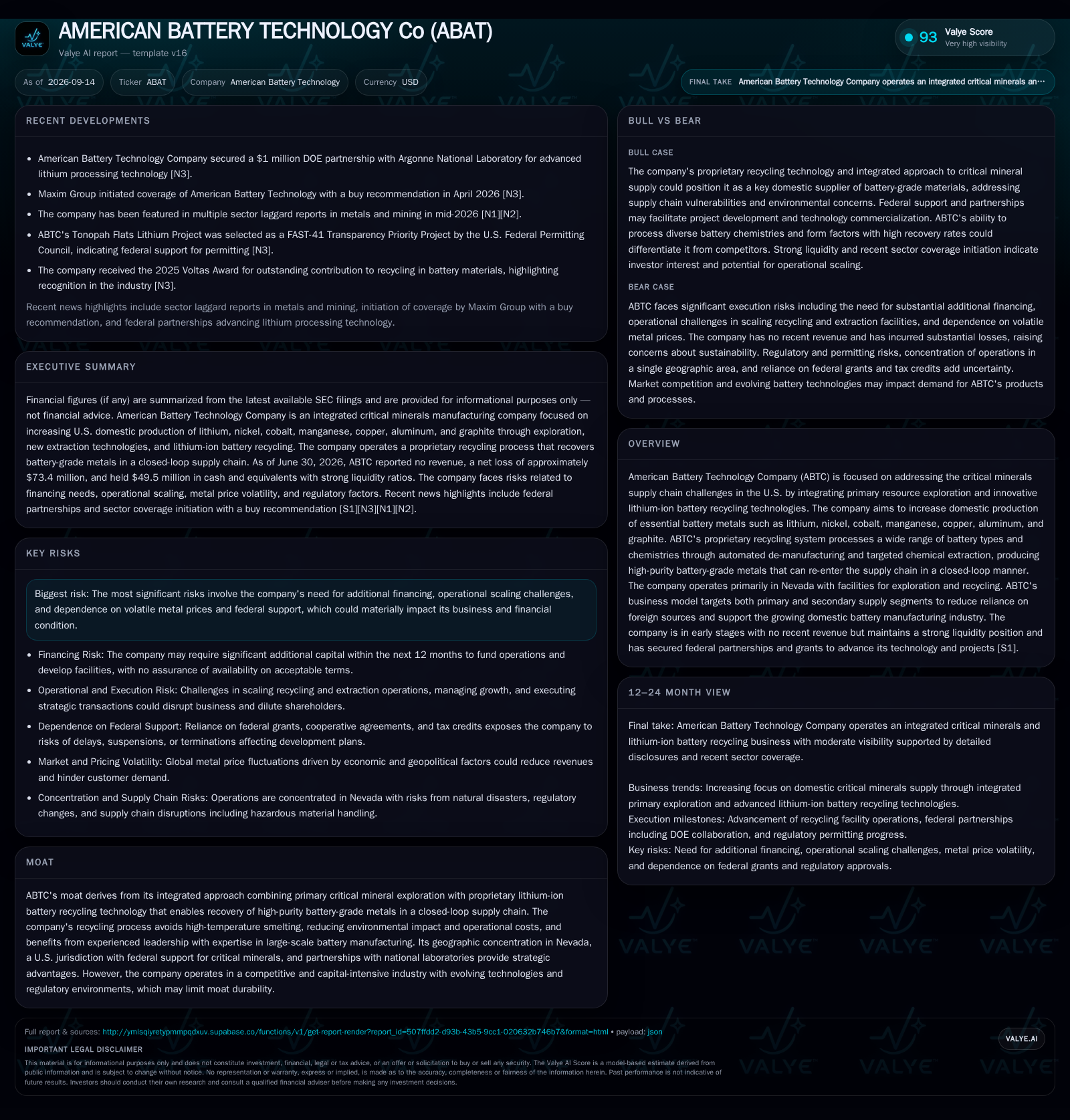
As of June 30, 2026, American Battery Technology Co reported no revenue, a net loss of $73.4 million, and a negative EPS of -$0.58 for the fiscal year, but maintained $49.5 million in cash and a current ratio of 9.53 [S1]. This liquidity; these figures do not by themselves establish operating, investment, or financing capacity, but does not obviate the need for future capital raises. The company’s selection for federal permitting priority on its Tonopah Flats Lithium Project and receipt of industry recognition for recycling innovation signal external validation and potential acceleration of project timelines [N3]. However, the lack of commercial sales to date means that ABTC's economic model, cost structure, and customer demand remain largely theoretical at this stage.
The timing and sequencing of capital deployment will be critical for ABTC, as the company must balance aggressive scaling ambitions with prudent cash management. Given the capital-intensive nature of both mining and recycling operations, delays or cost overruns in one segment could cascade, impacting the entire integrated business model. Additionally, the company’s ability to attract follow-on financing will likely depend on demonstrable progress in operational milestones and tangible evidence of process scalability. In this context, the interplay between federal support mechanisms and private capital markets will shape ABTC’s runway and strategic flexibility, underscoring the importance of maintaining strong stakeholder communications and transparent milestone reporting.
Integrated Model Targets Both Upstream and Downstream Battery Value Chains
ABTC’s business model seeks to monetize both primary mineral extraction and secondary supply through recycling, aiming to supply battery-grade metals to U.S. manufacturers. The proprietary recycling process is designed to handle diverse battery chemistries and form factors, employing automated de-manufacturing and chemical extraction to produce high-purity outputs. If the process delivers as intended, economics could benefit from lower energy inputs (no high-temperature smelting), potential byproduct sales, and a closed-loop value proposition attractive to OEMs seeking domestic and sustainable sources. However, without disclosed data on throughput, yield, or customer contracts, actual unit economics and margin potential remain untested. Capital needs are substantial: scaling both extraction and recycling facilities typically requires hundreds of millions in investment, and ABTC’s cash position, while strong for an early-stage company, is not sufficient for full commercialization. Operating leverage could be significant if fixed costs are spread over high volumes, but only if market demand and operational reliability materialize.
A nuanced understanding of the interplay between recycling and primary extraction economics is essential to evaluating ABTC’s integrated model. Recycling operations typically offer faster ramp-up times and lower upfront capital requirements compared to mining, but may face feedstock availability constraints and fluctuating input costs tied to battery collection rates and market penetration of electric vehicles. Conversely, primary mineral extraction involves longer development cycles and higher capital intensity but can provide more predictable feedstock volumes once operational. The synergies between these segments—such as shared infrastructure, logistics, and processing expertise—could enhance overall cost efficiency, but only if managed to avoid operational bottlenecks or capital allocation conflicts. Therefore, the company’s success hinges on optimizing resource allocation and achieving operational balance between these complementary yet distinct value chains.
Can Technology and Federal Support Offset Industry Headwinds?
The company’s moat is predicated on its integrated approach and proprietary recycling technology, which avoids energy-intensive smelting and aims for high recovery rates of battery-grade metals. This could offer a cost and environmental advantage if large-scale operations prove as efficient as claimed. Federal support—including selection for permitting priority and grant partnerships—may provide a regulatory and funding tailwind not available to all competitors. However, ABTC operates in a field crowded with both established mining companies and specialized recycling startups, many of which are also racing to secure government support and commercial contracts. Substitutes include direct sourcing from foreign suppliers, incumbent pyrometallurgical recyclers, and new battery chemistries with lower critical mineral content. The competitive landscape is further complicated by volatile metal prices, rapid technology cycles, and the potential for OEMs to vertically integrate or form exclusive partnerships, which could bypass independent recyclers and explorers.
The competitive advantage of ABTC’s proprietary recycling technology will depend not only on technical performance but also on its adaptability to evolving battery chemistries and regulatory standards. Battery manufacturers continuously innovate to improve energy density, reduce costs, and minimize critical mineral usage, which may alter the composition and recyclability of spent batteries. ABTC’s technology must therefore demonstrate flexibility to process emerging chemistries without significant retooling costs or efficiency losses. Furthermore, regulatory frameworks mandating recycled content or imposing environmental standards could shift rapidly, influencing demand dynamics and competitive positioning. Hence, the company’s ability to anticipate and respond to technological and policy shifts will be as crucial as its current operational capabilities in sustaining a durable moat.
Pathway to Commercial-Scale Operations and Strategic Partnerships
If ABTC successfully scales its recycling facility to industrial throughput and demonstrates reliable production of battery-grade metals, it could become a strategic supplier for U.S. battery manufacturers seeking domestic, sustainable inputs. Federal permitting and grant support could shorten project timelines and de-risk capital deployment, encouraging further private investment or strategic partnerships. The company’s technology, if proven effective across multiple battery chemistries and form factors, may attract OEMs looking to secure supply chain resilience and meet regulatory requirements for recycled content. Confirmation would come from disclosed commercial contracts, ramping production volumes, and first material sales, as well as evidence of positive gross margins and cost competitiveness relative to incumbent suppliers. A successful commercialization could enable ABTC to leverage its Nevada hub for regional expansion and potentially achieve operating leverage, improving financial sustainability.
Incremental Progress, Persistent Capital Needs, and Execution Risk
The most plausible path over the next 12-24 months is incremental operational progress—such as pilot-scale recycling, regulatory milestones, and initial material shipments—coupled with ongoing capital raises to fund expansion and working capital. ABTC may secure small-scale offtake agreements or joint development partnerships, but is likely to continue reporting net losses as it invests in scaling and optimization. Federal support may help de-risk some projects, but will not eliminate the need for commercial validation and cost discipline. Confirmation would come from stepwise increases in recycling throughput, new grant or equity funding announcements, and early customer engagement. Falsification would be signaled by delays in project milestones, cost overruns, or inability to secure follow-on financing.
Execution Failures and Funding Shortfalls Could Force Strategic Reassessment
If ABTC faces significant delays in scaling its recycling process or primary extraction operations, or if its technology fails to deliver promised yields and purity at commercial scale, the company could exhaust its liquidity before reaching meaningful revenue. A tightening capital market, reduction in federal support, or adverse movements in metal prices could further restrict funding options. In such a scenario, ABTC might be forced to halt or divest projects, seek unfavorable financing, or pivot its business model. Evidence of downside risk would include missed regulatory or operational milestones, withdrawal of grant or permitting support, and persistent cash burn without corresponding progress in commercialization or customer acquisition.
Milestones That Will Define ABTC’s Transition from Promise to Performance
Disclosure of pilot or commercial-scale recycling throughput, and yield rates for battery-grade metals, if reported, would help validate the process economics.
Announcements of commercial contracts, offtake agreements, or strategic partnerships with battery manufacturers or automotive OEMs would indicate demand for ABTC’s output.
Updates on the permitting and construction progress of the Tonopah Flats Lithium Project, including timeline adherence and regulatory approvals.
Evidence of new federal grants, tax credits, or state-level incentives that could extend ABTC’s funding runway or lower project risk.
Quarterly cash burn and changes in liquidity position, particularly if major capital expenditures are initiated.
Material developments in metal price trends (lithium, nickel, cobalt, etc.) that could impact the economics of both recycling and primary extraction.
Competitive announcements, such as new recycling capacity or partnerships by peer companies, which could alter the industry landscape.
If disclosed, customer feedback or qualification testing results from OEMs using ABTC’s recycled materials would provide commercial validation.
Disclaimer: This is research-only, informational analysis and not investment advice. It may include AI-generated interpretation and general industry context. Always verify important details using primary sources.

Comments