
Immersion Corp: Royalty Model Under Pressure as Perpetual License Cliff Redefines Growth Baseline
Immersion’s transition from one-time license windfalls to a heavier reliance on recurring per-unit royalties exposes both the resilience and fragility of its IP monetization strategy. With Asia as its revenue anchor and litigation costs ebbing, the company faces a new normal in visibility and volatility.
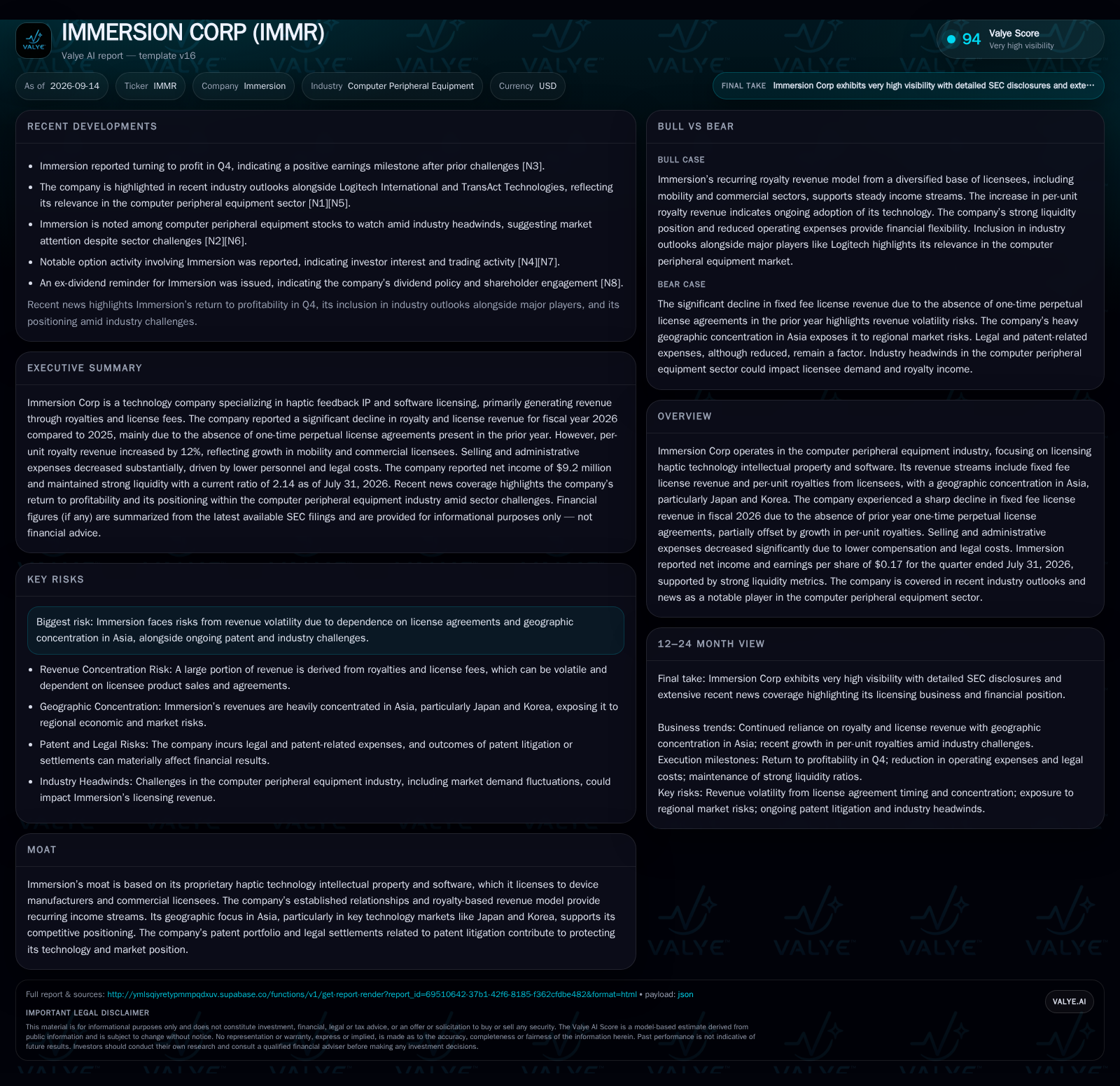
Immersion Corp’s fiscal 2026 saw a dramatic reduction in total license revenue, primarily due to the absence of prior-year one-time perpetual license deals. However, underlying per-unit royalties grew by 12%, suggesting core adoption remains intact. The company’s cost base has reset lower following reduced litigation and compensation expenses, supporting a return to net profitability. With 73% of revenue sourced from Asia and a strong cash balance, Immersion’s future hinges on sustaining and expanding recurring royalty streams amid sector and geographic concentration risks. [S1] [S2]
Immersion Corp’s business model—built on monetizing haptic technology through IP licensing—has entered a new phase following the sharp drop-off in one-time perpetual license revenues. While the company’s 2026 financials show a headline revenue contraction, the underlying trend in per-unit royalty growth and a leaner cost structure point to a more stable, if lower, earnings baseline. Yet, Immersion’s fortunes are now more closely tied to the cadence of consumer device launches and ongoing adoption in its core Asian markets, raising the stakes for both technology relevance and partner alignment.
Perpetual License Cliff Resets Revenue Baseline
The most material recent development for Immersion Corp is the steep decline in total royalty and license revenue to $15.9 million for FY2026, down from $74.1 million the year before—a drop primarily attributed to the absence of $44.1 million in one-time Mobile license revenue and $10.4 million in Gaming revenue from prior-year perpetual license deals. This sharp contraction is not a function of core royalty erosion but rather the lapping of exceptionally large, non-recurring deals. In contrast, per-unit royalty revenue rose 12% to $13.0 million, suggesting underlying demand for Immersion’s haptic IP in mobility and commercial devices remains intact. Expense discipline is also evident: selling and administrative costs fell 53% to $12.2 million, largely due to lower legal and compensation expenses post-litigation. The company returned to profitability, reporting $9.2 million in net income for the July quarter. As of July 31, 2026, Immersion reported $174.8 million in cash and a current ratio of 2.14, indicating notable liquidity. [S1] [S2]
Royalty Model Economics: Recurring Streams, Lumpy Upside
Immersion’s economics are fundamentally tied to its ability to monetize a portfolio of haptic technology patents and software through licensing agreements. The business model blends two major revenue types: fixed-fee (sometimes one-time or multi-year) license deals and ongoing per-unit royalties based on device sales by licensees. The sharp drop in total revenue this year underscores the volatility associated with lumpy, non-recurring fixed-fee agreements—often driven by strategic settlements or large up-front deals. In contrast, per-unit royalties, while smaller in absolute terms, provide the foundation for recurring revenue and greater predictability, especially as they scale with device volumes.
Operating leverage is visible in the cost structure: selling and administrative expenses are a mix of relatively fixed corporate overhead and variable legal costs, which can spike during patent litigation but have now receded. The drop in legal costs has reset the company’s expense base lower, enabling profitability even at a lower revenue run-rate. The capital intensity of the business is low; Immersion’s primary assets are its patents and software, requiring ongoing R&D and legal protection but not heavy physical infrastructure. The company’s reported cash and short-term investments provide flexibility for patent defense, opportunistic investments, or potential shareholder returns. However, future cash flows will depend more directly on the cadence of per-unit royalty receipts and the avoidance of further litigation spikes.
IP Moat, Regional Anchoring, and Competitive Counterforces
Immersion’s competitive edge stems from its proprietary haptic IP portfolio, which is licensed to major device manufacturers—particularly in the high-volume Asian consumer electronics markets. The moat is reinforced by patents and the company’s demonstrated willingness to litigate to protect its rights. However, the reliance on IP licensing also means that revenue is vulnerable to patent expiration, successful challenges, or workarounds by device makers. The company’s revenue concentration in Asia (73%) raises exposure to regional regulatory, competitive, and technology adoption risks.
Competition comes from several quarters: direct competitors with alternative haptic solutions, device manufacturers developing in-house technology, and the risk of software-based substitutes that could reduce the need for hardware-driven haptics. The company’s relevance is periodically validated by its inclusion in industry outlooks alongside Logitech and TransAct Technologies, but it lacks the diversification and scale of these hardware-focused peers. Ultimately, Immersion’s long-term strength depends on sustaining the perceived value of its IP, renewing relationships with major licensees, and expanding its footprint into new device categories or geographies.
Recurring Royalty Growth Outpaces Lumpy Downturn
A bullish outcome for Immersion would see per-unit royalty revenues continuing to grow by double digits, fueled by the proliferation of haptic-enabled devices in both established and emerging product categories (e.g., AR/VR, automotive interfaces, wearables). If the company can secure new licensees or expand the scope of existing agreements—particularly in geographies outside Asia—it could mitigate the volatility from lapsed one-time deals and reduce concentration risk. A further reduction in legal expenses, paired with stable or growing royalty streams, could drive sustained profitability and free cash flow.
Confirmation of this scenario would come from successive quarters of rising per-unit royalty revenue, new licensing announcements (especially with top-tier OEMs or in new sectors), and continued low operating costs. Expansion of geographic revenue mix and updates on patent extensions or new filings would further support the bullish thesis.
Stabilized Royalty Base with Episodic Upside
The most plausible near-term path for Immersion is a stable but lower revenue baseline, anchored by recurring per-unit royalties that grow modestly as licensees release new devices. The company’s cost base, now reset after litigation, should support continued profitability unless new legal challenges emerge. Occasional fixed-fee or settlement-driven license deals may provide episodic upside, but are unlikely to match the scale of the prior-year windfall.
Evidence for this scenario would be per-unit royalty growth in the mid-single digits, steady or slightly rising operating margins, and the absence of major new litigation. Revenue would remain concentrated in Asia, with limited but gradual diversification. Cash balances would be stable or slowly rising, reflecting modest but positive free cash flow.
Royalty Erosion and Regional Risk Amplify Volatility
A negative trajectory could emerge if major licensees in Asia, facing their own market headwinds or shifting technology priorities, reduce device volumes or seek alternatives to Immersion’s IP (via workarounds or expired patents). Intensified competition, regulatory changes, or adverse litigation outcomes could further erode royalty streams and force up legal costs. Revenue volatility would increase, profitability could be lost, and the company might be forced to draw down its cash reserves to cover expenses.
Confirmation would come from declining per-unit royalty revenues, announcements of lost or non-renewed license agreements, spikes in legal expense, or a significant drop in Asian market demand for haptic-enabled devices. A shrinking cash balance and deteriorating current ratio would also signal downside risk materializing.
What Could Redefine Immersion’s IP Monetization Outlook
Quarterly per-unit royalty revenue growth rates; a useful metric would be the year-over-year change in royalty receipts, if disclosed.
The number and identity of new or renewed licensees, especially outside the core Asian markets, would help test geographic diversification.
Updates on major patent expirations, successful defenses, or newly issued patents, as these directly impact the company’s moat and pricing power.
Legal expense trends and any new or ongoing major litigation, as these can rapidly alter the cost structure and earnings visibility.
Device volume trends among top licensees in mobility, gaming, or emerging categories (e.g., AR/VR, automotive), as these drive the royalty base.
Geographic revenue mix shifts; greater contribution from North America or Europe would indicate reduced concentration risk.
Announcements of new fixed-fee license deals or settlements, which could signal episodic upside or future volatility.
Cash flow from operations and changes in cash balances, which would signal the sustainability of the current financial model.
Disclaimer: This is research-only, informational analysis and not investment advice. It may include AI-generated interpretation and general industry context. Always verify important details using primary sources.

Comments