
Verde Resources: Carbon-Negative Road Materials, Commercialization Hurdles, and the Asset-Light Scalability Test
Verde Resources stands at the intersection of sustainable infrastructure and carbon credit monetization, leveraging proprietary biochar-based asphalt and strategic partnerships. The company’s ability to convert technical validation and exclusive licensing into commercial traction will define its future economics, while execution risks and market adoption hurdles remain central variables.
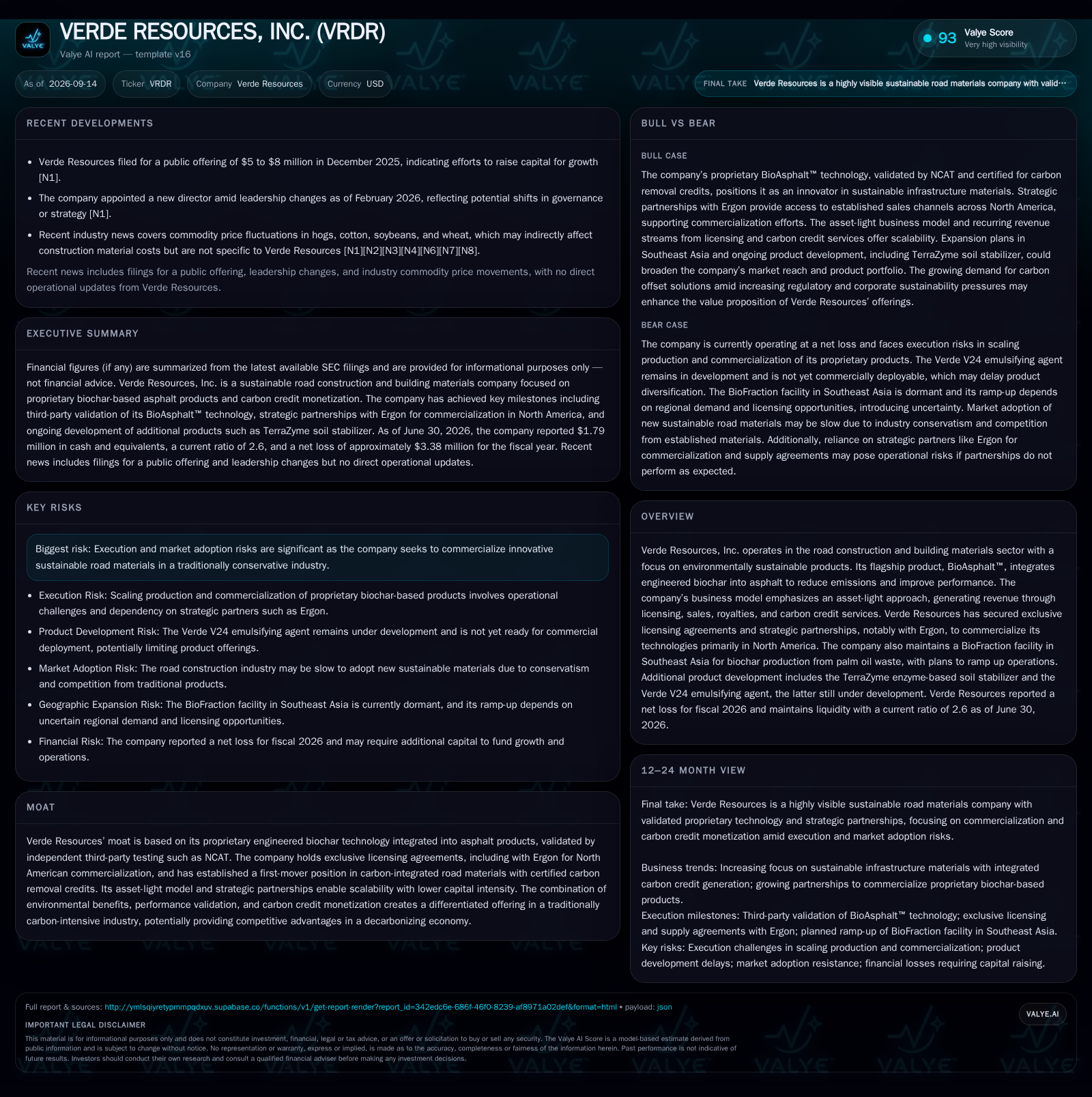
Verde Resources is commercializing BioAsphalt™, a proprietary, biochar-infused road material validated by third parties and certified for carbon removal credits. Exclusive agreements, notably with Ergon, offer a North American commercialization pathway. Asset-light operations and recurring revenue ambitions hinge on scaling adoption, but the company remains loss-making, with $1.79 million in cash and a $3.38 million net loss as of June 2026. Execution, product development, and market adoption risks are acute as the company seeks to move from validation to revenue growth.
Verde Resources, Inc. aims to disrupt the carbon-intensive road construction sector by integrating engineered biochar into its proprietary BioAsphalt™, promising both emissions reduction and performance gains. With third-party validation and the world’s first certified carbon removal credit for asphalt application, the company has secured exclusive commercialization agreements—most notably with Ergon in North America. Yet, with minimal revenue and persistent losses, Verde’s journey from technical innovation to scalable, profitable deployment will hinge on market adoption, operational execution, and the ability to leverage its asset-light model into recurring, high-margin revenue streams.
Recent Milestones and Financial Position Shape Verde’s Next Steps
Verde Resources’ most significant current developments include independent validation of its BioAsphalt™ product by the National Center for Asphalt Technology (NCAT), and the award of the world’s first carbon removal credit for asphalt production by Puro.earth [S1]. These milestones provide technical credibility and open potential new revenue streams through carbon credit monetization. The company secured a strategic partnership with Ergon, resulting in an exclusive licensing agreement and a Master Commercial Cooperation Agreement (MCCA) that positions Verde as the preferred vendor of engineered biochar within Ergon’s North American network [S1]. Financially, Verde reported a net loss of $3.38 million for fiscal 2026 and held $1.79 million in cash as of June 30, 2026, with a current ratio of 2.6, reflecting a stable but limited liquidity profile [S1]. Revenue remains negligible, with only $4,679 reported for the six months ended December 31, 2025 [S1]. These facts underscore a company moving from technical validation to the commercialization phase, but with an unproven ability to scale revenue and achieve profitability.
How Verde’s Asset-Light Model and Carbon Credits Could Drive Margin Expansion—If Adoption Materializes
Verde Resources’ business model is structured to minimize capital intensity by focusing on licensing, royalties, and recurring revenue from carbon credits, rather than owning and operating large-scale manufacturing assets. The company’s revenue streams could, in theory, include: (1) licensing proprietary asphalt formulations to partners; (2) selling engineered biochar for road applications; (3) collecting royalties based on partner sales; and (4) sharing revenue from the commercialization of carbon removal credits generated by projects using its materials [S1]. This structure offers inherent operating leverage—should adoption scale, incremental revenues could accrue with relatively modest increases in fixed costs.
However, the company’s current economics are challenged by minimal revenue and ongoing development costs. The reported net loss and low revenue base indicate that Verde is still in the investment phase, with profitability dependent on accelerating commercial adoption and the successful integration of its products into public and private infrastructure projects. The carbon credit angle is a potential differentiator: if regulatory and corporate demand for carbon-negative infrastructure accelerates, Verde could command premium pricing or secure recurring credit revenue. Conversely, the asset-light approach creates dependency on partner execution and industry adoption curves, potentially limiting price control and delaying revenue ramp if adoption is slower than anticipated.
Defensible Technology, Partner Leverage, and the Challenge of Industry Conservatism
Verde Resources’ competitive positioning is anchored in its proprietary engineered biochar technology, its first-mover status in certified carbon-negative asphalt, and exclusive North American licensing agreements with Ergon [S1]. Third-party validation by NCAT and carbon credit certification add credibility in a sector often skeptical of unproven materials. These factors may allow Verde to differentiate on both environmental and performance metrics.
However, the company faces significant counterforces. The road construction industry is historically conservative, prioritizing cost, reliability, and regulatory compliance, which could slow adoption of novel materials. Competing products include traditional asphalt, cement-based stabilizers, and emerging green alternatives from both start-ups and incumbents. The reliance on partners like Ergon for sales, distribution, and project execution is a double-edged sword—offering scale but limiting direct control over customer relationships and go-to-market velocity. Additionally, as sustainability becomes a mainstream procurement criterion, established players may accelerate their own decarbonization initiatives, potentially eroding Verde’s early lead unless the company can rapidly convert technical differentiation into entrenched market share.
If Carbon-Negative Road Materials Gain Regulatory Tailwind, Verde Could Scale Recurring Revenues Rapidly
In a favorable scenario, tightening emissions regulations and mounting pressure on public agencies to decarbonize infrastructure would drive rapid adoption of carbon-negative road materials. Verde leverages its NCAT validation and exclusive Ergon partnership to secure pilot projects and, ultimately, multi-year supply agreements across North America. The company’s asset-light model enables it to scale with minimal incremental capital, while carbon credit monetization provides a high-margin, recurring revenue stream that compounds as more projects come online.
Evidence confirming this scenario would include: (1) a material ramp in reported revenues, particularly from licensing and royalties; (2) public disclosures of large-scale project wins or renewals with government agencies or major contractors; (3) a visible pipeline of carbon credit issuance and resale; and (4) expanded Ergon channel penetration into U.S., Canadian, and Mexican markets. Falsification would be signaled by persistently low revenue, lack of disclosed project wins, or delays in regulatory acceptance of carbon credits for infrastructure projects.
Gradual Commercialization and Partner-Dependent Growth, Tempered by Industry Adoption Cycles
The most plausible path is one of incremental progress: Verde continues to leverage its Ergon relationship to access project opportunities, but adoption is gated by the slow-moving nature of public infrastructure procurement and the need for additional field validation. Revenue grows modestly, with initial projects serving as case studies to de-risk broader adoption. Carbon credit monetization contributes, but remains a small portion of the overall revenue mix until market acceptance and regulatory frameworks mature.
Confirmation would come from sequential growth in licensing or project-based revenue, periodic announcements of new deployments, and evidence of successful project completion with performance outcomes matching laboratory results. Falsification would involve stagnant revenues, lack of new partnership announcements, or feedback from the field indicating technical or cost barriers to broader adoption.
Execution and Adoption Risks Stall Commercialization, Forcing Additional Dilution or Restructuring
In a negative scenario, Verde’s commercial rollout faces delays due to slow industry adoption, technical integration challenges, or underperformance in real-world conditions. Key product candidates such as Verde V24 remain in development limbo, and the dormant BioFraction facility in Southeast Asia fails to ramp due to weak regional demand or licensing setbacks. With minimal revenue, ongoing net losses, and limited cash, the company is forced to seek additional capital—potentially at dilutive terms or with restrictive covenants—which could constrain strategic flexibility.
Evidence confirming this scenario would include: (1) continued negligible revenue despite technical milestones; (2) disclosure of cost overruns or partner execution failures; (3) delays or cancellations of announced projects; and (4) new equity or debt raises at unfavorable terms. The scenario could be partially falsified if Verde demonstrates a sustained uptick in commercial activity or secures non-dilutive funding tied to project wins.
Thesis Tests: Commercial Traction, Carbon Credit Uptake, and Partner Performance
Quarterly and annual revenue growth, especially attributable to licensing, royalties, or carbon credit sales—if disclosed—will be the clearest signal of commercial traction.
Number and scale of publicly announced project deployments, including pilot or full-scale road paving contracts, in North America and internationally.
Progress on the ramp-up, utilization, and revenue contribution from the BioFraction facility in Sabah, Borneo—currently dormant but planned for 2027.
Updates on the development and commercial readiness of Verde V24 and TerraZyme, which would indicate product portfolio breadth and risk diversification.
Disclosures related to carbon credit issuance volumes, pricing, and resale activity, as confirmation of the carbon monetization strategy.
Partner performance metrics: evidence of Ergon’s sales channel penetration, renewal of agreements, or expansion into additional geographies.
Cash burn rate and changes in liquidity position, especially in the context of ongoing net losses and potential capital needs.
Any regulatory developments or procurement guideline changes that explicitly recognize carbon-negative materials or carbon removal credits in infrastructure projects.
Disclaimer: This is research-only, informational analysis and not investment advice. It may include AI-generated interpretation and general industry context. Always verify important details using primary sources.

Comments