
Value Line, Inc.: Asset-Light Recurring Revenue, Print Headwinds, and the Digital Adaptation Test
Value Line’s asset-light investment research and data publishing model continues to deliver steady profits and dividends, but persistent print revenue declines and intensifying digital competition challenge its long-term growth narrative.
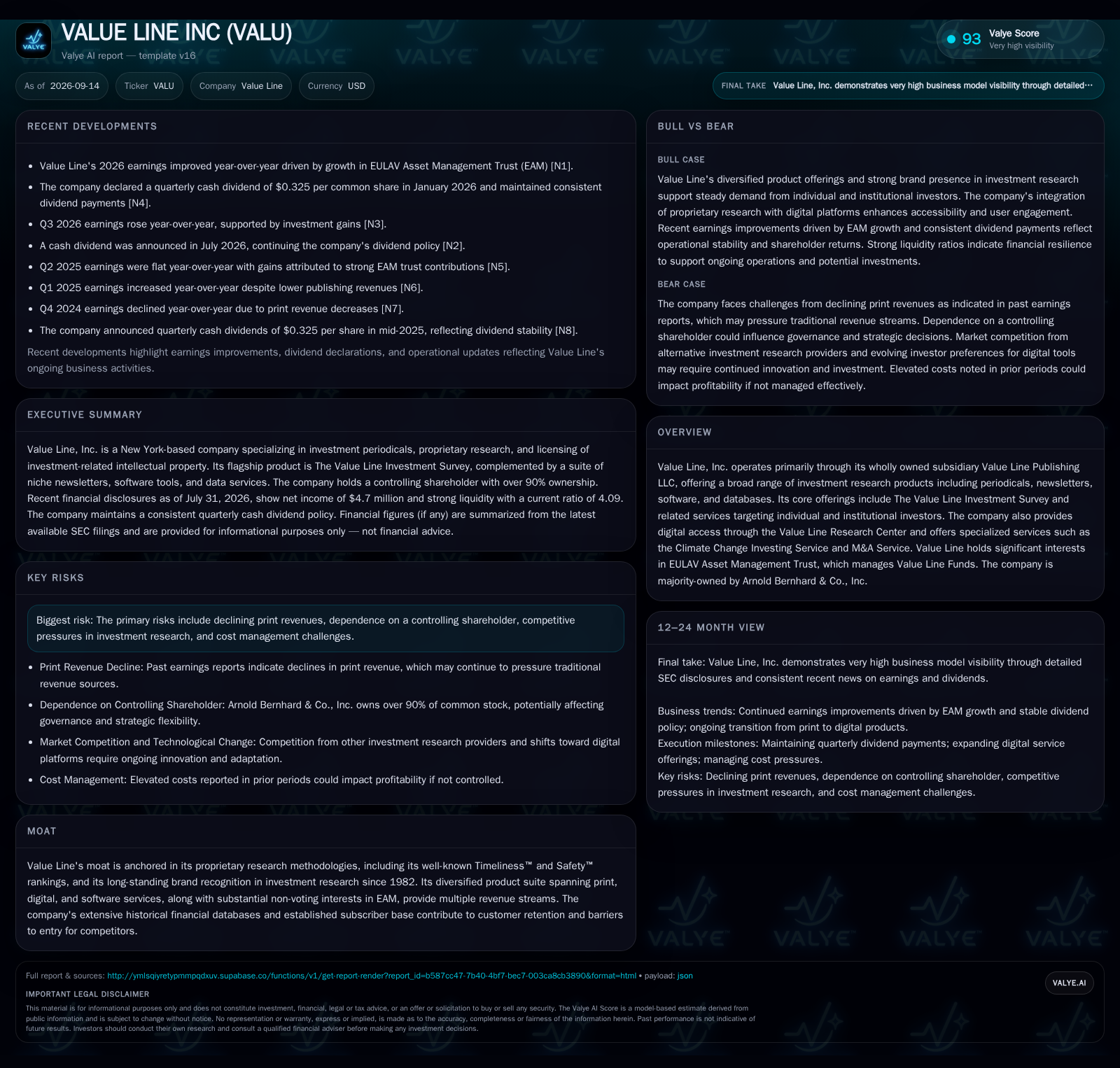
Value Line, Inc. maintains steady profitability and reported liquidity position, driven by its core research publishing business and non-voting interests in EULAV Asset Management Trust. The company’s recurring revenue streams and dividend consistency are offset by ongoing print revenue declines and heightened digital competition. The pivot to digital platforms and cost discipline will be central to maintaining margins and relevance as investor preferences evolve.
Value Line, Inc.—a long-standing brand in investment research—continues to generate stable profits and maintain reported liquidity position, supported by recurring revenue from its flagship Investment Survey and non-voting interests in EULAV Asset Management Trust. However, the company is grappling with structural challenges: persistent declines in print publishing, evolving investor behavior, and intensifying digital competition. The sustainability of its dividend-centric model now hinges on effective digital adaptation and cost management as legacy revenue streams erode.
Earnings Growth Driven by Asset Management, Print Weakness Persists
Value Line’s most recent results highlight a year-over-year improvement in earnings for 2026, attributed primarily to growth in its EULAV Asset Management Trust (EAM) revenue streams [N1]. This asset management exposure provides a buffer against the secular decline in print publishing, which has continued to weigh on results; for instance, Q4 2024 saw a drop in earnings linked to print revenue deterioration [N7]. As of July 31, 2026, the company reported $16.0 million in cash, $90.5 million in current assets, and a current ratio of 4.09, indicating reported liquidity position [S2]. Value Line’s quarterly dividend—recently maintained at $0.325 per share—remains a cornerstone of its shareholder value proposition [N2] [N4]. These facts frame a company in transition, balancing reliable legacy income with the pressures of a shifting industry landscape.
Recurring Revenue and High Margins: The Mechanics Behind Value Line’s Model
Value Line’s business is fundamentally asset-light, relying on the creation and distribution of proprietary investment research, data, and rankings. Core economics are defined by subscription-based periodicals and digital services, which—if retention is high—can yield stable, predictable cash flows and strong gross margins. The cost structure is weighted toward research staff, editorial, and IT, with fixed costs amortized over a large subscriber base. Variable costs (notably print and distribution) are gradually shrinking as digital adoption rises, which should, over time, improve operating leverage if digital pricing holds.
The company’s non-voting revenue and profit interests in EAM provide a separate, less labor-intensive income stream linked to asset management fees. This diversifies cash flows and insulates Value Line from pure publishing cyclicality, but also exposes it to capital market and fund performance risk.
Capital needs are modest; with minimal physical infrastructure and no manufacturing, working capital requirements are low, and cash can be used for dividends, product development, or selective digital investments. However, continued print declines put pressure on top-line growth, and the ability to price digital products at a premium will determine whether operating leverage is positive or negative in the medium term.
Brand, Data Depth, and Proprietary Rankings—But Digital Substitution Looms
Value Line’s enduring strengths are its brand recognition, proprietary research methodologies (such as its Timeliness™ and Safety™ rankings), and comprehensive historical databases. These factors support customer retention and create moderate switching frictions, especially for professional and institutional users who value data continuity and analytical consistency.
However, the competitive landscape has shifted. The proliferation of free and low-cost digital research platforms, the rise of algorithmic tools, and greater availability of financial data challenge Value Line’s value proposition. Major competitors include alternative research publishers, financial data aggregators, and digital-native investment platforms. For retail investors, the cost-benefit of a Value Line subscription is increasingly compared to free online resources and robo-advisory tools. For institutions, the depth and timeliness of Value Line’s proprietary models must continually justify their premium.
The company’s legacy print business is particularly vulnerable to digital substitution, and while its software and online research center expand digital reach, the effectiveness of customer migration and retention strategies will determine whether Value Line can defend or grow its market share in the long run.
Digital Subscription Growth Offsets Print Erosion and Unlocks Margin Expansion
A favorable scenario sees Value Line successfully accelerating the migration of existing subscribers to digital platforms while attracting new, digitally native customers—both institutional and individual. If subscription pricing holds and digital service penetration increases, the company could achieve higher margins as print and distribution costs decline. Expansion of specialized digital products (such as climate change and M&A thematic services) could also broaden the addressable market and reduce reliance on legacy products.
Further, if EAM continues to grow assets under management, Value Line’s non-voting profit interests could provide a scalable, fee-based revenue tailwind—particularly in rising equity markets.
Evidence that would confirm this scenario includes a rising proportion of digital revenues, stable or growing subscriber counts, expanded digital product launches, and improving operating margins. Conversely, stagnation in digital uptake or digital pricing pressure would falsify this upside path.
Steady Profits Amid Print Attrition and Digital Transition
The most plausible trajectory is one of slow but steady profit generation, with digital growth largely offsetting the attrition in print subscriptions. Earnings remain resilient, helped by recurring digital and asset management revenues, but top-line growth is constrained by the shrinking print base and competitive headwinds. Dividend payments continue, supported by reported liquidity position and low capital needs.
This scenario would be confirmed by stable net income, maintenance of the current dividend, a gradual shift in revenue mix toward digital, and cost control sufficient to preserve margins. If digital revenue growth stalls or costs associated with digital transformation rise sharply, margin compression and dividend strain would challenge this baseline.
Accelerated Print Decline Outpaces Digital Gains, Squeezing Profitability
In an adverse scenario, the decline in print publishing accelerates, and digital subscriber growth fails to compensate—either due to price competition, commoditization of financial data, or inadequate product differentiation. If institutional renewals weaken and retail churn rises, recurring revenue could slip, while fixed costs associated with research and IT limit the company’s ability to adjust expenses quickly.
Should EAM profits stagnate or decline—perhaps due to market downturns or fund outflows—Value Line’s secondary income stream would also falter. In this environment, dividend coverage could become questionable, and persistent earnings declines could erode the company’s cash cushion.
Confirmation of this scenario would come from sequential declines in total subscribers, shrinking digital ARPU (average revenue per user, if disclosed), and falling EAM fee income. Any dividend cut or sustained negative operating leverage would further validate the downside.
What Will Determine Value Line’s Digital and Dividend Durability?
Quarterly trends in the mix of digital versus print revenue, if disclosed, would help assess the pace of digital adoption and print attrition.
Subscriber retention and churn rates for both retail and institutional segments—if disclosed—would clarify the stickiness of Value Line’s offerings.
Average revenue per user (ARPU) for digital products, if available, would indicate pricing power and customer willingness to pay for premium research.
Operating margin trends, especially as digital adoption rises and print costs fall, will be key to understanding the economics of the transition.
Growth rates and profit contributions from EULAV Asset Management Trust should be monitored as a diversification hedge and earnings driver.
Any changes to the dividend policy or payout ratio, particularly if earnings growth falters, would signal shifts in financial resilience.
Competitive product launches or pricing changes from major digital research providers could pressure Value Line’s market share and margins.
Updates on cost management initiatives, including IT and research staff investment, would provide color on the company’s ability to sustain profitability.
Disclaimer: This is research-only, informational analysis and not investment advice. It may include AI-generated interpretation and general industry context. Always verify important details using primary sources.

Comments