
George Risk Industries: Custom Security Hardware in a Concentrated, Competitive Channel
Rising sales and sustained operational profitability mask underlying risks from customer concentration, margin pressure, and market-sensitive investment income, as George Risk Industries leans on product customization and a strong balance sheet to navigate a maturing security hardware landscape.
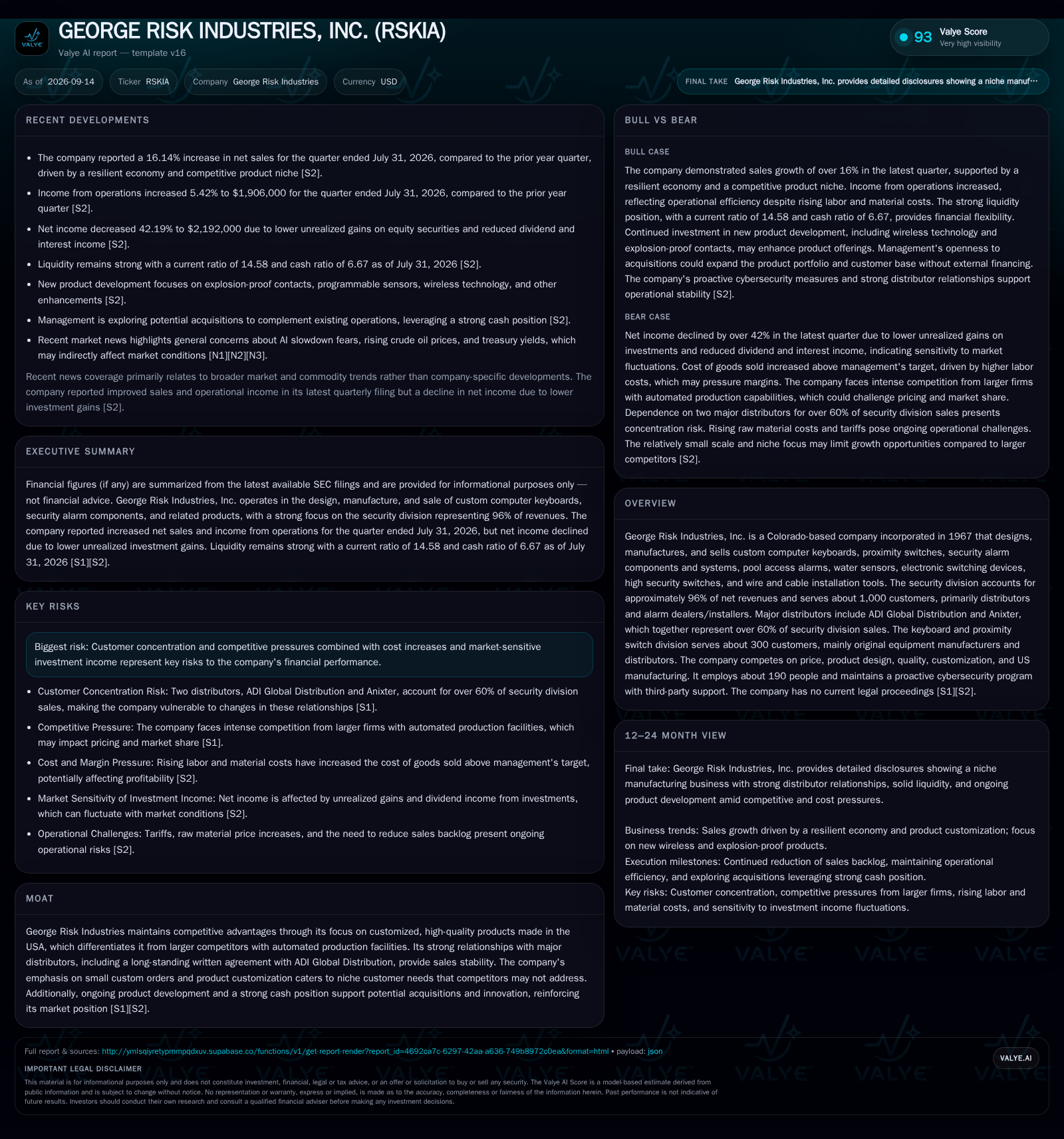
George Risk Industries (GRI) reported 16% sales growth and higher operating income in the latest quarter, driven by its niche in security hardware for distributors and installers. However, net income dropped sharply, mainly due to lower investment gains, and margins faced pressure from rising labor costs. The company’s top two distributors account for over 60% of sales, presenting concentration risk, even as GRI invests in new products and eyes potential acquisitions with ample cash reserves. The strategic question is whether GRI’s customization focus and US manufacturing can offset mounting cost and channel risks as the security hardware market evolves. [S2]
George Risk Industries, a longstanding US manufacturer of custom security hardware and related electronics, continues to deliver top-line growth amid a shifting competitive landscape. While recent quarters show resilience in sales and operating income, the company’s heavy reliance on just two distributors, rising labor costs, and exposure to volatile investment income create a layered risk profile. As GRI invests in new product development and explores acquisition opportunities, its core challenge remains: can a customization-focused, US-based operation defend profitability and sustain growth in a market increasingly defined by price competition, automation, and channel consolidation?
Recent Performance: Growth, Margin Pressure, and Channel Concentration
For the quarter ended July 31, 2026, George Risk Industries reported a 16.14% increase in net sales, outpacing prior periods and suggesting continued demand for its security hardware niche. Operating income also grew by 5.42%, indicating that core business profitability improved despite rising costs. However, net income fell by 42.19%—a drop not from core operations, but from a sharp decline in unrealized gains on marketable securities and reduced investment income. This reveals a material sensitivity to non-operating income streams. Meanwhile, the company’s revenue base remains highly concentrated: two distributors, ADI Global and Anixter, accounted for over 60% of sales, underscoring a significant counterparty risk if either relationship were to weaken. [S2]
How GRI’s Custom Hardware Model Shapes Margin and Cash Flow Dynamics
George Risk Industries generates nearly all its revenue from the security hardware division, supplying thousands of small orders to about 1,000 customers—but with the vast majority of volume funneled through just two large distributors. The business model relies on customization, short-run US manufacturing, and a reputation for quality, which can support premium pricing in segments less attractive to highly automated, low-cost mass producers. However, this also means higher labor and production costs: in the most recent quarter, cost of goods sold rose to 52.89% of sales, exceeding management’s 50% target, primarily due to labor pressures. While operating expenses as a percentage of sales shrank slightly (to 19.28%), continued wage inflation and input cost volatility could erode GRI’s operating leverage unless offset by pricing power or further automation.
The company’s capital needs are modest, with just $6,000 spent on property and equipment in the latest quarter—down sharply from the prior year—suggesting a mature asset base and limited organic expansion. Cash flow is further bolstered by investment income, but this source is inherently volatile, as shown by the dramatic year-over-year decline in unrealized gains. GRI’s strong cash position allows for opportunistic acquisitions or new product launches without external financing, but it also means that a meaningful portion of reported net income can swing with market cycles, not operational performance. [S2]
Customization as a Differentiator in a Market of Scale and Automation
GRI’s core competitive advantage lies in its ability to deliver customized, small-batch security devices and components—an area often underserved by larger, automated manufacturers focused on scale and standardization. US-based production and a history of customer-specific R&D (with costs often passed to customers) reinforce its niche positioning. However, this differentiation comes with limits: intense price competition, especially from global players and low-cost imports, can compress margins and erode pricing power over time.
Customer concentration further weakens bargaining power. If either ADI Global or Anixter shifts procurement to a competitor—potentially attracted by lower prices or integrated offerings—GRI could face abrupt sales declines and reduced negotiating leverage. While the company’s customization capability and strong distributor relationships create switching frictions, these are not insurmountable if competitors close the customization gap or if distributors consolidate suppliers for efficiency. The lack of recurring, contractual revenue also means future visibility is limited and subject to economic cycles and distributor strategy shifts. [S1] [S2]
What Would It Take for GRI’s Customization Niche to Deliver Durable Growth?
A favorable scenario would see GRI leveraging its new product pipeline—explosion-proof contacts, wireless-enabled devices, and programmable sensors—to deepen its niche and capture incremental share from specialized security installers and OEMs. If these innovations meet emerging regulatory or customer needs (for example, more stringent building codes or integration with smart home systems), GRI could command higher margins and insulate itself from pure price competition.
Confirmation of this scenario would require evidence of sustained top-line growth above market rates, margin improvement even as labor costs rise, and successful expansion of the customer base beyond the two dominant distributors. Early uptake of new products, new distributor relationships, or evidence of reduced customer concentration (i.e., no single distributor accounting for more than 30% of sales) would further support the thesis. The company’s ability to deploy its cash for accretive acquisitions—adding either new product lines or additional distribution channels—could also amplify upside.
Sustaining the Core: Incremental Growth Amid Persistent Margin and Channel Risks
The most plausible path is that GRI continues to deliver modest sales growth, primarily through existing distributors, with periodic margin volatility driven by labor costs and input prices. The company’s customization niche and US manufacturing base allow it to defend a portion of its customer base from low-cost entrants, but not to expand meaningfully beyond its established footprint. Investment income remains a swing factor, causing periodic noise in net income but not fundamentally altering operational cash flow.
This scenario would be confirmed by stable or slightly rising sales, continued reliance on ADI Global and Anixter for the bulk of revenue, and gross margins that fluctuate within a narrow range as cost pressures ebb and flow. Lack of significant customer diversification or major new product adoption, coupled with steady (but not transformative) acquisition activity, would further support the base case.
Channel Disruption or Margin Compression: How GRI’s Model Could Unravel
Adverse outcomes could materialize if either of the top two distributors reduces purchases—due to a change in procurement strategy, loss of a major end-customer, or distributor consolidation—leading to a sudden drop in sales. Alternatively, if larger competitors successfully automate customization or undercut GRI’s pricing, the company may face both volume and margin erosion. Rising labor and input costs, if not offset by pricing or efficiency gains, could push cost of goods sold further above management’s 50% target, compressing profits even if sales are stable.
Evidence of this scenario would include a significant loss of sales from either ADI Global or Anixter (e.g., a 10%+ sequential drop), gross margins persistently below historical averages, or disclosures of price concessions required to maintain distributor relationships. Failure to launch new products or unsuccessful acquisition attempts—especially if cash reserves begin to shrink without operational improvement—would further validate the downside risk.
Milestones and Metrics That Will Define GRI’s Competitive Resilience
Proportion of sales accounted for by ADI Global and Anixter in future quarters—a reduction would indicate customer diversification, while increases would heighten concentration risk, if disclosed.
Gross margin trends, especially the ability to maintain or improve margins in the face of rising labor and input costs.
Adoption rate and revenue contribution from new products such as explosion-proof contacts, wireless-enabled devices, and programmable sensors—a useful metric would be disclosed sales or customer wins attributable to these launches.
Evidence of new distributor or OEM relationships that could broaden the customer base and reduce reliance on the top two channels.
Capital allocation decisions, including size and scope of any acquisitions made, and their subsequent impact on sales and margins.
Volatility and composition of investment income as a proportion of net income—sustained swings could obscure core business performance.
Changes in operating expense ratios, particularly sales commissions and R&D spend, as indicators of both growth and operating leverage.
Inventory and accounts receivable trends that might signal either demand weakness (inventory build) or channel strain (rising receivables), if disclosed.
Disclaimer: This is research-only, informational analysis and not investment advice. It may include AI-generated interpretation and general industry context. Always verify important details using primary sources.

Comments