
Starlink AI Acquisition Corp: SPAC Economics, Acquisition Imperative, and the Uncertainty Premium
Starlink AI Acquisition Corp (OTAI) stands as a well-capitalized special purpose acquisition company with recent profits but minimal operational disclosure. The value proposition—and risk profile—hinge entirely on its ability to source and consummate a value-creating business combination. This analysis examines the financial posture, economics of the SPAC model, competitive landscape, and scenario logic as the company approaches its critical acquisition milestone.
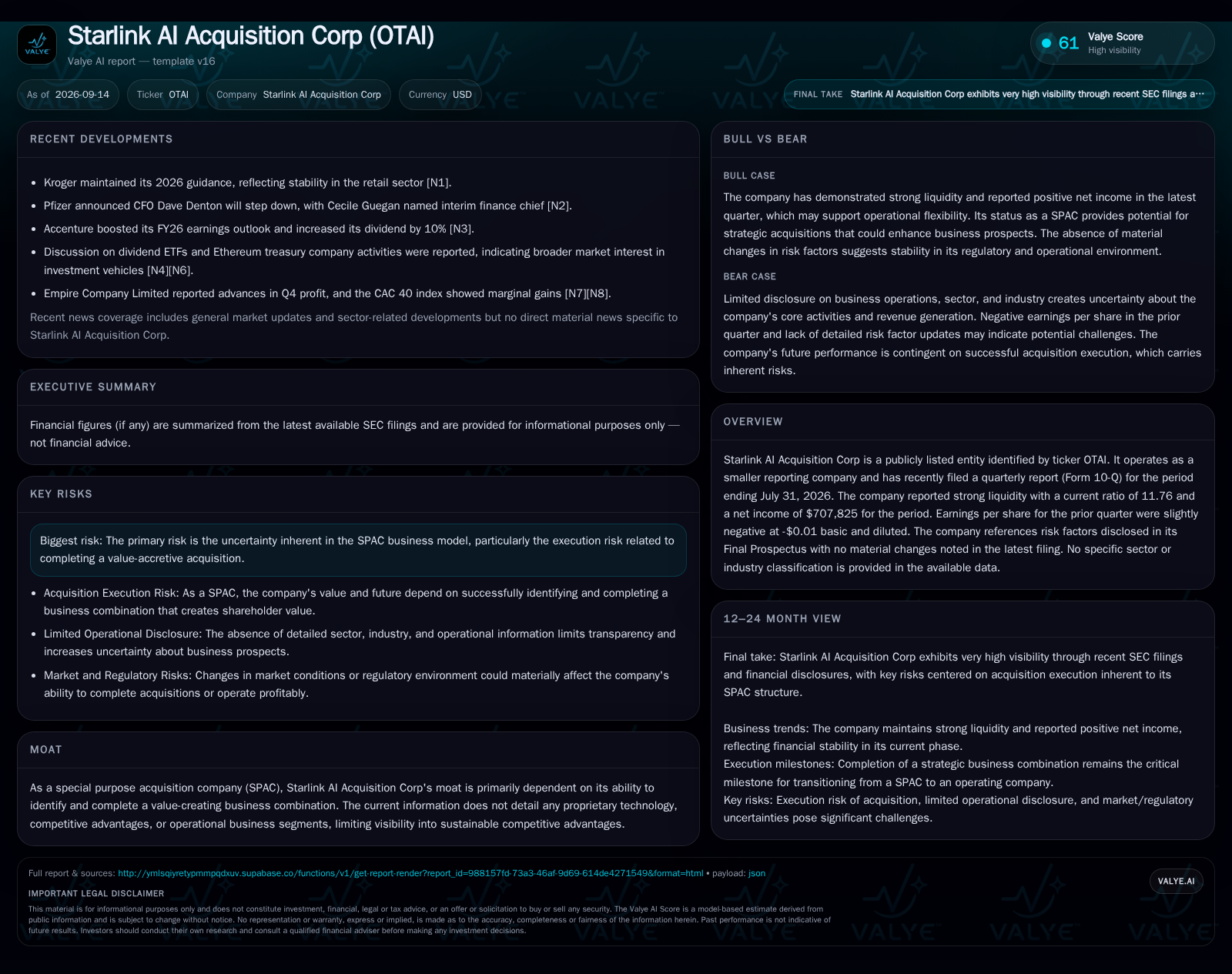
Starlink AI Acquisition Corp (OTAI) reported liquidity position and a net income of $707,825 as of July 31, 2026, but provides no operational detail beyond its SPAC status. Its future depends on identifying and closing a meaningful acquisition. The company’s current high current ratio and profitability; these figures do not by themselves establish operating, investment, or financing capacity, but the absence of sector or target information leaves investors exposed to execution and transparency risks. The thesis centers on whether OTAI can convert its capital and public listing into a durable operating business through a successful deal. [S1]
Starlink AI Acquisition Corp (OTAI) is a publicly listed special purpose acquisition company (SPAC) that, as of its latest 10-Q, reports reported liquidity position and recent net income. However, the company provides no insight into business operations, sector focus, or acquisition targets, making its future trajectory opaque. The central thesis is whether OTAI can transform its financial base and public vehicle into a value-creating operating business through a successful acquisition. This analysis explores the economics of the SPAC model, the strategic imperatives facing OTAI, and the scenarios that could define its shareholder outcomes.
Liquidity and Profitability Define Current Financial Position
As of July 31, 2026, Starlink AI Acquisition Corp reported current assets of $632,036 against current liabilities of $53,731, yielding a current ratio of 11.76—well above typical operating company benchmarks and indicating abundant short-term liquidity relative to obligations [S1]. The company posted net income of $707,825 for the period, though basic and diluted earnings per share were negative in the prior quarter at -$0.01, a pattern characteristic of many SPACs whose income often reflects interest on trust assets rather than operating profits [S1]. No material changes to risk factors or business strategy were disclosed, and there is no information regarding sector, industry, or acquisition targets in the latest filings [S1]. These facts matter because they frame OTAI as a cash-rich, non-operating entity whose future value is entirely dependent on a yet-to-be-announced business combination.
SPAC Model: How Value Could Be Created or Lost
The economics of a SPAC like OTAI are fundamentally distinct from those of operating businesses. SPACs raise capital through an initial public offering, typically placing most proceeds in a trust while incurring minimal operating costs until a target is identified. The reported net income is likely driven by interest income or changes in fair value of trust assets, rather than from any underlying commercial activity. The capital structure is simple: limited assets and liabilities, with value accruing not from operations but from the optionality of executing a merger.
If OTAI succeeds in acquiring a promising private company, it can unlock value by providing liquidity, public market access, and capital to the target. However, the economics are binary: failure to complete a deal within the required timeframe (often 18-24 months from IPO) typically leads to liquidation and return of capital to shareholders, minus expenses. This model imposes minimal fixed costs and limited capital needs pre-acquisition, but the economics post-merger will be dictated entirely by the acquired company's business model, market position, and integration success.
Operating leverage is not relevant until a transaction closes; until then, the main economic variable is the preservation of trust capital and the ability to source a credible deal. The dilution from founder shares and warrants can become material upon consummation of a merger, potentially impacting post-deal returns for public shareholders.
SPAC Competition and the Challenge of Sourcing Attractive Deals
OTAI operates in a highly competitive SPAC market, where hundreds of blank-check companies vie for a finite pool of attractive private targets. The competitive set includes other SPACs, private equity firms, and direct listings—all of which may offer different value propositions to potential targets. In recent years, SPAC sponsors have faced increased scrutiny over deal quality, target readiness, and post-merger performance.
Without disclosed sector focus, proprietary sourcing advantages, or sponsor credentials, OTAI’s differentiation is unclear. SPACs with high-profile sponsors, sector expertise, or unique networks may have an edge in sourcing and closing deals. Conversely, undifferentiated SPACs risk being left with less desirable targets or failing to consummate a deal altogether. The absence of operational detail or sponsor reputation in OTAI's disclosures suggests that its ability to compete for high-quality targets remains an open question.
Transformational Deal Could Unlock Public Market Value
The most favorable outcome for OTAI is the identification and successful acquisition of a high-growth, scalable private company that benefits from public market access. In this scenario, OTAI leverages its capital and listing to bring a differentiated, potentially technology-enabled business to market, catalyzing a re-rating of its shares.
Confirmation of this scenario would come from a public announcement of a definitive merger agreement with a credible target—preferably one with strong growth prospects, an established customer base, and clear path to profitability. Additional positive signals would include sponsor or management teams with deep sector expertise, favorable deal terms, and market enthusiasm as reflected in share price appreciation or PIPE (private investment in public equity) participation.
Falsification would be evident if OTAI fails to announce a deal within the statutory window, or if the merger is with a low-quality or speculative business lacking clear fundamentals.
Most Likely: Prolonged Search and Standard SPAC Uncertainty
The most plausible outcome, given the absence of disclosed deal activity or sector focus, is that OTAI continues its search for a suitable acquisition over the coming quarters. This period is likely to be marked by limited news flow, minimal operating expenses, and returns for shareholders that closely track trust asset interest income.
If OTAI announces a deal, the quality of the target and the market’s reaction will determine whether value is created or destroyed for public shareholders. Until then, the share price may hover near trust value, reflecting the market’s uncertainty premium on SPACs without announced transactions. Confirmation of this scenario would include continued financial reporting with minimal changes to assets, liabilities, or risk disclosures, and no material news regarding a merger.
Falsification would occur if the company unexpectedly announces a high-quality transaction or, conversely, if it signals an inability to identify a suitable target and moves toward liquidation.
Deal Failure or Low-Quality Acquisition Erodes Shareholder Value
The primary risk for OTAI shareholders is that the company fails to identify a suitable acquisition target before the statutory deadline, resulting in liquidation and return of capital (minus expenses), or that it consummates a business combination with a subpar or speculative target. In both cases, return on investment is likely to be limited or negative once sponsor dilution and transaction costs are factored in.
Downside confirmation would include delays in deal announcement, negative market reaction to a disclosed target, or regulatory scrutiny of the transaction. A meaningful write-down of trust assets, material increase in expenses, or redemptions by public shareholders at the time of deal vote would also signal adverse outcomes.
Alternatively, if the post-merger operating business underperforms or fails to meet its projections, the share price could decline significantly, compounding losses for those who remain invested after the merger.
Milestones and Data Points That Will Define OTAI’s Value-Creation Path
Announcement of a definitive merger agreement, including target identity, sector, and rationale for the transaction.
Disclosure of sponsor or management credentials, which would help assess sourcing advantage and post-deal leadership quality.
Any shift in trust asset value or material changes in current assets/liabilities; a useful metric would be quarterly updates to trust account balance, if disclosed.
Redemption rates at the time of deal vote, which would indicate shareholder confidence in the proposed acquisition.
PIPE (private investment in public equity) participation or other third-party validation of deal quality, if and when a transaction is announced.
Changes to risk factor disclosures or regulatory filings that could signal evolving business or deal risk.
Post-merger financial projections and operating milestones of the acquired business, should a transaction close.
Disclaimer: This is research-only, informational analysis and not investment advice. It may include AI-generated interpretation and general industry context. Always verify important details using primary sources.

Comments