
Hong Yuan Holding Group: Supply Chain Ambition Meets Liquidity Constraints in China’s Premium Consumer Market
Hong Yuan Holding Group’s pivot to a loan-based store funding model and supply chain integration targets China’s structurally growing premium goods sector, but severe near-term liquidity pressure and execution risk threaten its path to sustainable profitability.
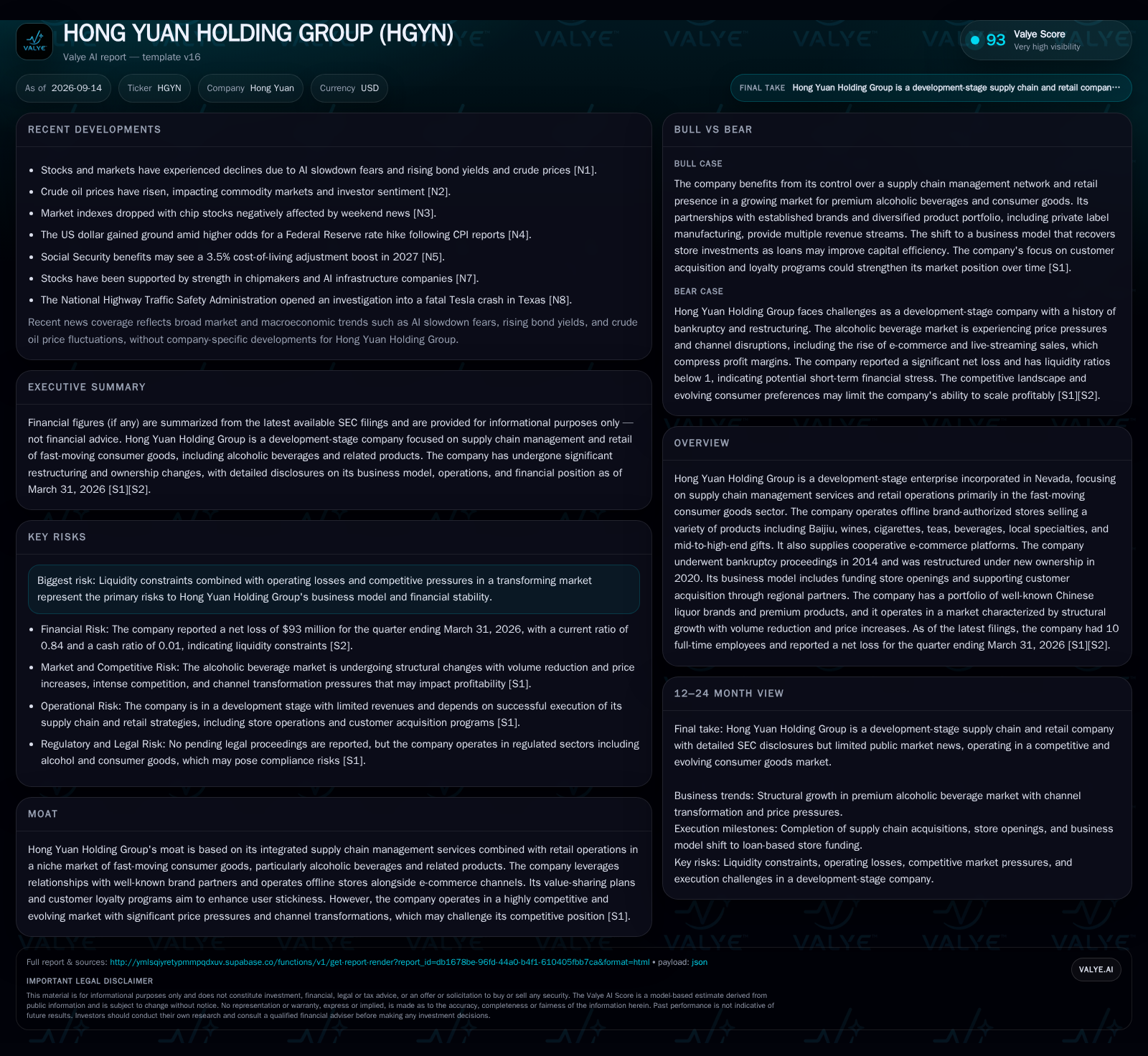
Hong Yuan Holding Group operates a supply chain management and retail platform focused on premium Chinese consumer goods, including liquor, wine, tea, and mid-to-high-end gifts. Following a 2024 acquisition and a business model shift in 2025, the company now funds store openings as loans rather than equity, aiming for capital efficiency and scale. Despite access to major brands and a multichannel approach, Hong Yuan faces significant liquidity constraints—with a current ratio below 1 and a large quarterly net loss—making execution, customer acquisition, and capital recycling the critical variables for its future viability. [S1] [S2]
Hong Yuan Holding Group sits at the intersection of China’s evolving premium consumer goods market and the operational realities of scaling a modern supply chain platform. After emerging from bankruptcy and restructuring under new ownership, Hong Yuan has staked its future on a capital-light, loan-based retail expansion model—funding store launches while targeting rapid capital recovery from store profits. The company’s access to top Chinese and global brands positions it well for premiumization trends, but its financials reveal acute liquidity stress and a steep operating loss. The challenge: can Hong Yuan translate its supply chain access and new model into enough profitable throughput before liquidity and execution risks overwhelm its ambitions? [S1] [S2]
Liquidity Crunch and Model Shift Define the Near-Term Picture
The two most material facts for Hong Yuan Holding Group are its acute liquidity constraints and its recent shift in business model. As of March 31, 2026, the company reported a current ratio of 0.84 and a cash ratio of just 0.01—signaling that liquid assets are far short of covering short-term obligations. Simultaneously, it posted a quarterly net loss of $93.3 million, reflecting the heavy upfront costs and slow revenue ramp typical of development-stage enterprises. [S2]
In June 2025, Hong Yuan pivoted from holding equity in its stores to a loan-based approach: it now funds the opening of stores, then seeks to recover these investments as loans repaid from store profits. This model is intended to accelerate store rollout without tying up capital indefinitely, but the effectiveness of this capital recycling is not yet proven. [S1]
The combination of a capital-intensive expansion model, negative cash flow, and limited liquidity creates immediate pressure to demonstrate that the new structure can generate enough returns fast enough to sustain operations and growth.
How Hong Yuan’s Capital-Light Retail Model Could Work—or Falter
Hong Yuan’s economics hinge on its ability to fund new store openings, support store operations, and recover its investments via loan repayments from store-level profits. Rather than owning stores, the company acts as a capital provider and supply chain orchestrator. This theoretically reduces direct operational risk and enables faster scaling, as capital is recycled rather than trapped in equity stakes.
Revenue is driven by wholesale and internet sales of premium fast-moving consumer goods—Baijiu, wines, premium teas, cigarettes, beverages, and gifts—leveraging partnerships with top brands. The company’s access to first- and second-tier brands, and its ability to integrate upstream procurement, may provide better gross margins if it can maintain pricing power and control costs.
Variable costs are significant, as the company must support store launches, marketing, and regional partner incentives. Fixed costs are modest (10 full-time employees), but the business is still in a ramp-up phase, so operating leverage is unproven. The capital-light model only works if stores reach profitability quickly and reliably repay loans; slow paybacks or high default rates would result in negative cash conversion and growing funding needs.
The low current and cash ratios suggest the company is highly dependent on rapid capital recycling, external financing, or both to avoid a liquidity event. Without evidence of positive store-level economics or robust repayment cycles, the sustainability of the model remains speculative. [S2]
Brand Access vs. Channel Disruption: Competitive Forces at Play
Hong Yuan’s competitive position draws on its partnerships with leading Chinese and international brands and its ability to source both premium and everyday goods. This breadth potentially allows the company to serve both high-end and mass-market consumers, and to negotiate favorable procurement terms, enhancing margin potential.
However, the market for alcoholic beverages and premium consumer goods in China is undergoing structural change. Channel disruption is pronounced: e-commerce, live-streaming, and direct-to-consumer models are reshaping how brands reach customers, compressing profit margins for traditional supply chain intermediaries.
Competitors include large e-commerce platforms, established offline chains, and emerging digital-first retailers. While Hong Yuan’s offline store approach may provide experiential advantages, it must contend with higher fixed costs and the risk that consumer traffic continues to migrate online.
The company’s value-sharing and loyalty programs are designed to create stickiness, but the effectiveness of these mechanisms in the face of intense promotional activity from larger platforms remains to be demonstrated.
If Capital Recycling and Brand Leverage Drive Profitable Growth
In a favorable scenario, Hong Yuan successfully demonstrates high store-level profitability and rapid loan repayment cycles. This would validate its capital-light expansion model: funds deployed for new stores are quickly recycled, supporting further growth without the need for substantial new equity or debt financing.
Brand access enables the company to capture premium pricing, while direct procurement and supply chain integration reduce costs. If customer loyalty programs and regional partner incentives result in strong member acquisition and retention, Hong Yuan could carve out a defensible niche even as broader market channels shift.
Confirmation of this scenario would come from disclosed metrics such as store-level payback periods, loan repayment rates, positive operating cash flow, and evidence of sustained gross margin improvement. A falsification would be persistently slow loan recovery, rising defaults, or continued operating losses despite store expansion.
A Mixed Outcome: Growth Strains Liquidity, Execution Remains the Bottleneck
The most plausible path for Hong Yuan is one of measured growth constrained by ongoing liquidity and execution risk. The company may succeed in opening new stores and expanding its supply chain footprint but struggle to achieve consistent and timely loan repayments. As a result, while revenue grows, cash flow remains negative and external funding is periodically required to bridge working capital gaps.
Competitive pressure from e-commerce and channel innovation compresses gross margins, requiring continuous cost discipline and product mix optimization. Store-level performance is uneven, with some locations generating strong profits and others lagging expectations.
Evidence supporting this scenario would include gradual improvement in liquidity ratios, moderate reduction in net losses, and periodic new financings. Falsification would occur if either a major financing fails to materialize or if store-level losses accelerate, pushing the company toward another restructuring.
Liquidity Squeeze Triggers Forced Retrenchment or Restructuring
In the adverse scenario, Hong Yuan’s liquidity position deteriorates further as store-level repayments fall short of projections. The company is unable to recycle capital at the pace needed to fund ongoing operations, leading to missed payments, delayed store launches, and potential defaults on obligations.
Competitive pressures intensify, with e-commerce platforms and direct brands capturing share at the expense of traditional intermediaries. Margins erode as Hong Yuan is forced to cut prices or offer higher incentives to attract partners and consumers.
Confirmation of this scenario would be a decline in the number of operating stores, negative working capital trends, or the announcement of new restructuring efforts. Falsification would require disclosure of a material improvement in cash flow or the securing of substantial new financing on favorable terms.
Milestones That Will Determine Whether Hong Yuan’s Model Is Viable
Store-level payback periods: If disclosed, the average time required for loan recovery from new stores would directly test the capital recycling thesis.
Loan repayment/default rates: A useful metric would be the percentage of store funding repaid on schedule versus in arrears or written off.
Gross margin trends: Monitoring gross margin over time would help assess whether procurement scale and brand access are translating into sustainable profitability.
Operating cash flow: Movement toward positive operating cash flow would signal that the business model is beginning to work at scale.
Store count and geographic expansion: Growth in the number of active stores, particularly in targeted regions, would indicate execution progress.
Customer/member acquisition and retention: If disclosed, these rates would help test the effectiveness of loyalty programs and value-sharing incentives.
External financing events: The timing, terms, and size of any new debt or equity raises will be crucial for ongoing operations.
Competitive channel shifts: Watching for further evidence of consumer migration to digital or direct channels will inform the durability of the offline retail strategy.
Disclaimer: This is research-only, informational analysis and not investment advice. It may include AI-generated interpretation and general industry context. Always verify important details using primary sources.

Comments