
Nymox Pharmaceutical: Clinical-Stage Ambition Collides with Liquidity Pressure and Development Hurdles
Nymox Pharmaceutical Corp’s prospects hinge on the clinical and regulatory success of NX-1207 for BPH and prostate cancer, but persistent operating losses, minimal liquidity, and lack of revenue create a precarious foundation. The company’s ability to secure financing and demonstrate clinical progress will determine whether it can transition from R&D to commercial viability.
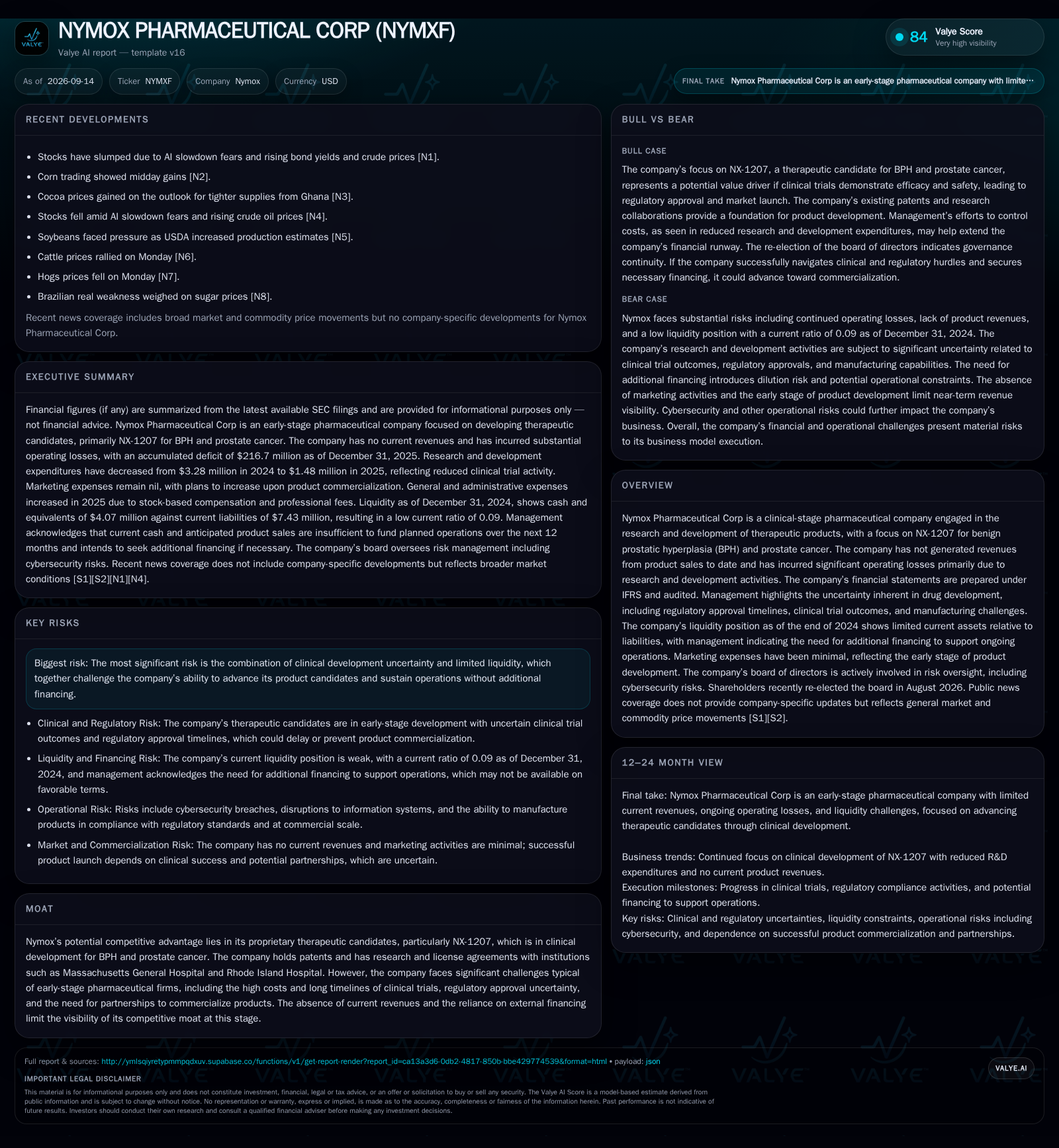
Nymox Pharmaceutical Corp remains a clinical-stage biotech focused on NX-1207 for BPH and prostate cancer, with no product revenue and a significant accumulated deficit. Liquidity is critically strained, with a current ratio of 0.09 as of December 2024 and management openly acknowledging the need for further financing to sustain operations. The company’s future is highly dependent on successful clinical outcomes, regulatory approval, and its ability to obtain capital or partnerships to bring products to market. Near-term execution risk is high given the cash position and absence of commercial activities. [S1] [S2]
Nymox Pharmaceutical Corp exemplifies the challenges faced by clinical-stage biotechs: it is betting its future on the success of NX-1207, a potential therapy for benign prostatic hyperplasia (BPH) and prostate cancer, yet it remains pre-revenue with an accumulated deficit exceeding $216 million. The company’s sharp reduction in R&D spending, ballooning administrative costs, and severe liquidity shortfall raise immediate questions about its ability to advance clinical programs without substantial new funding. With no near-term product launch or marketing activity, Nymox’s path forward depends on its capacity to secure capital and deliver clinical progress—a high-stakes proposition in a sector where attrition is the norm and only a minority of candidates achieve regulatory and commercial success. [S1] [S2]
Liquidity Crunch and Stalled Revenue: Where Nymox Stands Now
As of December 31, 2024, Nymox Pharmaceutical Corp reported cash and equivalents of $4.07 million against current liabilities of $7.43 million, resulting in a current ratio of just 0.09 and a cash ratio of 0.55—figures that indicate severe liquidity pressure. The company has not generated any product revenue for the years ended December 2024 and 2025, and its accumulated deficit has grown to $216.7 million by the end of 2025. R&D expenses dropped from $3.28 million in 2024 to $1.48 million in 2025, suggesting either the completion of an expensive trial phase or a forced slowdown due to funding constraints. General and administrative costs, however, rose to $2.19 million in 2025, driven by stock-based compensation and professional fees. Management has acknowledged that current resources are insufficient to fund planned operations for the coming 12 months, and intends to seek additional financing to continue its programs. [S1] [S2]
How Nymox’s Business Could Scale—If Clinical and Commercial Hurdles Are Cleared
Nymox’s economic engine is entirely dependent on the successful development, regulatory approval, and commercialization of its lead asset, NX-1207, for BPH and prostate cancer. In the pharmaceutical model, significant upfront costs in R&D and regulatory compliance are offset (if successful) by potential high-margin revenues upon market entry, especially for first-in-class or best-in-class therapies. Pricing power for novel BPH/prostate cancer treatments can be substantial if clinical differentiation is proven, but payer acceptance and competitive dynamics play a large role in ultimate realized revenue.
Currently, Nymox exhibits a classic high-fixed-cost, low-variable-cost structure typical of pre-commercial biotechs: R&D and administrative expenses dominate, with no offsetting product revenue. The lack of marketing expense underscores the absence of commercial-stage assets. As the company progresses (if at all) toward late-stage trials or regulatory submission, capital requirements typically rise due to larger, more expensive trials or manufacturing scale-up. Without external funding or a strategic partnership, Nymox’s pathway to positive operating leverage and self-sustaining cash flow is blocked. Additional financing, likely in the form of dilutive equity or debt, appears necessary in the near term. [S1] [S2]
Competitive Landscape: Proprietary Science Versus Sector Attrition
Nymox’s competitive position rests on its intellectual property and clinical progress with NX-1207. Patents and licensing agreements with research institutions offer some protection, but in the absence of late-stage clinical data or regulatory approval, these are potential rather than realized advantages. The market for BPH and prostate cancer therapies is crowded, with established pharmaceutical competitors, generics, and ongoing innovation in both drug and device-based interventions.
Clinical-stage biotechs like Nymox must not only demonstrate superior efficacy and safety but also navigate regulatory and reimbursement hurdles. Switching frictions in this space are low for prescribers and payers unless a new therapy offers meaningful clinical or economic benefit. Until Nymox produces compelling Phase 3 data or signs a commercial partnership, its competitive moat remains theoretical and highly vulnerable to both clinical and financial setbacks.
What Could Go Right: Clinical Breakthrough and Strategic Capital Unlock Value
The most favorable outcome for Nymox would see NX-1207 demonstrating clear clinical efficacy and safety in pivotal trials, leading to regulatory approval for BPH and/or prostate cancer. This breakthrough could attract licensing or partnership deals with larger pharmaceutical companies, providing both non-dilutive capital and commercial infrastructure. Such an event would likely be preceded by positive clinical data releases, regulatory milestone achievements, and announcements of strategic investments or collaborations.
Confirmation of this scenario would include: successful completion and publication of late-stage clinical trial results, regulatory submissions or approvals, new non-dilutive funding (such as upfront payments from partners), and the initiation of marketing or commercial launch activities. Falsification would occur if late-stage trials fail, regulatory agencies request additional data, or the company is unable to secure necessary financing, forcing a halt to development.
Most Likely Trajectory: Financial Strain and Clinical Uncertainty Persist
The central expectation is that Nymox will continue to face financial strain as it seeks to advance NX-1207 through further clinical development.Given the current cash position and lack of revenue, the company will likely pursue additional dilutive equity financing or attempt to secure a partnership to; these figures do not by themselves establish operating, investment, or financing capacity. Progress in clinical trials may be slow, with potential for delays or setbacks common in the sector.
Evidence supporting this scenario would include continued low marketing spend, modest or declining R&D expenditures reflecting constrained resources, and frequent capital raises. Any lack of clinical progress updates or regulatory milestones would further reinforce the thesis that Nymox remains a pre-commercial, high-risk speculative biotech.
Failure Mode: Funding Shortfall or Clinical Setback Forces Restructuring
The adverse scenario features one or more of the following: failure to secure additional financing, negative or inconclusive clinical trial results, or regulatory setbacks that halt or delay the NX-1207 program. In such a situation, Nymox would be forced to cut costs drastically, restructure, or even wind down operations if no strategic alternatives are available.
This scenario would be confirmed by news of failed or discontinued clinical programs, inability to raise capital on acceptable terms, large-scale layoffs, or public statements about strategic alternatives including asset sales or liquidation. A prolonged absence of clinical updates, combined with further deterioration in liquidity metrics, would also signal this downside path.
Milestones That Will Define Nymox’s Viability Over the Next Year
Updates on the status, enrollment, and results of ongoing or planned clinical trials for NX-1207—positive interim or final data would be critical.
Any announcements of new financing rounds, whether dilutive (equity) or non-dilutive (partnerships, grants, licensing deals), and their terms.
Changes in R&D expenditure levels, which can indicate the pace and scope of development activity.
Disclosure of regulatory interactions, submissions, or feedback, especially milestones like IND/CTA filings, Phase 3 initiations, or NDA/BLA submissions.
Initiation or expansion of marketing activities—if disclosed, this would signal a nearer-term commercial launch.
Board or management changes, particularly if they indicate a shift in strategy or response to operational stress.
Material changes in liquidity metrics—quarterly cash and equivalents, current ratio, and any going-concern warnings in filings.
Any partnership, licensing, or acquisition activity with larger pharmaceutical companies or strategic investors.
Disclaimer: This is research-only, informational analysis and not investment advice. It may include AI-generated interpretation and general industry context. Always verify important details using primary sources.

Comments