
Benitec Biopharma: Gene Therapy Ambition, Clinical Progress, and the Road to Commercial Validation
Benitec Biopharma’s reported liquidity position and advancing BB-301 clinical program create a runway for gene therapy innovation in OPMD, but capital efficiency, trial outcomes, and competitive differentiation will determine its leap from clinical promise to commercial reality.
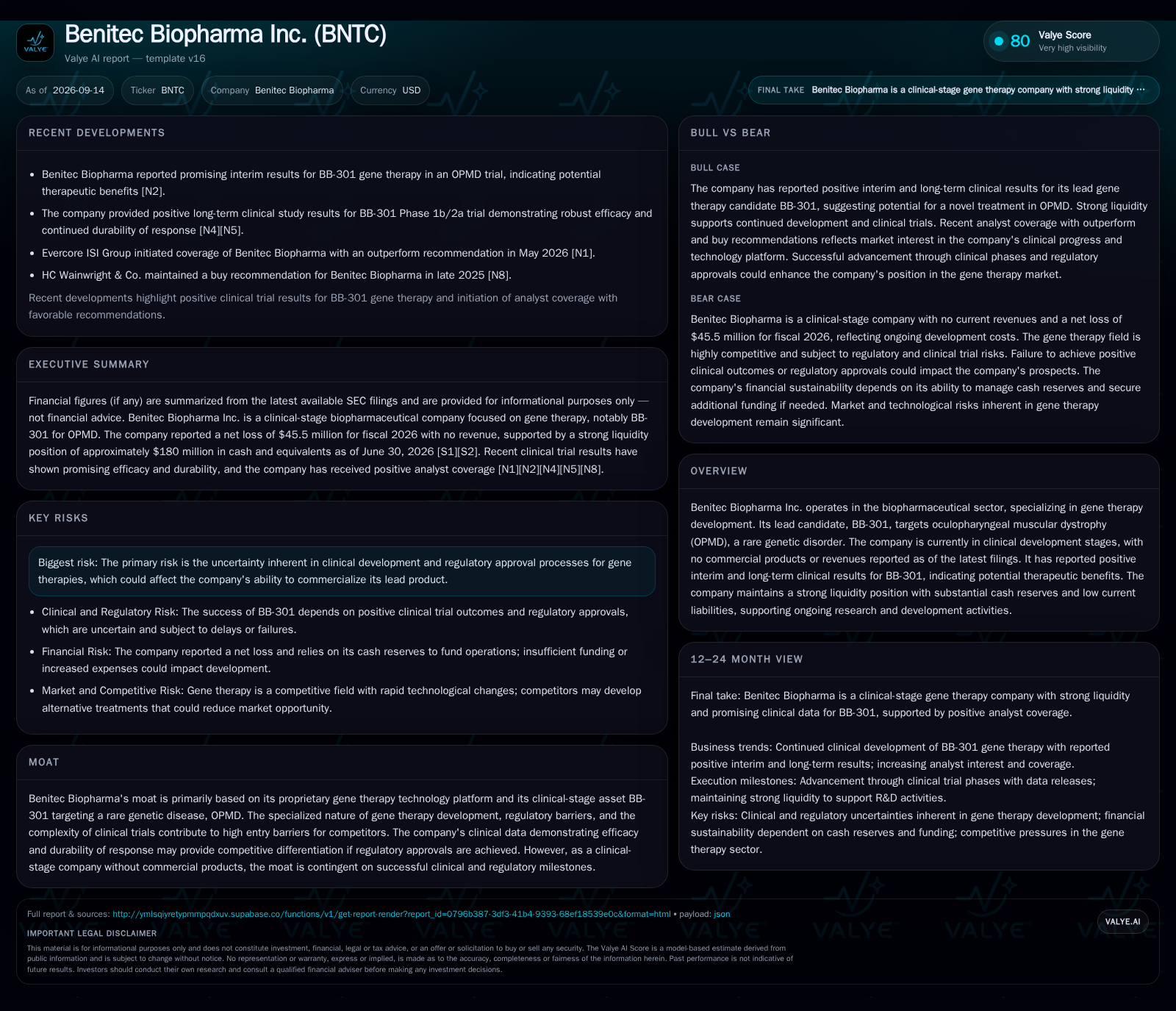
Benitec Biopharma is a clinical-stage gene therapy developer focused on BB-301 for oculopharyngeal muscular dystrophy (OPMD). The company has reported positive interim and long-term clinical results but remains pre-revenue and deeply unprofitable.A robust cash position ($180 million as of June 2026); these figures do not by themselves establish operating, investment, or financing capacity, while recent analyst coverage is optimistic. The critical path is successful clinical advancement and regulatory approval, with commercial success dependent on durable efficacy, competitive positioning, and capital discipline. Key risks are clinical failure, regulatory setbacks, and the capital intensity of gene therapy development.
Benitec Biopharma stands at a familiar inflection point for clinical-stage gene therapy companies: it has generated encouraging clinical signals for its lead asset, BB-301, in the rare disease OPMD, but remains pre-revenue and reliant on a substantial cash buffer to sustain operations. The company’s positive interim and long-term trial results have attracted favorable analyst attention and suggest potential therapeutic differentiation. Yet, the path from clinical promise to commercial product is fraught with execution, regulatory, and market risks. The next two years will likely determine whether Benitec can convert its scientific and financial runway into lasting value.
Clinical Progress and Financial Position Define Benitec’s Present
Benitec Biopharma’s current context is shaped by three material facts: (1) positive interim and long-term clinical results for its lead gene therapy candidate BB-301 in oculopharyngeal muscular dystrophy (OPMD), (2) a net loss of $45.5 million for fiscal year 2026, and (3) a robust cash position of $179.97 million as of June 30, 2026, with minimal current liabilities [S1] [N2] [N4] [N5] [S2]. The company remains pre-revenue, with zero reported sales for the most recent quarter [S2]. Positive analyst coverage, including new outperform ratings, reflects market optimism but does not alter the core risks of a clinical-stage, capital-consuming business [N1] [N8]. These facts matter because they define Benitec’s runway, its dependency on future clinical milestones, and its vulnerability to setbacks before revenue generation.
Beyond the headline liquidity and loss figures, a deeper understanding of Benitec’s operational efficiency and burn rate dynamics would clarify the sustainability of its cash runway. For instance, the cadence of R&D spend relative to clinical milestones achieved could reveal whether the company is optimizing resource allocation or facing escalating costs due to trial complexity. Additionally, the timing and sequencing of clinical data releases are critical; delays or accelerated timelines materially impact capital needs and investor confidence. Monitoring the interplay between clinical progress and financial health is essential to anticipate whether Benitec can maintain its strategic flexibility without dilutive financing or operational cutbacks.
Gene Therapy Economics: Capital Intensity, Path to Revenue, and Margin Structure
Benitec’s business model is the archetype of clinical-stage gene therapy: high upfront R&D investment, lengthy and expensive clinical trials, and a binary payoff structure dependent on regulatory success. The company’s current net loss reflects ongoing investment in BB-301’s development, with no offsetting revenue [S1] [S2]. If BB-301 achieves approval, the economics could pivot dramatically—gene therapies for rare diseases often command premium pricing due to high unmet need, limited patient populations, and the potential for one-time or durable treatments. However, the cost structure is heavily front-loaded: manufacturing gene therapies requires specialized facilities, stringent quality controls, and ongoing post-market commitments. Margins can be attractive post-approval, but only if pricing power is maintained and payor adoption is secured. Until then, Benitec’s economics are characterized by negative cash flow, dependence on existing liquidity, and the risk of future dilutive financings if timelines slip or expenses rise.
The economics of gene therapy development also hinge on the scalability and reproducibility of manufacturing processes, which are often underestimated drivers of cost and risk. If Benitec can establish robust, cost-effective production methods early, it may reduce the per-dose cost and improve gross margins post-approval. Conversely, manufacturing setbacks or yield variability can inflate expenses and delay commercial launch, eroding investor returns. Furthermore, reimbursement dynamics for rare disease gene therapies remain uncertain; payors may demand long-term outcomes data or innovative payment models, such as annuity-based pricing or outcomes-linked contracts. Benitec’s ability to navigate these evolving economic frameworks will be pivotal in converting regulatory approval into sustainable revenue streams.
Differentiation Prospects and the Dynamics of Rare Disease Gene Therapy
Benitec’s potential advantage lies in its proprietary gene therapy platform and the clinical progress of BB-301 targeting OPMD—a rare genetic disease with limited current treatment options. The rarity of OPMD, combined with positive clinical data showing efficacy and durability, could provide initial competitive insulation if regulatory approval is achieved [N2] [N4] [N5]. However, gene therapy is a rapidly evolving field; academic groups, established biopharmas, and emerging startups are pursuing similar vector technologies and rare disease indications. Barriers to entry include regulatory complexity, manufacturing know-how, and clinical trial execution, but these are surmountable for well-capitalized competitors. Benitec’s moat will only solidify if BB-301 demonstrates not just efficacy, but also a safety profile and durability superior to alternatives or best supportive care. The company’s ability to secure intellectual property around its constructs and delivery methods will also be tested as the field matures.
How Clinical Success Could Enable a Rare Disease Franchise
A favorable scenario for Benitec unfolds if BB-301 continues to deliver robust efficacy and durable therapeutic benefit in ongoing and future trials, leading to regulatory approval in major markets. This would validate Benitec’s technology platform, potentially enabling premium pricing and rapid adoption among OPMD patients and specialist centers. If payors recognize the value of a one-time or infrequently dosed gene therapy that meaningfully alters disease progression, Benitec could generate significant revenue from a small patient base. Analyst upgrades and additional licensing or partnership interest would likely follow. Confirmation of this scenario would require: (1) positive pivotal trial results with clear clinical endpoints, (2) regulatory acceptance and efficient approval pathways, (3) early payor and clinician endorsement, and (4) evidence of scalable, compliant manufacturing. Any licensing deals or early-access programs would further validate the potential.
Clinical Milestones, Capital Discipline, and the Wait for Commercial Clarity
The most plausible path for Benitec is continued investment in BB-301’s clinical development, with interim data readouts and regulatory interactions over the next 12–24 months. The company’s liquidity is likely sufficient to fund these activities absent major delays or unforeseen costs [S1]. However, the transition from positive early data to pivotal trial success is fraught with risk—many gene therapy candidates fail to replicate early results in larger or longer-term studies. In this scenario, Benitec remains pre-revenue, with periodic capital raises possible if timelines extend or manufacturing costs increase. Confirmation would come from steady clinical progress, transparent disclosure of trial milestones, and prudent cash management. Falsification would be signaled by trial setbacks, adverse safety signals, or accelerated cash burn requiring emergency financing.
Clinical or Regulatory Failure Forces Strategic Retrenchment
The adverse scenario materializes if BB-301 encounters efficacy, safety, or regulatory hurdles in late-stage trials. Failure to meet primary endpoints, unexpected adverse events, or regulatory demands for additional data could delay or derail approval. In such a case, Benitec’s lack of commercial products means it would likely need to cut costs, seek partnerships, or consider strategic alternatives—especially as cash reserves dwindle in the face of continued negative operating cash flow [S1]. Additional dilution or asset sales could result if capital markets become less receptive. Confirmation would come from negative or inconclusive clinical results, regulatory refusals, or guidance indicating a strategic pivot or cost reduction program.
Milestones That Will Shape Benitec’s Value-Creation Trajectory
Interim and final data releases from ongoing and planned BB-301 clinical trials—efficacy, durability, and safety will be decisive.
Regulatory feedback and submission status updates, especially interactions with the FDA or EMA regarding trial design and approval pathways.
Cash burn rate and R&D expense trends—tracking whether current liquidity supports the projected clinical and regulatory timeline.
Manufacturing progress, including facility readiness and scalability for gene therapy production, if disclosed.
Any disclosed partnership, licensing, or early access arrangements that could provide non-dilutive capital or commercial validation.
Intellectual property developments: new patents, challenges, or settlements relating to the gene therapy platform or BB-301.
Payor and clinician sentiment, if disclosed, regarding the value proposition and likely adoption of BB-301 upon approval.
Pipeline expansion or new indication announcements leveraging the gene therapy platform, supporting potential for a broader franchise.
Disclaimer: This is research-only, informational analysis and not investment advice. It may include AI-generated interpretation and general industry context. Always verify important details using primary sources.

Comments