
WEWARDS, INC.: Bitcoin Rewards Platform Faces Commercialization Hurdles and Liquidity Strain
Despite owning proprietary technology for Bitcoin-based consumer rewards and a crypto-integrated MMO game, WEWARDS, INC. has yet to secure licensing agreements or generate revenue. The company's future now hinges on its ability to convert its intellectual property into commercial partnerships amid acute liquidity constraints.
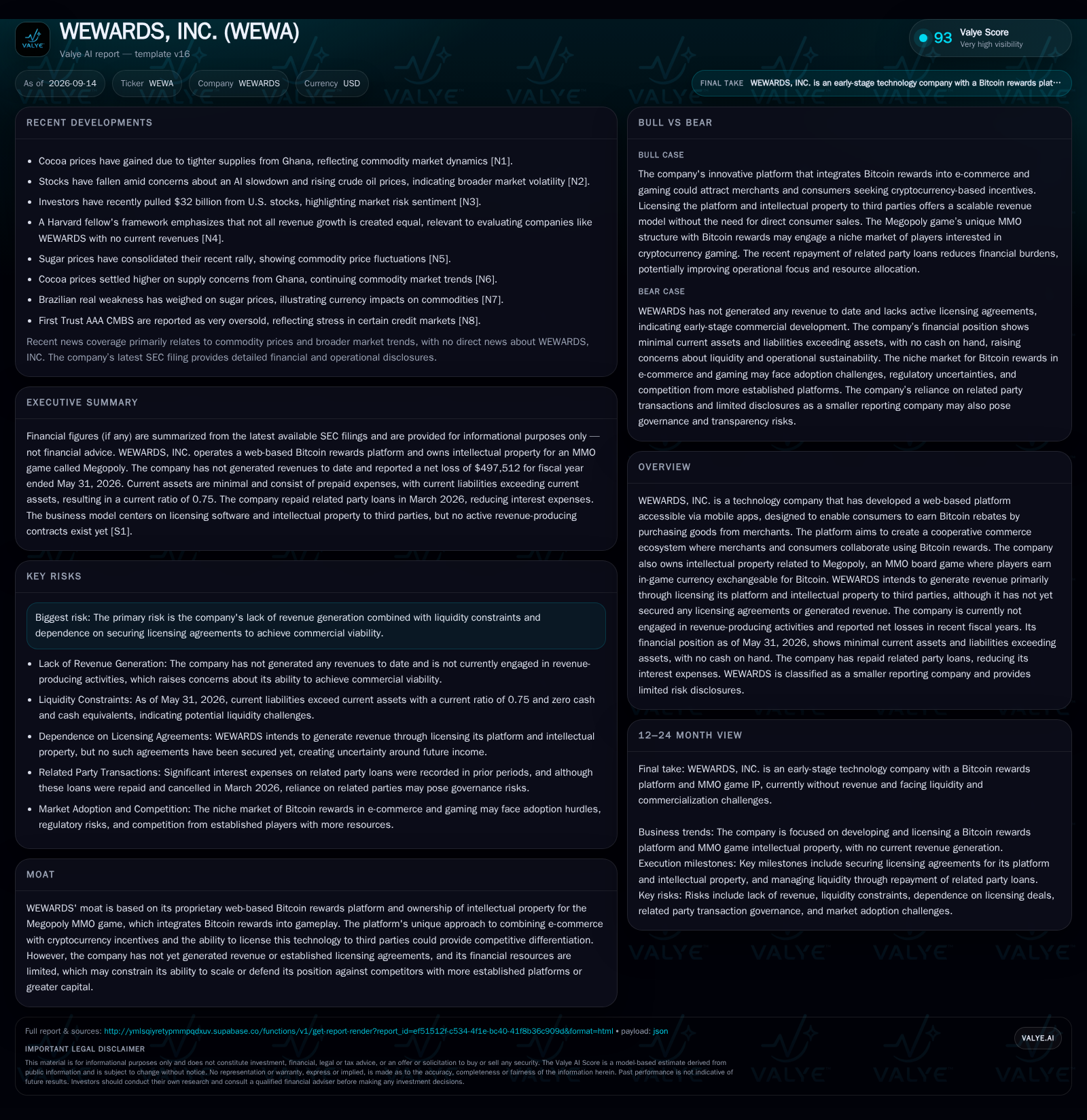
WEWARDS, INC. is an early-stage technology company with a web-based Bitcoin rewards platform and MMO game IP, but as of May 2026 it has not generated revenue or secured licensing agreements. Acute liquidity constraints, with zero cash and current liabilities exceeding assets, raise questions about operational runway. The company's path to viability depends on converting its proprietary technology into third-party licensing deals, but execution, market adoption, and regulatory acceptance remain unproven. Repayment of related party loans has reduced interest expenses, but overall financial risk remains high. [S1]
WEWARDS, INC. aspires to bridge e-commerce and gaming with a proprietary Bitcoin rewards platform and crypto-integrated MMO gameplay. Yet, despite a decade since its Nevada incorporation and a pivot to a licensing-based business model, the company has not secured any revenue-generating agreements or established commercial traction. Its balance sheet is precarious, with liabilities exceeding assets and no cash reserves, underscoring the urgency to transform technological assets into real partnerships. The company’s future now rests on its ability to execute licensing deals that validate product-market fit, while navigating the risks of market adoption, regulatory hurdles, and limited financial runway.
No Revenue, No Cash: The Immediate Stakes for WEWARDS
WEWARDS, INC. reported zero revenue for the fiscal years ended May 31, 2026 and 2025, with no active licensing agreements for its Bitcoin rewards platform or Megopoly MMO game intellectual property. This absence of commercial traction is compounded by an acute liquidity constraint: as of May 31, 2026, the company had only $300 in current assets (entirely prepaid expenses), $400 in current liabilities, and zero cash on hand, resulting in a current ratio of 0.75 [S1]. Although the company repaid related party loans in March 2026—reducing future interest expenses—its ability to fund ongoing operations or invest in business development remains severely limited. These facts make the near-term imperative clear: without securing licensing deals or alternative funding, WEWARDS faces existential risk.
Licensing-Driven Revenue Model: High Leverage, High Uncertainty
WEWARDS’ stated business model is to generate revenue by licensing its proprietary Bitcoin rewards platform and the Megopoly game IP to third parties, rather than direct-to-consumer monetization [S1]. Licensing economics, if realized, can offer high operating leverage: licensing deals often involve minimal ongoing costs per incremental customer or partner, with revenue recognized via fixed minimum guarantees and/or royalties based on partner sales. This asset-light structure could allow for rapid scaling if the platform is adopted by merchants or other ecosystem partners.
However, the absence of any executed licensing agreements means there is no evidence yet of willingness to pay or product-market fit. In practice, platform licensing in fintech and gaming requires significant upfront investment in sales, support, and integration, as well as the credibility to convince established players to adopt a nascent solution. Furthermore, the Bitcoin rewards mechanism—while differentiating—may add regulatory scrutiny and friction, potentially lengthening sales cycles and increasing partner due diligence.
The company’s current financial position, with no cash and minimal assets, limits its ability to invest in business development or platform enhancements. This creates a catch-22: the operating leverage of licensing can only be unlocked if partners are secured, but resource constraints may impede the sales and integration efforts needed to land those first deals.
Bitcoin Rewards as Differentiator—But Is It Enough?
WEWARDS’ competitive thesis rests on its integration of Bitcoin rewards into both e-commerce and gaming, targeting a niche of merchants and consumers interested in cryptocurrency incentives. The platform’s ability to bridge these two segments could, in theory, create a differentiated value proposition compared to traditional cashback or points-based rewards programs.
However, the market for crypto-based loyalty and gaming rewards is increasingly crowded, with established fintechs, loyalty platforms, and crypto exchanges experimenting with similar models. Larger competitors often possess deeper integration with merchant networks, greater marketing resources, and established compliance frameworks—advantages that can be decisive in both merchant acquisition and consumer trust.
Switching costs for merchants in loyalty/rewards ecosystems tend to be low unless the platform delivers significant incremental value or network effects. For WEWARDS, the challenge will be to prove that Bitcoin-based rewards drive higher engagement or conversion rates than fiat-based alternatives. In gaming, the MMO Megopoly offers a unique twist by enabling in-game Bitcoin earnings, but the sustainability of such a mechanic depends on ongoing consumer interest, regulatory acceptance, and the ability to prevent abuse or fraud.
Ultimately, WEWARDS’ competitive position remains theoretical unless and until it demonstrates commercial adoption or unique technical capabilities that competitors cannot easily replicate.
If First Licensing Deals Land: A Scalable Platform Emerges
A favorable scenario for WEWARDS would see the company secure its first licensing agreements—either with merchant networks, e-commerce platforms, or gaming operators—validating both the technical feasibility and market demand for Bitcoin rewards. Such deals could be structured with upfront minimum guarantees and revenue-sharing components, providing immediate cash inflow and recurring royalty streams.
Early proof points might include announcements of signed contracts, pilot program launches, or initial revenue recognition. These would demonstrate product-market fit and could catalyze further interest from additional partners, creating a virtuous cycle of adoption. The asset-light nature of licensing means incremental deals would require little additional fixed cost, potentially leading to strong operating leverage and rapid margin expansion.
To confirm this scenario, investors would look for evidence of signed agreements, disclosed pipeline activity, or early customer testimonials. Conversely, if no such deals materialize or announced pilots fail to convert to revenue, the upside scenario would be quickly invalidated.
Commercial Inertia Continues Without Immediate Relief
The most plausible near-term outcome is that WEWARDS remains in a pre-revenue holding pattern, struggling to overcome the twin hurdles of commercial adoption and resource constraints. Without cash reserves, the company’s ability to invest in business development, platform enhancements, or regulatory compliance is severely hampered. Licensing discussions, if underway, may progress slowly due to partner risk aversion, technical integration needs, or skepticism about the incremental value of Bitcoin rewards.
Absent a breakthrough deal, the company may seek bridge financing, attempt to raise additional capital, or pursue partnerships on less favorable terms. Evidence supporting this scenario would include continued lack of revenue, further cost-cutting, or new disclosures about financing needs. Any sign of staff reductions, halted development, or delayed product updates would further confirm operational inertia.
Liquidity Exhaustion Forces Strategic Reset or Wind-Down
If WEWARDS fails to secure either licensing agreements or additional funding within the next operating cycle, its acute liquidity constraints could force the company into drastic measures such as asset sales, a strategic pivot, or even wind-down proceedings. With no cash on hand and current liabilities exceeding current assets, the company is exposed to default risk and may be unable to meet minimal operating expenses.
In this scenario, evidence would include an inability to pay vendors, missed regulatory filings, going concern warnings, or announcements of asset divestitures. A forced sale of its intellectual property or a distressed equity raise—likely on highly dilutive terms—could further erode shareholder value. If market or regulatory conditions turn against crypto-based rewards, the company’s IP may have limited salvage value.
Milestones That Will Define WEWARDS’ Commercialization Trajectory
Announcement of first signed licensing or commercial agreements for the Bitcoin rewards platform or Megopoly IP.
Disclosure of initial revenue recognition or pipeline of committed partners (if disclosed).
Evidence of successful pilot programs, merchant onboarding, or user acquisition metrics that demonstrate product-market fit.
Updates on liquidity events: any new equity/debt financing, bridge loans, or capital infusions.
Progress on platform enhancements, regulatory compliance milestones, or integrations with third-party merchant/gaming ecosystems.
Any change in cost structure—such as layoffs, expense reductions, or delayed development—that signals operational pressure.
Disclosures about ongoing business development activity, prospective partner discussions, or reasons for commercial delays (if disclosed).
Regulatory developments affecting Bitcoin rewards in e-commerce or gaming, which could accelerate or impede adoption.
Disclaimer: This is research-only, informational analysis and not investment advice. It may include AI-generated interpretation and general industry context. Always verify important details using primary sources.

Comments