
Wealthfront After IPO: Automation, Asset Mix, and the Challenge to Scale Beyond Cash Management
Wealthfront’s technology-driven platform for digital natives has achieved high client retention and positive net income, but its revenue remains heavily concentrated in cash management. The next phase hinges on diversifying product adoption, managing operational complexity, and navigating competition from both incumbents and fintech upstarts.
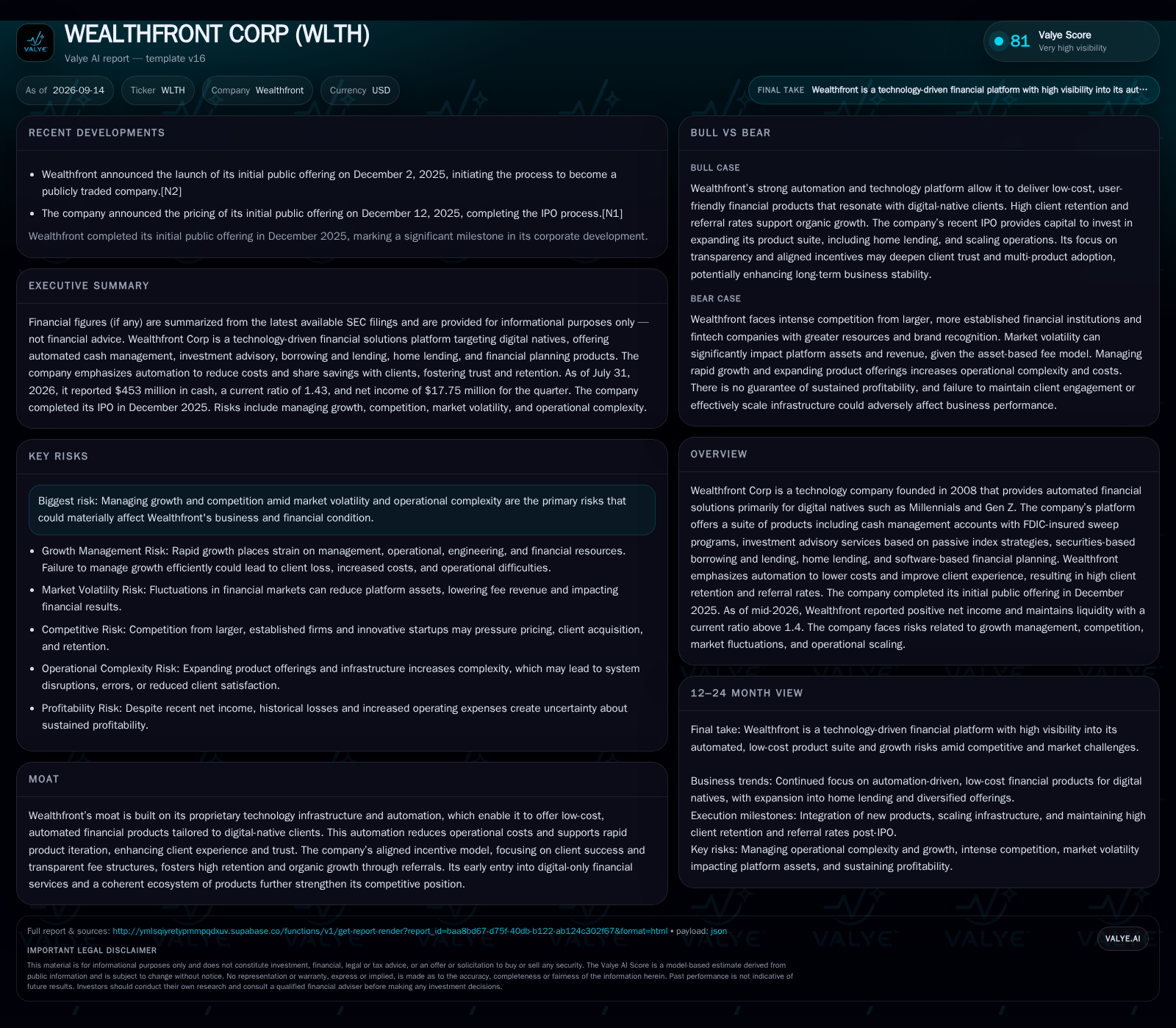
Wealthfront Corp, now a public company, reported $17.75 million in quarterly net income and maintains a current ratio of 1.43, but with roughly three-quarters of revenue from cash management, it faces concentration risk. The company’s automation-centric model underpins high retention and referral rates, yet scaling new products like home lending and investment advisory will test its ability to compete with larger financial services firms and fintechs, manage operational complexity, and sustain profitability as it grows.[S2]
Wealthfront Corp’s post-IPO landscape is defined by the interplay between its automation-driven, low-cost financial solutions and its heavy dependence on cash management revenue. While the company boasts high client retention and positive net income, the path forward requires more than operational efficiency—it demands successful cross-selling of new products, careful navigation of industry competition, and the ability to maintain trust among a digitally native clientele. The next phase will test whether Wealthfront can evolve from a cash-centric platform to a true multi-product financial ecosystem, all while managing the risks that come with growth and market volatility.[S2]
Revenue Mix, Retention, and Post-IPO Liquidity Shape Wealthfront’s Immediate Outlook
As of July 31, 2026, Wealthfront reported $17.75 million in quarterly net income, a current ratio of 1.43, and $453.3 million in cash and equivalents, reflecting a stable liquidity position in the near term.[S2] The company’s revenue remains highly concentrated, with approximately 74–75% generated from cash management products and only about 24–25% from investment advisory services in fiscal 2025 and 2026.[S2] Annual client retention rates exceeded 95%, and more than half of new clients arrived via referral, signaling strong organic engagement.[S2] Wealthfront’s home lending and securities-based lending products, though launched, have yet to deliver material revenue, underscoring the early stage of diversification efforts.[S2]
How Wealthfront’s Automation Model Drives Economics—And Where It Could Falter
Wealthfront’s core economic engine is its automation infrastructure, which enables it to deliver financial products at lower cost than traditional human advisors. This cost advantage is fundamental to its ability to offer competitive interest rates on cash management accounts and low asset-based fees on investment advisory services. The platform’s fixed costs center on technology development, compliance, and customer support, while variable costs scale primarily with client acquisition, banking fees, and regulatory requirements.
The predominance of cash management revenue means that Wealthfront’s top line is sensitive to interest rate spreads and the competitive APY environment. If rates fall or competitors compress margins, revenue could decline disproportionately. The investment advisory business, based on passive index portfolios and asset-based fees, has lower revenue volatility but is dependent on both market performance and asset growth. Operating leverage may increase as the company adds clients without proportional increases in overhead, but new product lines—such as home lending—require upfront investment and regulatory infrastructure, potentially delaying their positive contribution to margins.
Funding needs are currently modest thanks to IPO proceeds and positive net income, but scaling new businesses (especially lending) could require additional capital or partnerships if Wealthfront pursues balance-sheet-heavy products or geographic expansion.
Automation, Trust, and the Challenge of Competing with Both Giants and Fintech Peers
Wealthfront’s competitive position rests on its proprietary automation, transparent fee structures, and user experience tailored to digital natives. Its early-mover advantage in digital-only financial services has yielded high retention and organic client growth. However, these same advantages are increasingly being targeted by both large incumbents (such as diversified banks and asset managers integrating digital advice) and newer fintechs with aggressive pricing or broader product suites.
Incumbents possess scale, brand credibility, and regulatory reach, allowing them to match or undercut pricing and invest in technology. Meanwhile, fintech peers may outpace Wealthfront in launching novel features, embedded finance, or alternative asset offerings. Switching costs for consumers remain relatively low in financial services, especially for cash and passive investment products, so sustained advantage will depend on Wealthfront’s ability to continually enhance user experience, cross-sell new products, and maintain a high degree of trust and transparency. The platform’s automation moat may erode over time as technology becomes commoditized and regulatory compliance grows more complex.
From Cash Platform to Financial Ecosystem: What Success Would Look Like
A favorable trajectory for Wealthfront would see rapid adoption of its new products—particularly home lending and securities-based lending—by its existing, highly engaged client base. If the company can leverage its automation and trust to drive multi-product adoption, the revenue mix would diversify, reducing dependence on cash management and mitigating interest-rate risk. Strong cross-sell and high retention could also support operating leverage, as fixed technology and compliance costs are spread over a larger, more engaged client cohort.
Evidence supporting this scenario would include a rising share of revenue from non-cash-management products, increased average assets per client, and meaningful fee income from lending and advisory services. Sustained client satisfaction and referral rates, alongside margin expansion without loss of service quality, would further confirm that Wealthfront is scaling as a true digital-first financial ecosystem.
Gradual Diversification, Margin Pressure, and the Ongoing Need for Retention
The most plausible outcome is that Wealthfront continues to grow its client base and assets, but new products contribute meaningfully only over a multi-year horizon. Cash management remains the largest revenue source, exposing the company to rate and competitive pressures, though positive net income is maintained through operational efficiency and disciplined cost control. Incremental growth in investment advisory and nascent lending products helps to slowly diversify the revenue base, but the ramp is gradual due to the complexity of building trust and regulatory infrastructure in new verticals.
Confirmation would come from steady client growth, stable or improving retention and referral rates, and incremental (rather than step-change) increases in non-cash-management revenue. Margin pressure may persist if competitive APYs force Wealthfront to share more yield with clients or if client acquisition costs rise. Falsification would be evident if new products remain immaterial for several more quarters or if retention and referral metrics deteriorate.
Concentration Risk, Market Cycles, and Execution Gaps Could Derail the Growth Story
A negative outcome could emerge if Wealthfront’s revenue concentration in cash management exposes it to a sharp decline in interest rates or aggressive pricing from larger competitors, compressing margins and stalling top-line growth. If new products fail to gain traction—due to operational missteps, regulatory hurdles, or lack of client trust—the company may face stagnation or loss of relevance, especially as competitors bundle similar offerings with broader financial services. Market volatility could further reduce assets under management, diminishing fee income from investment advisory products.
This scenario would be confirmed by declining revenue, rising client churn, or flatlining platform assets, especially if accompanied by growing operating losses as fixed costs become harder to absorb. Lack of progress in home lending or securities-based lending, or visible service disruptions and compliance failures, would further indicate execution risk.
Milestones That Will Determine Whether Wealthfront Can Build a Durable, Multi-Product Platform
Revenue mix evolution: Track the percentage of total revenue derived from cash management versus investment advisory, lending, and other products each quarter.
Home lending adoption: Monitor the growth of home lending originations, client uptake, and contribution to total revenue—especially outside Colorado as the product scales.
Net new client growth: A useful metric would be quarterly changes in client count and average assets per client, if disclosed, to assess organic expansion.
Retention and referral rates: Continued annual retention above 95% and high referral-driven new client acquisition would support the thesis of durable client trust.
Margin trends: Watch for gross margin and net income trends, particularly as new products launch and scale—compression could indicate pricing or cost pressures.
Competitive APY response: Monitor how Wealthfront’s offered APYs and client cash balances respond to changes in interest rates and competitor offerings.
Operating expense trajectory: Evaluate whether operating expenses (especially technology and compliance) grow in line with revenue, supporting scalable economics.
Product expansion milestones: Track announcements or launches of new product lines or geographic expansion, and whether these convert into material revenue within 12–24 months.
Disclaimer: This is research-only, informational analysis and not investment advice. It may include AI-generated interpretation and general industry context. Always verify important details using primary sources.

Comments