
Eco Science Solutions: Compliance-Centric Software Ambition Confronts Severe Liquidity Strain
Eco Science Solutions, Inc. has launched early-stage revenue operations with a specialized ERP and payments suite for highly regulated industries, but persistent operating losses, a critical working capital deficit, and reliance on insider funding severely threaten its ability to scale.
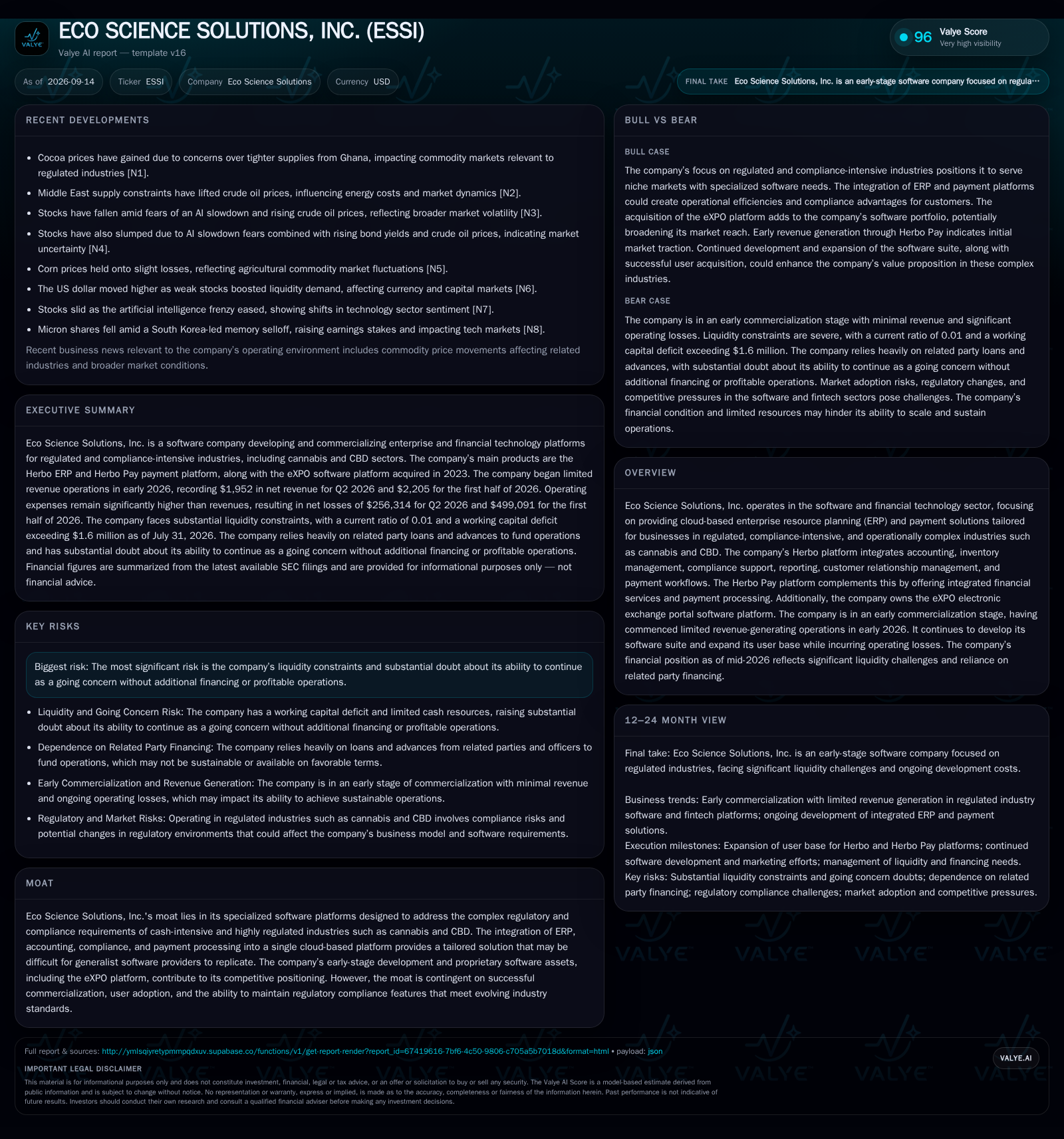
Eco Science Solutions has begun generating modest revenue from its Herbo Pay platform, targeting compliance-heavy sectors like cannabis and CBD with integrated ERP and financial software. However, the company’s net losses, a working capital deficit over $1.6 million, and near-absence of cash highlight a dire liquidity situation. Its go-forward viability hinges on external funding or a rapid inflection in profitable customer adoption—neither of which is yet evident. The company’s specialized product suite may fill a real market gap, but execution risk remains extreme at this stage. [S2]
Eco Science Solutions, Inc. has entered the market with a suite of cloud-based ERP and financial technology platforms tailored for highly regulated, compliance-heavy industries such as cannabis and CBD. While the company has initiated limited revenue-generating operations through its Herbo Pay platform, its financial statements as of mid-2026 reveal a company in crisis: operating losses vastly outpace nascent revenues, liquidity is critically strained, and the business is almost wholly dependent on insider loans for survival. The core thesis now pivots on whether Eco Science Solutions can translate its specialized compliance software into scalable, profitable customer adoption before funding options run out—or whether the company’s acute liquidity constraints will force a strategic reset or cessation.
Liquidity Crisis and Early Commercialization Define the Current State
Eco Science Solutions, Inc. reported $2,205 in net revenue for the six months ended July 31, 2026, marking its first meaningful commercial activity via Herbo Pay. However, this initial traction is dwarfed by $499,091 in net losses over the same period, driven by operating expenses exceeding $247,000 in the latest quarter. Most alarmingly, the company’s cash balance was just $7,833 at the end of July, with current liabilities of $1.67 million and a working capital deficit of $1.65 million. This translates to a current ratio of 0.01, signaling that the company cannot meet its short-term obligations without urgent new funding. The business remains heavily reliant on loans and advances from insiders and related parties, and management has disclosed substantial doubt about its ability to continue as a going concern absent external financing or a rapid turnaround in operating results. [S2]
Unproven Revenue Model and Severe Cost-Structure Imbalance
Eco Science Solutions aims to monetize its Herbo ERP and Herbo Pay platforms by charging transaction and processing fees, as well as design, testing, and hosting fees. These revenue streams are typical for cloud-based SaaS and fintech models targeting compliance-intensive industries. However, the company’s current revenue base is negligible relative to its fixed and variable cost structure. With operating expenses dominated by management, consulting, legal, R&D, and software amortization, and with minimal scale in customer adoption, the business exhibits negative operating leverage: incremental revenues have not yet offset the baseline cost of development and administration. Capital needs are acute, as ongoing software build-out and marketing require cash that the company does not have. If Eco Science Solutions cannot secure additional external financing or achieve rapid revenue ramp, the economics will remain unsustainable.
Specialization in Regulated Markets: Niche Potential vs. Platform Giants
Eco Science Solutions targets a niche where regulatory complexity and compliance burdens—especially in sectors like cannabis and CBD—create barriers to entry for generic ERP and payment solutions. Its Herbo suite is designed to integrate compliance, traceability, accounting, and payments, theoretically offering a tailored solution that larger, horizontal SaaS platforms may struggle to replicate at sufficient depth. However, this specialization is a double-edged sword: while it may insulate the company from direct competition with mass-market ERP providers, it also limits the addressable market and exposes the business to regulatory regime changes. Further, established fintech and enterprise software vendors are increasingly targeting verticals with configurable compliance modules, raising the risk of encroachment. The company’s proprietary eXPO platform could add exchange functionality, but its competitive impact is unproven at this stage.
How Rapid Adoption and Regulatory Tailwinds Could Enable a Turnaround
The most favorable scenario would see Eco Science Solutions convert its early customer relationships into recurring, high-value contracts as compliance burdens in regulated industries intensify. If Herbo and Herbo Pay can demonstrate clear ROI in operational efficiency, auditability, and risk reduction, the company could see accelerated customer uptake—especially if regulatory changes mandate tighter controls. Evidence supporting this scenario would include a sharp increase in active platform users, growing transaction volumes through Herbo Pay, and announcements of multi-site or multi-year customer relationships. A successful capital raise or strategic partnership with a larger fintech player could also validate the value proposition and provide runway to scale. The thesis would be falsified if revenue growth remains stagnant, customer churn is high, or if regulatory changes erode rather than enhance the company’s addressable market.
Incremental Growth Amid Ongoing Funding Strain: The Most Likely Outcome
The most plausible path is one of incremental user and revenue growth, but at a pace insufficient to self-fund operations in the near term. Eco Science Solutions may add a handful of customers in its core verticals, gradually increasing transaction revenues and building a reference base for future sales. However, unless the company secures substantial new funding—either from related parties or external investors—its liquidity position will remain precarious. The company might be forced to scale back development, delay new feature rollouts, or seek strategic alternatives (such as asset sales or mergers) to survive. Evidence for this scenario would be continued modest revenue growth but persistent operating losses, recurring disclosures of going concern risk, and repeated reliance on insider loans.
Liquidity Exhaustion and Strategic Reset if Funding Fails
If Eco Science Solutions is unable to raise new capital or accelerate profitable customer adoption, it faces a high probability of running out of cash within the next reporting cycle. In this scenario, the company could be forced to halt software development, lay off staff, and seek protection from creditors or pursue a distressed sale of its technology assets. Signs of this scenario would include further deterioration in the current ratio, missed payroll or vendor payments, default on related party loans, or public disclosure of strategic review for restructuring. Regulatory or market shocks—for example, a major adverse change in cannabis sector regulations—could accelerate this process by undermining customer demand or the value of the company’s compliance features.
Milestones That Will Determine Whether Eco Science Solutions Survives or Scales
Monthly or quarterly change in active Herbo and Herbo Pay platform users—if disclosed—would signal whether early adoption is accelerating or stalling.
Transaction volume and dollar value processed through the Herbo Pay platform, which would provide insight into customer engagement and scaling potential.
Gross margin evolution as the company onboards more customers, indicating whether the business model can achieve sustainable economics.
Disclosure of new capital raises, debt facilities, or strategic investments, which would address the immediate going concern risk.
Any announcement of multi-year or multi-site customer agreements, which would validate product-market fit and revenue visibility.
R&D and management expense trends—if the company is forced to curtail spending, this may indicate liquidity exhaustion or strategic retrenchment.
Updates on regulatory changes in the company’s target verticals, as more stringent compliance laws could either expand or contract the market opportunity.
Evidence of customer churn or complaints, which would suggest product or service gaps that could limit long-term adoption.
Disclaimer: This is research-only, informational analysis and not investment advice. It may include AI-generated interpretation and general industry context. Always verify important details using primary sources.

Comments