
HeartSciences: AI-Driven ECG Ambition Confronts Acute Liquidity Strain and Regulatory Uncertainty
HeartSciences’ MyoVista Insights™ platform targets a major gap in cardiovascular diagnostics with AI-enabled ECG management, but the company’s liquidity crisis and FDA regulatory risks present existential hurdles despite technical and commercial progress.
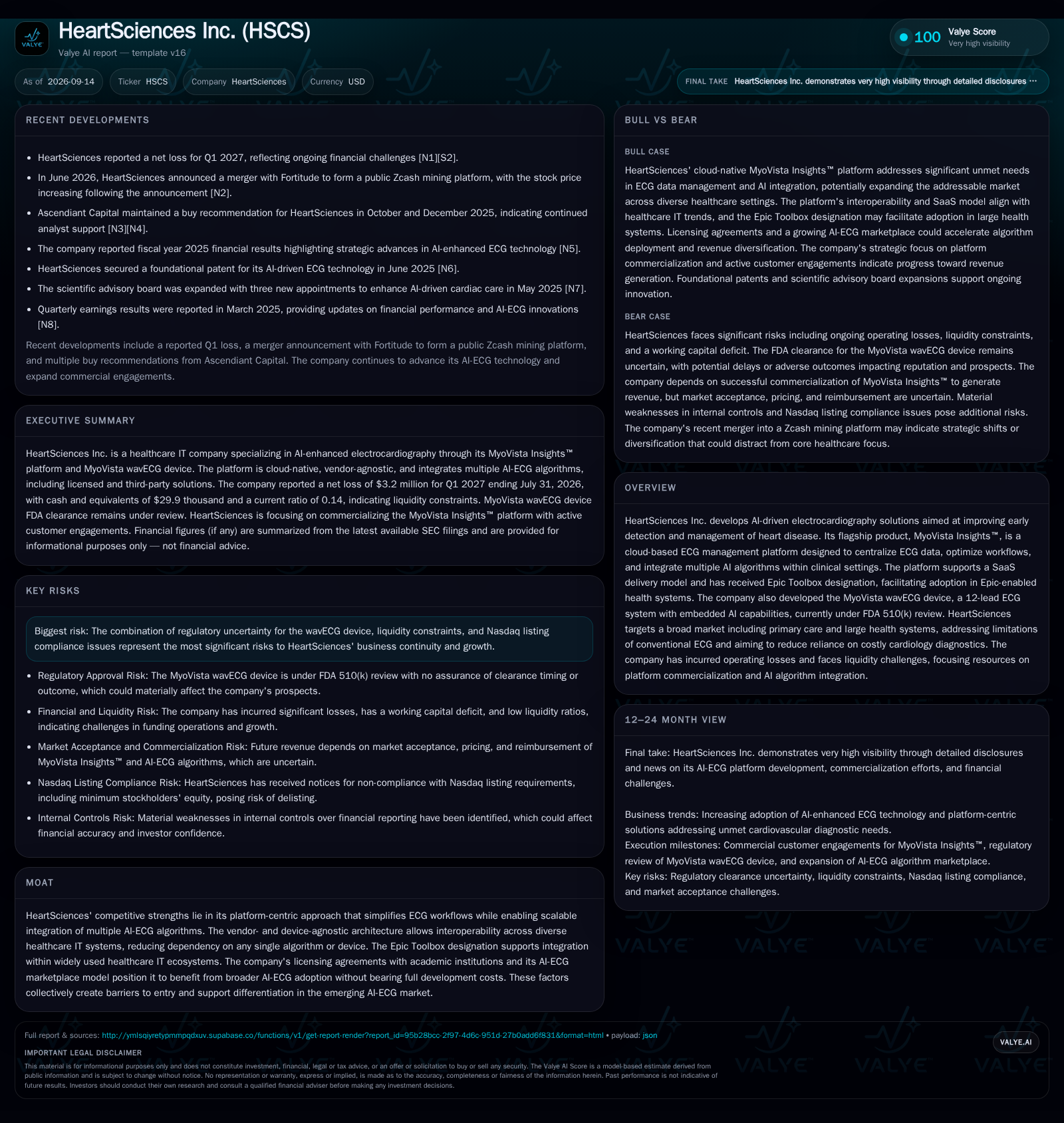
HeartSciences is betting on its cloud-native, AI-ECG platform to reshape cardiac diagnostics, leveraging vendor-agnostic integration and an AI algorithm marketplace. Recent technical milestones and Epic Toolbox designation support its commercial push, but the company’s severe liquidity constraints, regulatory delays for its wavECG device, and ongoing operating losses threaten its ability to execute. Strategic focus has shifted to the Insights™ platform, yet market acceptance and sustainable revenue remain unproven. The path forward hinges on resolving funding and regulatory bottlenecks while demonstrating traction with health systems.[S2]
HeartSciences Inc. stands at a crossroads, seeking to transform cardiac diagnostics with its AI-powered MyoVista Insights™ platform while grappling with acute liquidity pressure and regulatory uncertainty. Although the company has achieved technical milestones—including Epic Toolbox designation and integration of third-party AI algorithms—its financial runway is critically short, and adoption of its platform in real-world clinical settings is still nascent. The outcome for HeartSciences will depend on its ability to secure funding, achieve regulatory clearance for its wavECG device, and convert technical promise into sustainable commercial traction.
Liquidity Crisis and Platform Focus Define the Present Moment
The most material facts shaping HeartSciences’ outlook are its severe liquidity constraints, its strategic pivot to the MyoVista Insights™ platform, and regulatory delays for its hardware device. As of July 31, 2026, HeartSciences reported only $29.9 thousand in cash and equivalents, a current ratio of 0.14, and a working capital deficit of $4.8 million, signaling a near-term funding crisis.[S2] The company incurred a net loss of $3.2 million in the most recent quarter, with accumulated deficits mounting to $88.4 million.[S2]
In response, HeartSciences is concentrating resources on commercializing its cloud-native MyoVista Insights™ platform and has reserved against wavECG hardware inventory, essentially deprioritizing further hardware commercialization until regulatory clarity is achieved.[S2] Meanwhile, the wavECG device remains under FDA 510(k) review, and associated AI algorithms require additional clinical validation, stalling potential revenue streams and amplifying execution risk.[S2]
Revenue Model Potential and the Economics of Platform-First Healthcare IT
HeartSciences’ business model is built around a SaaS platform (MyoVista Insights™) that centralizes ECG data, optimizes clinical workflows, and integrates diverse AI algorithms. The company expects to generate revenue from installation fees, SaaS usage fees, and per-use or subscription-based fees for AI-ECG algorithms hosted on its marketplace.[S2] This model, if successfully scaled, could provide recurring, high-margin software revenue and enable HeartSciences to benefit from third-party algorithm innovation without bearing the full R&D cost.
However, the current economics are deeply negative, with expenses far outpacing any reported revenue, and the company’s balance sheet signals an urgent need for external funding or commercial inflection. The capital-light, cloud-native architecture theoretically supports operating leverage if customer acquisition accelerates, but without evidence of recurring revenue or disclosed contract terms, the degree of fixed-to-variable cost leverage remains unproven.
The wavECG hardware, while potentially a differentiator, is now a secondary focus and may ultimately serve as a complement to the platform rather than a standalone driver. The economics of hardware in medtech are typically lower-margin and more capital-intensive, so the shift to software-centric economics could improve gross margins—if adoption materializes.
Vendor-Agnostic Integration and AI Marketplace: Sources of Differentiation and Their Limits
HeartSciences’ competitive pitch rests on its vendor- and device-agnostic architecture, enabling integration with diverse ECG devices and EMR systems—a significant advantage in a fragmented healthcare IT environment. The Epic Toolbox designation further supports platform compatibility in large health systems, which could lower integration friction and expand the addressable market.[S2]
The company’s AI-ECG marketplace, hosting both proprietary and licensed algorithms (including Mount Sinai’s FDA Breakthrough-designated aortic stenosis algorithm), offers a modular approach to innovation. This model may allow HeartSciences to serve as an orchestrator of clinical AI, rather than a single-point solution provider, and could help build network effects if algorithm variety and clinical utility drive platform stickiness.
However, the competitive landscape is crowded, with incumbent ECG hardware vendors, EMR giants, and emerging digital health startups all vying for workflow integration and AI-enhanced diagnostics. Switching costs for health systems are typically high due to IT complexity, but pricing power and long-term retention for a young platform are unproven. HeartSciences’ moat will depend on its ability to rapidly demonstrate clinical impact, interoperability, and a growing algorithm library before larger players replicate or outspend it.
How Commercial and Regulatory Breakthroughs Could Unlock Platform Value
In a favorable scenario, HeartSciences secures bridge financing or strategic investment to address its liquidity crisis, buys time for regulatory clearance of the wavECG device and associated AI algorithms, and converts announced customer engagements into repeatable, recurring SaaS revenue. Successful FDA clearance for wavECG and validation of new algorithms would enhance the platform’s clinical credibility and expand its utility, driving adoption across health systems already invested in Epic or similar EMRs.
If the AI-ECG marketplace attracts high-quality third-party algorithms and customers begin integrating these into routine workflows, HeartSciences could see network effects: more algorithms attract more users, which in turn incentivizes further algorithm development. Confirmation of this scenario would include announced multi-site installations, disclosed recurring revenue growth, and third-party validation or peer-reviewed outcomes demonstrating improved cardiac detection or workflow efficiency.
Platform Progress Amid Ongoing Capital and Adoption Headwinds
The most plausible path is one of incremental commercial progress against a backdrop of persistent financial strain and uncertain regulatory timelines. HeartSciences may secure short-term funding—via equity, debt, or strategic partnerships—to maintain operations while continuing to build out its customer base and algorithm marketplace. Adoption of MyoVista Insights™ could be gradual, with sales cycles in healthcare IT typically long and requiring extensive validation and integration support.
FDA clearance for wavECG and associated algorithms may be delayed or require further studies, slowing the hardware’s contribution to revenue. The company’s focus on the software platform is likely to persist, with hardware positioned mainly as a value-add rather than a core revenue driver. Evidence confirming this scenario would be ongoing but modest increases in customer engagement announcements, further platform upgrades, and continued liquidity management challenges.
Liquidity Shortfall and Regulatory Setbacks Threaten Business Continuity
In the adverse case, HeartSciences fails to secure sufficient funding before its limited cash reserves are depleted, forcing a halt to operations, asset sales, or a distressed transaction. Simultaneously, further delays or negative outcomes in FDA reviews for the wavECG device and key algorithms could erode clinical and commercial credibility, making it harder to attract new customers or partners.
If announced customer engagements do not convert into material recurring revenue, and if health systems prove reluctant to adopt a new, unproven platform amid rapid digital health innovation, HeartSciences could lose relevance to better-capitalized competitors. Confirmation of this downside would include missed payroll or payables, delisting from Nasdaq, or a lack of new customer or revenue disclosures in subsequent quarters.
Milestones That Will Test HeartSciences’ Platform Thesis in the Coming Quarters
The company’s ability to disclose new or expanded customer contracts for MyoVista Insights™—including details on contract length, pricing, and renewal rates—would provide evidence of commercial traction.
FDA clearance (or definitive feedback) for the MyoVista wavECG device and for high-impact AI algorithms, especially those with FDA Breakthrough Device status, will be pivotal for establishing clinical credibility.
Trends in recurring SaaS revenue, if disclosed, and the mix of revenue attributable to algorithm marketplace activity versus one-time installation or service fees, would clarify the sustainability of the model.
Updates on liquidity events—such as financings, bridge loans, or strategic partnerships—are critical to assessing operational runway.
Evidence of integration partnerships with major EMR vendors beyond Epic, or expansion of the platform’s AI algorithm library, could signal increasing ecosystem relevance.
Any Nasdaq listing compliance updates, including remediation or delisting risks, would be material to public market access and investor confidence.
If disclosed, customer usage metrics such as number of ECGs processed, active users, or algorithm adoption rates would help test the platform’s real-world value proposition.
Announcements of peer-reviewed clinical outcomes, third-party validations, or real-world evidence supporting AI-ECG utility would materially de-risk the adoption curve.
Disclaimer: This is research-only, informational analysis and not investment advice. It may include AI-generated interpretation and general industry context. Always verify important details using primary sources.

Comments