
Dave & Buster’s: Expansion, Margin Strain, and the Fight to Revitalize the Entertainment-Dining Formula
Despite a broad multi-brand footprint and ongoing new store openings, Dave & Buster’s faces a challenging environment marked by declining same-store sales, margin compression, and liquidity pressure. The company’s turnaround hinges on reigniting customer engagement, improving cost discipline, and translating operational initiatives into sustainable cash flow.
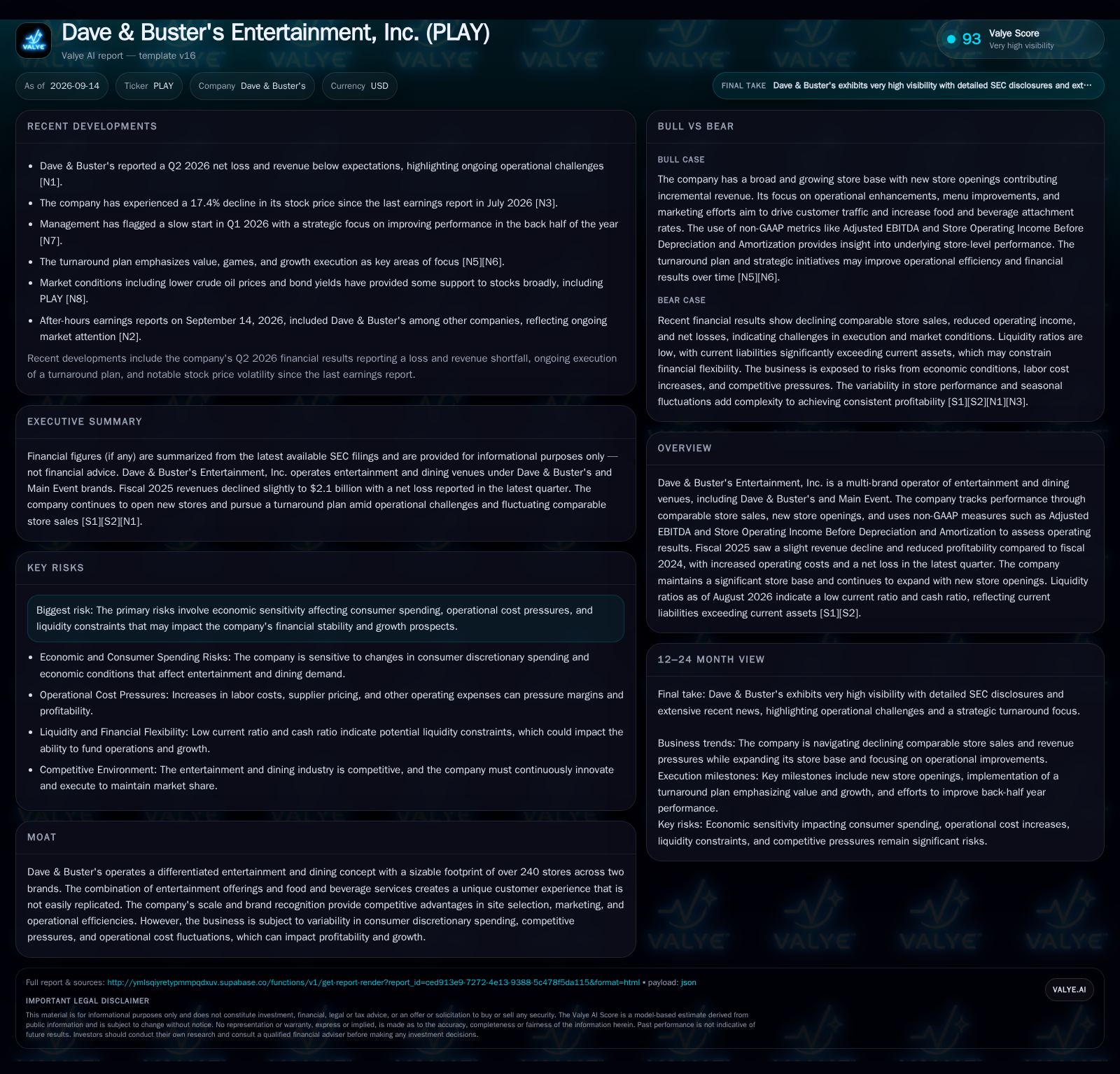
Dave & Buster’s operates over 240 entertainment and dining venues under two brands, but is currently grappling with a 5% drop in comparable store sales, shrinking margins, and a net loss amid rising costs and weak liquidity. The company is betting on a turnaround plan focused on value and growth, but must overcome both external headwinds and internal execution risk to restore profitability and potential financial flexibility. [S1] [S2] [N1] [N3]
Dave & Buster’s, a leader in the entertainment-dining sector, finds itself at a crossroads. Despite maintaining a nationwide presence and actively opening new venues, the company is contending with declining comparable store sales, operating margin pressure, and a net loss in its most recent fiscal year. Tight liquidity and rising costs compound the challenge, putting the spotlight on management’s turnaround strategy. The battle for relevance in a volatile consumer environment will require not just expansion, but the reinvigoration of both the guest experience and cost structure.
Recent Financial and Operational Setbacks Reshape the Narrative
Dave & Buster’s reported fiscal 2025 revenues of $2.103 billion, a 1.4% decline from the prior year, with a 5% drop in comparable store sales despite opening 11 new locations. The company’s operating income margin fell sharply to 4.1%, and net income shifted to a $48.7 million loss. Liquidity is under acute pressure, with just $16 million in cash and a current ratio of 0.3 as of August 2026. A Q2 loss and revenue shortfall have further eroded market confidence, contributing to a 17.4% stock price decline since July 2026. These developments highlight the urgency and complexity of the turnaround effort. [S1] [S2] [N1] [N3]
How the Entertainment-Dining Model Translates to Financial Outcomes
Dave & Buster’s generates revenue through a mix of entertainment (62.9% of 2025 revenues), food (25.5%), and beverage (11.6%), with entertainment—primarily arcade games—being the core economic driver. The business model relies on attracting guests for bundled experiences, with upselling opportunities in food and drink. Fixed costs are substantial, including lease/rent, labor, and game maintenance, while variable costs include food, beverage, and game prizes.
Operating leverage is typically high: incremental sales at existing stores can drive significant profit, but the reverse is also true—declining traffic and sales deleverage fixed costs, compressing margins. In fiscal 2025, cost of products as a percentage of revenue decreased modestly due to vendor savings and menu price hikes. However, this was more than offset by a rise in payroll (now 25.5% of revenues) and other operating expenses, reflecting both wage inflation and new store ramp-up. [S1]
The ongoing need to invest in new store growth, game refreshes, and marketing means capital requirements remain elevated. With current liabilities far outstripping current assets, the company’s ability to self-fund expansion or weather further downturns is constrained unless cash flow rebounds or external capital becomes available.
Entertainment-Dining Hybrids Face Intensifying Competition and Substitution
Dave & Buster’s competes in the fragmented out-of-home entertainment and casual dining sectors. Its differentiation rests on the integration of arcade-style games and a full-service restaurant/bar under one roof, aiming to draw both families and adult groups. The company’s scale—over 240 locations and two brands—confers some purchasing and marketing advantages.
However, the competitive landscape is evolving. Other experiential concepts (bowling lounges, trampoline parks, escape rooms, and niche arcades), traditional restaurants, and even at-home entertainment options (gaming consoles, VR, streaming) all vie for time and discretionary dollars. Cost pressures from labor and ingredients are industry-wide, but local competitors with lower overhead or more targeted offerings could nimbly undercut on price or experience.
The challenge for Dave & Buster’s is to maintain relevance and guest frequency as consumer preferences shift and alternative entertainment proliferates. Brand recognition, a diverse game portfolio, and the ability to run national promotions are strengths, but the absence of a unique technology or proprietary platform limits defensibility if guest experience and value perception falter.
If the Turnaround Plan Gains Traction: Leverage, Margin Rebound, and Guest Engagement
A successful turnaround would see the company’s focus on value, games, and operational execution translating into stabilized or growing comparable store sales. If management can reignite guest engagement—through improved food and beverage offerings, refreshed games, and compelling promotions—incremental traffic would rapidly leverage the fixed cost base, restoring operating margins.
Vendor cost savings and menu price optimization could further expand gross margins, while more efficient labor scheduling and automation would contain payroll growth. If the company can demonstrate several consecutive quarters of positive comp sales, improved Adjusted EBITDA, and a reversal of cash outflows, investor sentiment could rebound, enabling access to growth capital at reasonable terms.
Confirmation would come from positive trends in same-store sales, margin expansion, and a return to net profitability, along with evidence that new store openings are generating returns above the cost of capital.
Stabilization Requires Execution and Luck Amid Ongoing Margin Pressure
The most plausible path is one of gradual stabilization, with the company managing to halt the decline in comparable store sales but struggling to achieve robust growth. Incremental improvements in guest experience and cost discipline may slow margin erosion, but persistent wage inflation and competitive discounting could cap operating leverage.
New store openings contribute to top-line growth but may initially dilute margins if ramp-up periods are slow or cannibalization occurs. Liquidity remains tight, making the business vulnerable to any further shocks in demand or cost structure.
Key confirming evidence would be a flattening or modest recovery in comp sales, stable or slightly improving Adjusted EBITDA margins, and no further deterioration in liquidity. Falsification would be continued comp declines, negative cash flow, or signs that new stores are underperforming expectations.
Sustained Traffic Weakness and Cost Inflation Could Trigger Deeper Financial Distress
If consumer demand remains weak and cost inflation persists, Dave & Buster’s could face prolonged negative operating leverage. Continued declines in comparable store sales would further compress margins, potentially forcing the company to curtail new store development, cut marketing, or close underperforming locations.
Liquidity could become critical, with the current ratio already at precarious levels. In this scenario, the company might be forced to seek external financing on unfavorable terms, sell assets, or pursue a strategic transaction. Brand erosion and negative guest sentiment would make recovery more difficult.
Evidence for this scenario would be ongoing comp sales declines, further net losses, negative operating cash flow, and signals of covenant breaches or urgent capital raises.
Milestones to Gauge Dave & Buster’s Turnaround Momentum
Comparable store sales trends: A sustained improvement or stabilization in comp sales would be an early sign the turnaround is gaining traction. [S1] [S2]
Adjusted EBITDA and operating income margin: These measures will reveal whether cost discipline and revenue initiatives are translating into improved profitability. [S1] [S2]
Store-level cash flow: If disclosed, per-store cash generation and ramp-up speed for new openings would help gauge the returns on expansion.
Liquidity ratios and debt covenants: Changes in the current and cash ratios, along with any commentary on financing needs or covenant compliance, are critical.
Guest traffic and ticket/food-beverage attachment rates: Increases in visit frequency or higher per-guest spending would indicate successful execution on value and experience.
Labor cost as a percentage of sales: Monitoring whether wage and benefit costs are stabilizing or escalating further.
Pace and performance of new store openings: Whether new locations are meeting or exceeding internal targets for traffic and profitability.
Competitive pricing and promotional intensity: Evidence of aggressive discounting in the market or shifts in consumer value perception would help test the resilience of the model.
Disclaimer: This is research-only, informational analysis and not investment advice. It may include AI-generated interpretation and general industry context. Always verify important details using primary sources.

Comments