
Kestra Medical Technologies: Can a Defensible Cardiac Device Moat Outpace Profitability Strain?
Kestra’s FDA-cleared ASSURE WCD and deep patent portfolio establish high regulatory and intellectual property barriers—yet persistent losses and the challenge of scaling adoption in a complex, competitive cardiac market test the company’s long-term economic model.
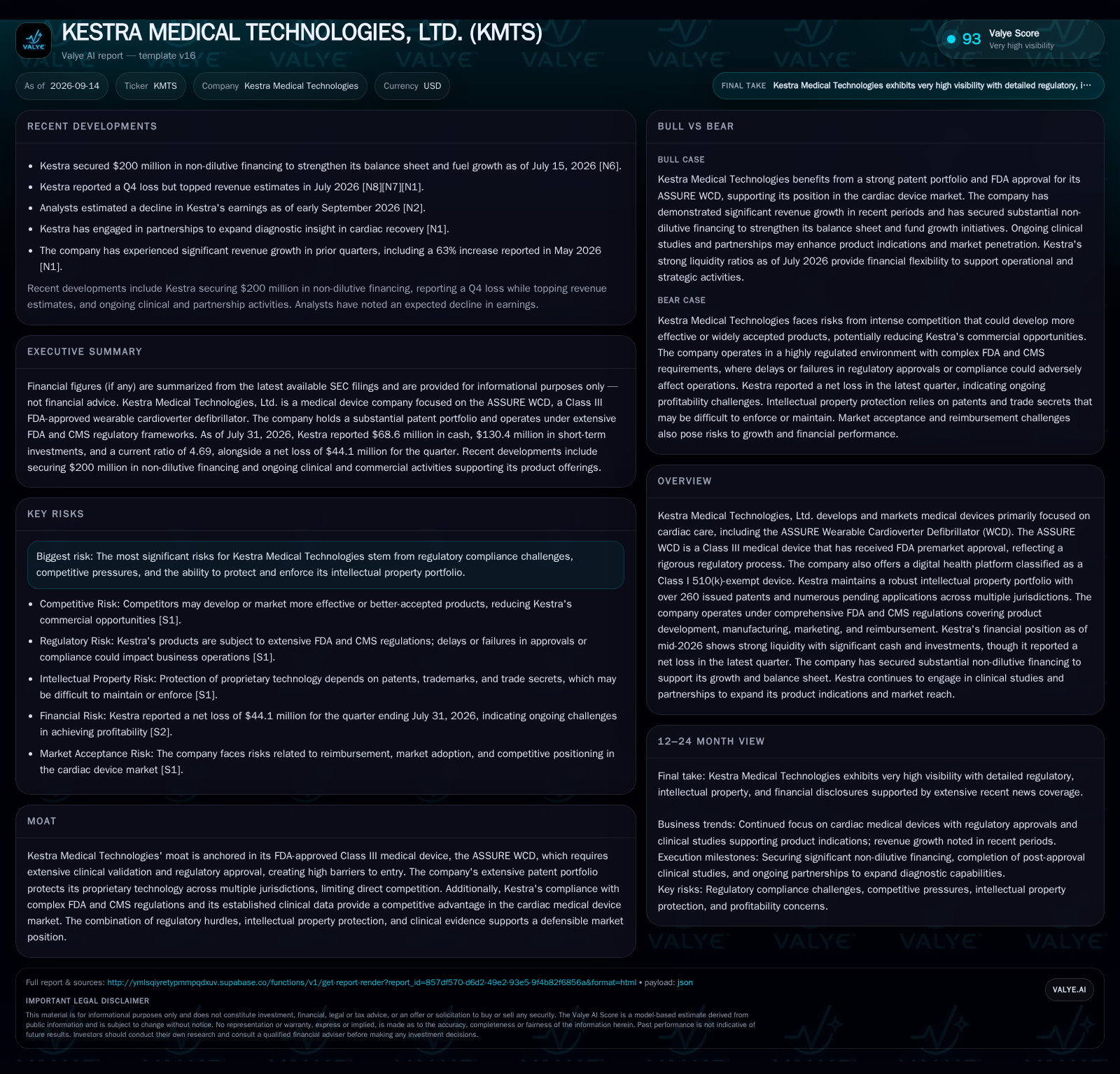
Kestra Medical Technologies, Ltd. develops the ASSURE Wearable Cardioverter Defibrillator (WCD), a Class III FDA-approved device supported by over 260 patents. The company holds a reported liquidity position (current ratio 4.69 as of July 2026) but reported a net loss of $44.1 million in the latest quarter. While recent revenue growth and partnerships signal commercial momentum, analysts expect continued earnings pressure. Kestra’s future depends on scaling adoption amid high regulatory, reimbursement, and competitive hurdles, with profitability and durable market share still unproven. [S2] [N1] [N2]
Kestra Medical Technologies stands at the intersection of high-stakes innovation and operational strain. With its FDA-approved ASSURE Wearable Cardioverter Defibrillator (WCD) and a substantial global patent portfolio, the company has established formidable barriers in the cardiac device market. However, continued net losses and the complexities of scaling a Class III medical device in a reimbursement-driven, competitive landscape cast uncertainty on its path to durable profitability. The coming quarters will test whether Kestra’s clinical and regulatory achievements can translate into a sustainable business model that withstands competitive and financial pressures.
Recent Financials and Regulatory Milestones Set the Stage
Kestra Medical Technologies reported a net loss of $44.1 million and basic and diluted EPS of -$0.75 for the quarter ending July 31, 2026, despite topping revenue estimates. The company reported $68.6 million in cash, $130.4 million in short-term investments, and a current ratio of 4.69. This balance-sheet position may provide potential financial flexibility for continued investment in R&D, clinical studies, and market expansion, but it also underscores ongoing profitability challenges. The ASSURE WCD, Kestra’s flagship product, maintains its FDA PMA status, while the company’s patent portfolio—264 issued, 125 pending—remains a key competitive asset. Analysts forecast further earnings pressure, highlighting the tension between commercial momentum and sustained losses. [S2] [N1] [N2]
Monetization Mechanisms and the Profitability Challenge
Kestra’s revenue model likely depends on a mix of outright device sales, potential leasing, and service contracts, typical for advanced cardiac devices. The ASSURE WCD’s Class III status and FDA approval enable access to reimbursement pathways, but reimbursement rates, payer coverage, and patient eligibility criteria can constrain volume and pricing. Fixed costs are high due to R&D, regulatory compliance, and ongoing clinical validation, while variable costs include manufacturing, distribution, and support. Operating leverage could improve as volumes scale, but persistent net losses suggest that Kestra has not yet achieved the critical mass required for profitability. The capital-intensive nature of clinical trials and regulatory compliance creates high upfront costs, and the need for continued investment in post-market studies and potential new indications may limit near-term margin expansion.
A critical factor influencing Kestra’s path to profitability is the structure and predictability of its revenue streams. While device sales generate upfront revenue, the potential for recurring income through service contracts, software updates, or remote monitoring could enhance long-term margins and customer retention. However, establishing such recurring revenue models in the cardiac device space often requires significant initial investment in infrastructure and customer education, as well as convincing payers to reimburse ongoing services. Additionally, the timing and scale of reimbursement approvals directly impact cash flow, making payer negotiations a pivotal element in the company’s monetization strategy. Without a stable recurring revenue base, Kestra’s financial performance may remain volatile and heavily dependent on new device sales cycles.
Cost dynamics in the cardiac device market extend beyond manufacturing to include substantial expenses related to regulatory compliance and post-market surveillance. Given the Class III designation of the ASSURE WCD, Kestra must maintain rigorous quality assurance and reporting systems, which can be resource-intensive and subject to evolving regulatory requirements. These ongoing costs can constrain margin expansion, especially if new clinical data necessitate additional studies or if regulatory bodies impose stricter conditions. Moreover, scaling manufacturing to meet increased demand without compromising quality presents operational risks. Efficient supply chain management and cost control in production will thus be essential to improve unit economics as volumes grow.
Defensible Moat Meets Aggressive Cardiac Device Competition
Kestra’s primary competitive advantages are its FDA-approved ASSURE WCD, a deep patent portfolio, and demonstrated compliance with rigorous regulatory standards. These create high barriers for new entrants, especially in the U.S. and other regulated markets. However, the cardiac device market is crowded with established medical technology companies offering implantable defibrillators, alternative wearable solutions, and integrated cardiac monitoring. Larger competitors often benefit from broader distribution, established hospital relationships, and greater pricing power. Technology substitution remains a risk: advances in implantable devices or remote monitoring could erode the wearable segment’s addressable market. Kestra’s partnerships to expand diagnostic insights may help differentiate its offering, but long-term retention and pricing power are unproven in the absence of recurring or bundled service contracts.
Pathway to Scale: Clinical Validation Drives Adoption and Margin Expansion
In a favorable scenario, Kestra leverages its regulatory approvals, clinical data, and partnerships to accelerate adoption of the ASSURE WCD across hospitals, cardiology practices, and post-acute care settings. Broader payer coverage and improved reimbursement terms could unlock greater patient access, while additional indications or geographies expand the addressable market. As device volumes grow, fixed costs are leveraged, boosting gross margin and moving the company toward profitability. Confirmation of this scenario would require disclosure of rising unit volumes, improved gross margins, expanded payer contracts, and positive post-market clinical outcomes. Additional FDA approvals or successful new clinical trials would further validate the growth trajectory. Falsification would occur if revenue growth stalls, gross margins remain flat, or no new payer agreements materialize despite clinical data.
Incremental Gains Amid Ongoing Market and Cost Pressures
The most plausible near-term trajectory is one of gradual revenue growth, supported by ongoing clinical studies and selective partnerships, but offset by continued operating losses. Kestra may gain incremental share in select cardiac care settings, especially where wearable solutions are preferred or implantable devices are contraindicated. However, competitive pricing, reimbursement delays, and the need for continued investment in regulatory compliance and market development likely prevent a near-term inflection to profitability. Evidence for this scenario would include steady but unspectacular revenue growth, stable or slightly improving gross margins, and persistent negative EPS. This path could shift if Kestra either accelerates adoption through a major partnership or faces an unexpected regulatory or reimbursement setback.
Profitability Elusive: Regulatory or Reimbursement Setbacks Amplify Losses
A negative scenario could unfold if Kestra faces regulatory delays, adverse post-market study results, or setbacks in payer coverage, restricting the addressable market for the ASSURE WCD. Intense competition could lead to pricing pressure or loss of key accounts, while high fixed costs amplify the impact of revenue shortfalls. If clinical data fail to support broader indications or regulatory authorities impose new requirements, Kestra may be forced to increase spending on studies and compliance, deepening losses. Confirmation would come from revenue declines, shrinking gross margins, additional fundraising needs, or negative regulatory or reimbursement news. Falsification would require evidence of sustained adoption and margin resilience even amid industry headwinds.
What Will Validate Kestra’s Cardiac Device Thesis?
Quarterly device unit volume growth and average selling prices—if disclosed—would directly test the adoption curve and pricing power.
Updates on payer coverage and reimbursement rates for the ASSURE WCD, including wins with major insurers or CMS.
Gross margin trends: sustained improvement would indicate operating leverage and better cost control.
Results from ongoing or new clinical studies, especially those supporting expanded indications or demonstrating superior outcomes.
Progress on regulatory approvals in new markets or for new indications, which could expand Kestra’s addressable market.
Retention rates, renewal rates, or evidence of recurring revenue from service or monitoring contracts—if disclosed.
Competitive developments, such as new product launches or pricing moves by major cardiac device players.
Cash burn rate and any new financing activities, as persistent losses could eventually constrain strategic flexibility.
Disclaimer: This is research-only, informational analysis and not investment advice. It may include AI-generated interpretation and general industry context. Always verify important details using primary sources.

Comments