
Uranium Royalty Corp.: Royalty Model Meets Liquidity Strain as Debt Maturity Looms
A recent restructuring has left Uranium Royalty Corp. with a consolidated Western U.S. portfolio and experienced leadership, but the company’s working capital deficit and January 2027 debt maturity cast a shadow over its ability to monetize assets or secure favorable financing.
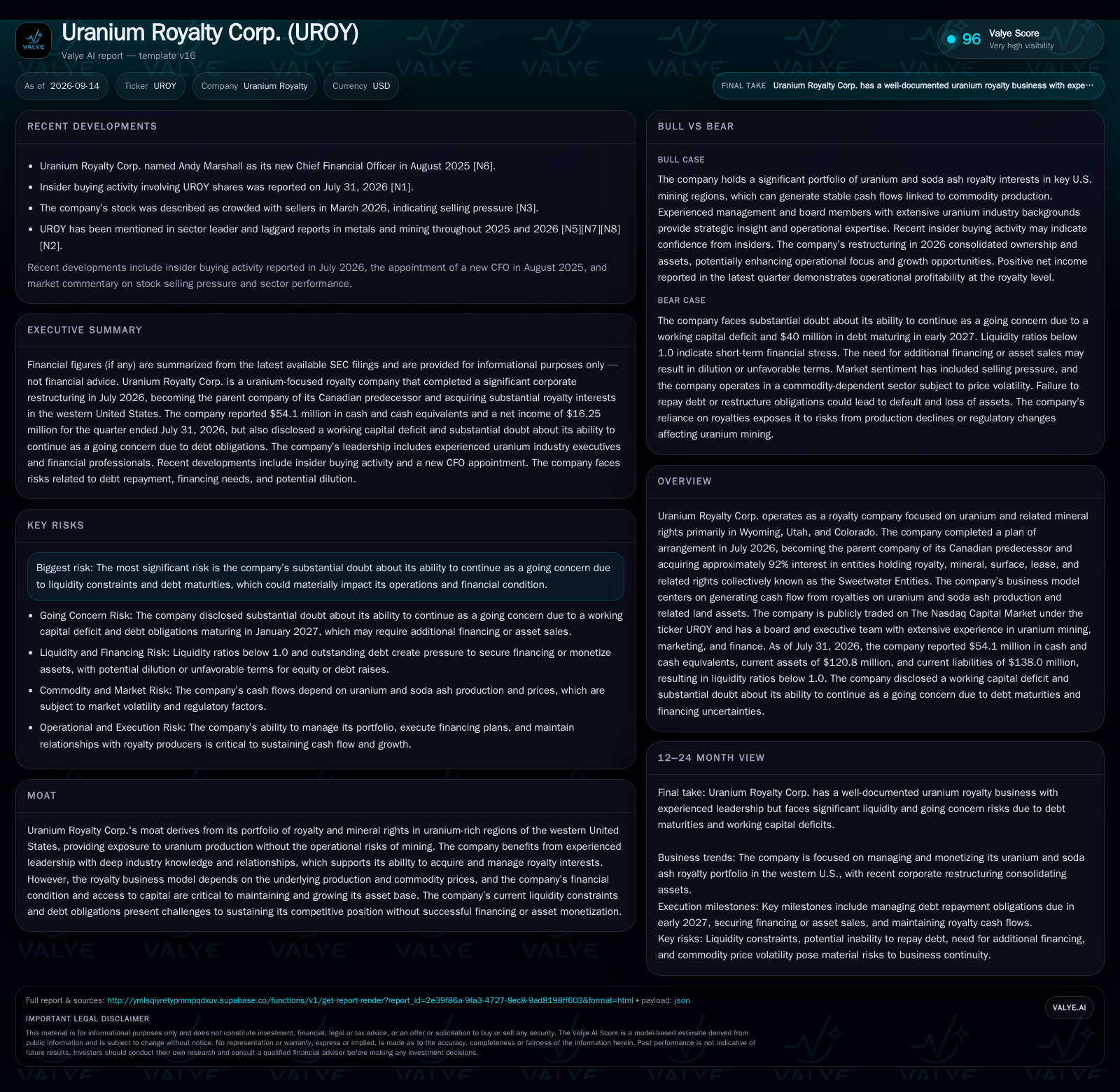
Uranium Royalty Corp. completed a major restructuring in July 2026, consolidating a 92% interest in royalty-bearing assets across Wyoming, Utah, and Colorado. Despite posting net income of $16.25 million for the latest quarter, the company faces a working capital deficit, sub-1.0 liquidity ratios, and $40 million in debt due in early 2027. With substantial doubt raised about its ability to continue as a going concern, UROY’s future hinges on its ability to monetize assets, generate royalty cash flow, or secure new financing before debt matures. Insider buying and experienced management are positives, but operational flexibility is constrained by financial stress. [S2] [N1] [N3] [N6]
Uranium Royalty Corp. stands at a pivotal juncture after a sweeping restructuring that consolidated its uranium and soda ash royalty interests across the Western United States. While the company’s asset-light royalty model and experienced leadership offer strategic advantages, its financial footing has eroded: a working capital deficit, low liquidity ratios, and $40 million in debt maturing within months have prompted management to warn of substantial doubt about ongoing viability. With markets showing selling pressure and the window to refinance or monetize assets narrowing, the next year will likely determine whether UROY can transition from financial stress to sustainable royalty-driven cash flow.
Recent Restructuring and Imminent Debt Maturity Define the Current Landscape
Uranium Royalty Corp. completed a significant corporate restructuring in July 2026, becoming the parent company of its Canadian predecessor and acquiring approximately 92% interest in entities holding royalty, mineral, surface, lease, and related rights in Wyoming, Utah, and Colorado. This move consolidated its asset base in key U.S. mining regions and streamlined ownership of its royalty portfolio. However, as of July 31, 2026, the company reported a working capital deficit of $17.25 million, with current assets of $120.8 million against current liabilities of $138.0 million, resulting in a current ratio of 0.88 and a cash ratio of 0.39. Most critically, $40 million under a senior secured revolving credit facility matures in January 2027, leading management to disclose substantial doubt about the company's ability to continue as a going concern within a year of the financial statement date. The company reported net income of $16.25 million in the latest quarter, but this profitability is overshadowed by the near-term need to address debt and liquidity challenges. [S2]
Royalty Model Offers Scalable Margins, But Liquidity Pressure Curtails Optionality
Uranium Royalty Corp.’s business model is built on acquiring royalty interests in uranium and soda ash production, entitling it to a fixed percentage of revenue or production from third-party operators. This structure is asset-light, requiring limited capital expenditure compared to direct mining, and can deliver high incremental margins when commodity production and prices are robust. Fixed costs are generally low, as ongoing operations are managed by the underlying producers, allowing a large portion of royalty revenue to flow through to earnings.
However, the company’s capital structure is now a constraint. With $40 million in debt due within months and liquidity ratios below 1.0, UROY’s ability to fund new royalty acquisitions or withstand production shortfalls is limited. The royalty model’s scalability is undermined if access to capital markets or asset sales becomes costly or dilutive. While positive net income suggests current portfolio cash flows are covering expenses, the working capital deficit and looming debt maturity mean that any delay or reduction in royalty receipts—or further weakness in uranium or soda ash prices—would quickly exacerbate financial stress. The need for near-term financing, asset sales, or equity raises may also erode future returns for shareholders.
Portfolio Breadth and Industry Expertise Face Counterforces from Financial Constraints and Commodity Volatility
UROY’s competitive edge lies in its concentrated portfolio of royalty and mineral rights in key uranium-producing regions of the Western U.S., which provides direct exposure to uranium market upside without the operational risks of mining. Its leadership team, including CEO Scott Melbye and Chairman Amir Adnani, brings deep sector expertise and relationships that can support deal sourcing and commercial negotiation.
Yet, the royalty business is inherently leveraged to third-party production and commodity prices. Unlike operators, royalty holders have little control over the pace of mine development, production, or operating costs. In addition, UROY’s financial stress—evidenced by its working capital deficit and near-term debt—could weaken its negotiating leverage in acquiring new royalties or retaining assets during downturns. Competitors, including other royalty companies and institutional investors, may have lower funding costs or greater balance sheet flexibility, allowing them to outbid UROY for attractive deals or withstand cyclical downturns with less dilution or asset sales. Furthermore, if uranium prices soften or regulatory pressures increase, the risk of production deferrals or mine closures could directly impact royalty revenue.
Accelerated Asset Monetization and Favorable Commodity Cycle Could Restore Potential Financial Flexibility
A favorable outcome for UROY would involve a combination of robust uranium and soda ash production, supportive commodity prices, and successful monetization of non-core assets or new royalty streams. If underlying mines ramp production and royalty revenues accelerate, the company could generate sufficient cash flow to service or partially repay its maturing debt, reducing the need for dilutive equity issuance or distressed asset sales.
Further, if UROY is able to sell or securitize a portion of its royalty interests at attractive valuations, or refinance its credit facility on favorable terms, it could restore its liquidity buffer and regain the operational flexibility to pursue growth opportunities. Evidence supporting this scenario would include a material increase in royalty receipts, successful asset sales at or above book value, new royalty acquisitions without excessive dilution, or a refinancing of the $40 million debt with extended maturities and manageable covenants. Insider buying, as reported recently, may signal management’s confidence in such a turnaround, but sustained improvements in liquidity and cash flow would be required to confirm the upside pathway. [N1]
Stabilization Hinges on Timely Refinancing and Maintenance of Royalty Cash Flows
The most plausible path for Uranium Royalty Corp. is one of financial triage and stabilization. In this scenario, the company manages to refinance or roll over its $40 million debt—potentially at less favorable terms, but without triggering a liquidity crisis or forced asset sales at distressed prices. Royalty receipts remain stable, supported by ongoing production from its portfolio mines, but limited access to capital markets or higher borrowing costs restricts new royalty acquisitions and growth.
Shareholder dilution may occur if equity is raised to bridge the working capital gap, but management’s industry connections and track record help maintain confidence among lenders and investors. The company’s asset base remains intact, but the focus shifts from expansion to cash preservation and debt management. Confirmation of this scenario would involve announcement of a debt refinancing agreement, stable or modestly growing royalty revenue, and absence of large-scale asset disposals or material production interruptions.
Default Risk Escalates if Asset Sales or Financing Fall Short Before Debt Maturity
The adverse scenario emerges if UROY is unable to secure new financing, monetize assets, or generate sufficient royalty cash flow ahead of its January 2027 debt maturity. In this case, liquidity would deteriorate rapidly, potentially forcing distressed asset sales at discounts or triggering a default under its senior secured credit facility. Default could result in foreclosure on key royalty assets, significant loss of shareholder value, and possible restructuring or bankruptcy proceedings.
This scenario could be confirmed by a continued decline in royalty receipts, failure to announce refinancing or asset sale transactions as the debt maturity nears, or public statements from management indicating inability to meet obligations. Market sentiment could further deteriorate, as seen in reports of heavy selling pressure earlier in 2026, amplifying dilution risk if equity must be raised under duress. [N3]
Milestones That Will Determine UROY’s Path Through Its Liquidity Crisis
Announcement of debt refinancing or extension for the $40 million facility prior to January 2027 maturity.
Quarterly royalty revenue and cash receipts from uranium and soda ash production—if disclosed—to gauge the stability and growth of core cash flows.
Material asset sales or securitizations, including transaction terms and whether proceeds are sufficient to cover working capital and debt repayment needs.
Equity or convertible debt issuance, including pricing, dilution, and use of proceeds, especially if raised under strained market conditions.
Updates on working capital position, current ratio, and unrestricted cash in quarterly filings, as improvements would indicate progress toward resolving going concern risk.
Changes in leadership or board composition, which could signal shifts in strategic direction or confidence in management’s ability to navigate the crisis.
Commodity price movements for uranium and soda ash, as sustained weakness would pressure royalty revenue and exacerbate liquidity risk.
Disclaimer: This is research-only, informational analysis and not investment advice. It may include AI-generated interpretation and general industry context. Always verify important details using primary sources.

Comments