
Marwynn Holdings: Early-Stage Diversification and the Execution Test in E-Waste, AI, and Supply Chain
Marwynn Holdings is repositioning itself as an energy- and technology-focused holding company, with active development in e-waste recycling and AI infrastructure, while legacy food and beverage operations adapt to shifting trade realities. The company's near-term trajectory will be shaped by its ability to scale new platforms, navigate competitive pressures, and manage capital needs amid thin early-stage economics.
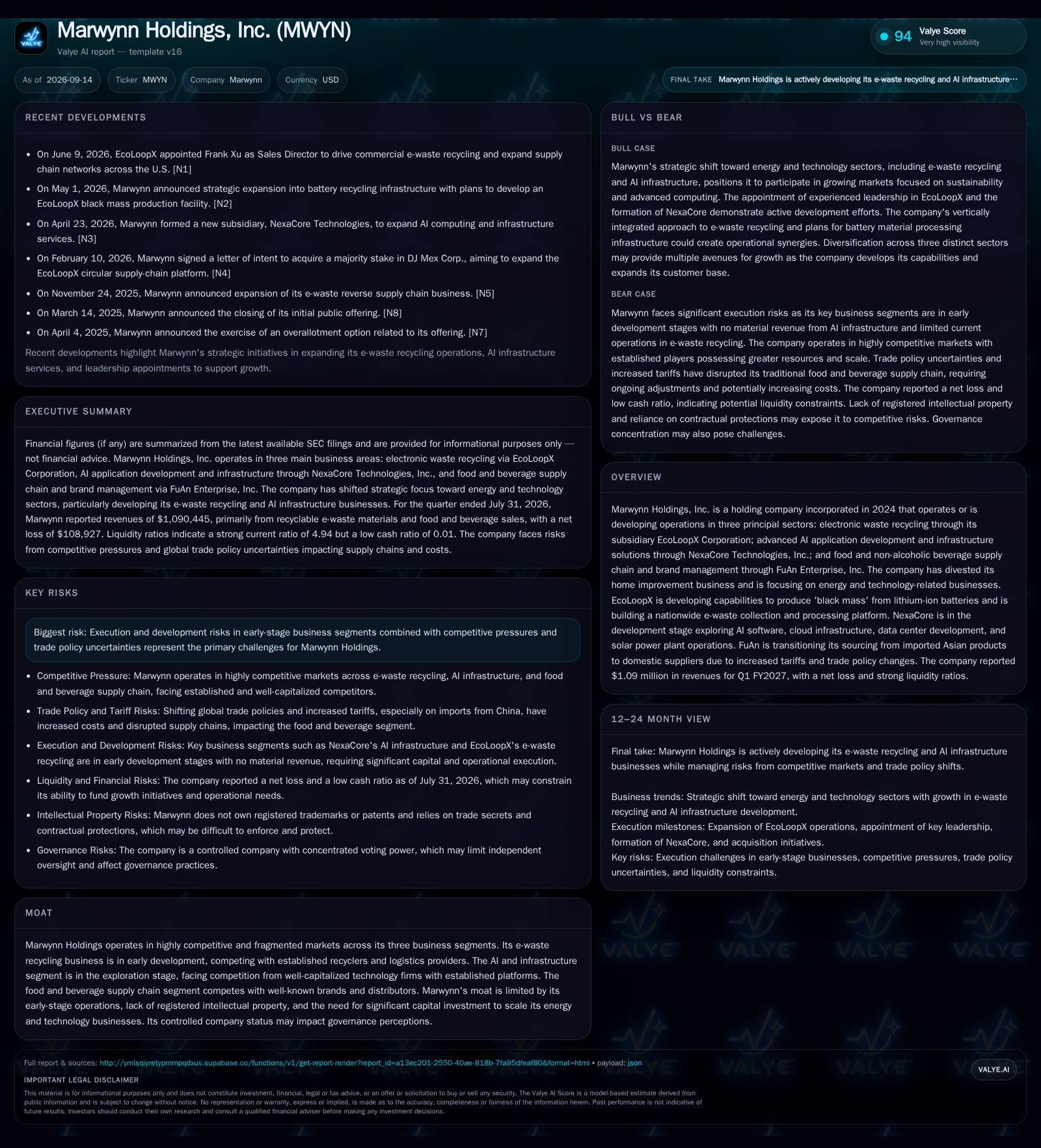
Marwynn Holdings is shifting its strategic emphasis from legacy supply chain businesses to growth opportunities in e-waste recycling and AI infrastructure. The company reported $1.09 million in quarterly revenue, with over half from recyclable e-waste, but remains loss-making and capital-constrained. Execution risk is high, with no material revenue yet from AI initiatives and intense competition across all segments. Near-term value hinges on Marwynn’s ability to scale its recycling and technology platforms, diversify supply sources, and manage costs in the face of trade headwinds and limited liquidity. [S2]
Marwynn Holdings, Inc. is at an inflection point, having divested its home improvement business and refocused on three disparate sectors: e-waste recycling, AI infrastructure, and food and beverage supply chain. The company’s latest results reveal a tilt toward e-waste as its primary revenue source, while its AI platform remains pre-commercial. However, Marwynn faces an uphill battle—balancing early-stage development costs, significant capital requirements, and stiff competition in all segments. The company’s ability to scale new platforms, diversify its revenue mix, and maintain potential financial flexibility will determine whether its strategic pivot delivers durable value or exposes it to prolonged execution and liquidity risk.
E-Waste Takes Center Stage, AI Still Pre-Revenue, Food Supply Chain Adapts
For the quarter ended July 31, 2026, Marwynn Holdings generated $1.09 million in revenue, with 52.31% coming from recyclable e-waste material sales and 41.27% from food and beverage distribution. Consulting services contributed a modest 6.42%. The company posted a net loss of $108,927, with a basic and diluted EPS of -$0.005. Cash and equivalents stood at $3,541, and the current ratio was a robust 4.94, but the cash ratio was just 0.01, signaling that liquidity is mostly tied up in non-cash assets. The NexaCore AI and infrastructure business remains in the development stage, with no material revenue yet. Meanwhile, FuAn’s food and beverage segment is coping with higher costs and supply disruptions following increased tariffs on Chinese imports, prompting a transition toward domestic sourcing. [S2]
Recent developments include the appointment of Frank Xu as Sales Director for EcoLoopX to expand e-waste collection networks, and the announcement of plans for a battery recycling facility focused on 'black mass' production. These moves indicate a strategic emphasis on energy materials and technology solutions, but their commercial impact is still unproven. [N1] [N2]
How Marwynn’s Multi-Segment Model Could Create—and Consume—Value
Marwynn’s economics hinge on three very different business models. EcoLoopX’s e-waste operations generate revenue by sourcing e-waste and scrapped copper, processing or brokering these materials, and selling recovered metals such as lithium, nickel, cobalt, and copper. If the company succeeds in vertically integrating collection and processing, it could capture more margin by moving up the value chain from commodity trading to materials refining. However, this approach is capital-intensive, requiring upfront investments in logistics, processing technology, and compliance infrastructure. Margins in e-waste recycling can be thin and volatile, dictated by commodity prices and processing yields.
NexaCore’s AI and infrastructure ambitions—enterprise AI software, IaaS, cloud storage, data center, and solar power plant operations—could, if successful, offer higher-margin, recurring revenue streams. However, the segment is still pre-commercial, and the economics are likely to be initially negative due to heavy development costs and the need for significant capital outlays for data center and infrastructure buildout. The capital requirements and customer acquisition costs in these markets are notoriously high, with profitability often hinging on scale and utilization rates.
FuAn’s food and beverage supply chain faces a mature, low-margin environment, now complicated by tariffs and supply chain disruptions. The shift to domestic sourcing may help mitigate tariff risk but could raise input costs and require new supplier relationships, affecting working capital needs and potentially compressing margins further.
Operating leverage for Marwynn is currently limited. Fixed costs are rising due to public company compliance and development initiatives, while revenue growth is not yet sufficient to absorb these costs. The company’s low cash ratio raises questions about its ability to; these figures do not by themselves establish operating, investment, or financing capacity.
Competitive Dynamics: Fragmentation, Scale Disadvantages, and IP Gaps
Marwynn faces formidable competition across all three business lines. In e-waste recycling, established players—including large integrated waste management firms and specialized recyclers—benefit from scale, established logistics, and, in many cases, proprietary processing technology. Marwynn’s lack of registered patents or proprietary IP makes it vulnerable to technology substitutes and price-based competition. Its planned vertical integration could help differentiate on service and reliability, but building such a platform requires significant time and capital.
In AI and infrastructure, Marwynn is entering a market dominated by well-capitalized technology giants with mature platforms, extensive partner networks, and high customer switching costs. Without proprietary technology, unique data assets, or a clear ecosystem advantage, Marwynn’s path to relevance may depend on finding underserved niches or leveraging operational synergies with its other segments.
The food and beverage supply chain business is highly fragmented, with established importers, distributors, and domestic brands competing on price, speed, and quality. The shift to domestic sourcing may reduce tariff exposure but puts Marwynn in direct competition with entrenched U.S. distributors.
Across all segments, Marwynn’s controlled company status (with its CEO and chair controlling over 90% of voting power) may provide strategic flexibility but could be perceived as a governance risk by outside investors, potentially impacting access to capital and partnership opportunities.
What Success Would Look Like: Execution, Scale, and Synergy Across Platforms
A favorable trajectory for Marwynn would require rapid scaling of EcoLoopX’s e-waste operations, successful commissioning of the planned battery recycling facility, and the establishment of a nationwide collection and processing network. If the company can secure reliable e-waste supply contracts, improve processing yields, and lock in offtake agreements for black mass or recovered metals, it could drive revenue growth and margin expansion even in a competitive market.
On the technology side, a breakthrough with NexaCore—such as landing anchor enterprise customers, launching a differentiated AI or infrastructure product, or forming strategic partnerships—could accelerate commercialization and provide a higher-margin revenue stream. If synergies emerge between Marwynn’s recycling and technology businesses (e.g., closed-loop supply chains for battery materials leveraging AI-driven logistics), the company could create a defensible niche.
Confirmation of this scenario would come from: (1) sustained sequential revenue growth in the e-waste segment; (2) evidence of successful facility commissioning and utilization; (3) initial commercial contracts or pilots for NexaCore; and (4) improved gross and operating margins driven by scale and integration.
Incremental Progress Amid Capital and Execution Constraints
The most plausible near-term outcome is that Marwynn achieves modest growth in e-waste revenues as its collection and processing network expands, but faces ongoing margin pressure due to competition and commodity price volatility. NexaCore likely remains in the investment and development phase, with limited or no material revenue contribution for several quarters. FuAn’s food and beverage business may stabilize as domestic sourcing matures, but is unlikely to deliver significant growth or margin expansion.
Operating costs—including public company compliance and early-stage development—are likely to keep the company in a net loss position unless it can accelerate revenue growth or materially improve working capital efficiency. The company’s liquidity position, while superficially strong on a current ratio basis, is vulnerable due to the low cash ratio, meaning funding for growth will likely depend on external capital, asset sales, or improvements in inventory and receivables turnover.
Evidence supporting this scenario would include: (1) steady but unspectacular e-waste revenue growth; (2) minimal progress on commercializing NexaCore; (3) continued net losses; and (4) stable but undifferentiated performance in food and beverage.
Execution Stumbles, Capital Shortfalls, and Intensifying Competitive Pressure
The adverse scenario sees Marwynn unable to scale its e-waste operations fast enough to offset development costs, with project delays, supply chain setbacks, or underutilized processing assets eroding returns. NexaCore’s development could stall due to funding gaps, lack of technical differentiation, or inability to attract early customers in a market dominated by incumbents. In food and beverage, failure to secure reliable domestic supply or loss of key distribution relationships could further compress margins or trigger revenue declines.
Liquidity becomes a critical constraint—if operating losses persist and working capital remains tied up in slow-moving inventory or receivables, Marwynn could be forced to dilute shareholders, divest assets, or scale back growth ambitions. Competitive responses from larger, better-capitalized rivals—such as price wars in e-waste or aggressive customer retention in AI—could further challenge Marwynn’s economics.
This scenario would be confirmed by: (1) declining or stagnant revenues in core segments; (2) rising operating losses; (3) deteriorating liquidity ratios; (4) negative project milestones (e.g., delayed facility launches, failed pilots); and (5) inability to secure outside funding or strategic partners.
Milestones That Will Determine Whether Marwynn’s Strategic Pivot Creates Durable Value
Quarterly revenue and gross margin trends in the e-waste segment, especially as new collection channels and processing capacity come online.
Progress and capital deployment toward the planned battery recycling (black mass) facility—announced milestones, commissioning, and initial throughput volumes.
NexaCore’s transition from development to commercial traction: customer pilots, signed contracts, or product launches, if disclosed.
Food and beverage supply chain gross margin and revenue stability as domestic sourcing ramps and tariff pressures persist.
Cash flow from operations and working capital turnover—movement in inventory and receivables, which will affect; these figures do not by themselves establish operating, investment, or financing capacity.
Updates on customer concentration or long-term supply agreements in e-waste and food and beverage segments, if disclosed.
Any new equity or debt financings, asset sales, or strategic partnerships that would extend the company’s runway or accelerate growth.
Disclosures of IP filings, proprietary process development, or technology differentiation, which would help test the sustainability of any competitive advantages.
Disclaimer: This is research-only, informational analysis and not investment advice. It may include AI-generated interpretation and general industry context. Always verify important details using primary sources.

Comments