
Radiant Logistics, Inc.: Profitability, Liquidity, and the Transparency Gap
With sustained profitability and a solid current ratio, Radiant Logistics demonstrates operational discipline—but limited disclosure on its business model and sector clouds the outlook for its competitive edge and growth prospects.
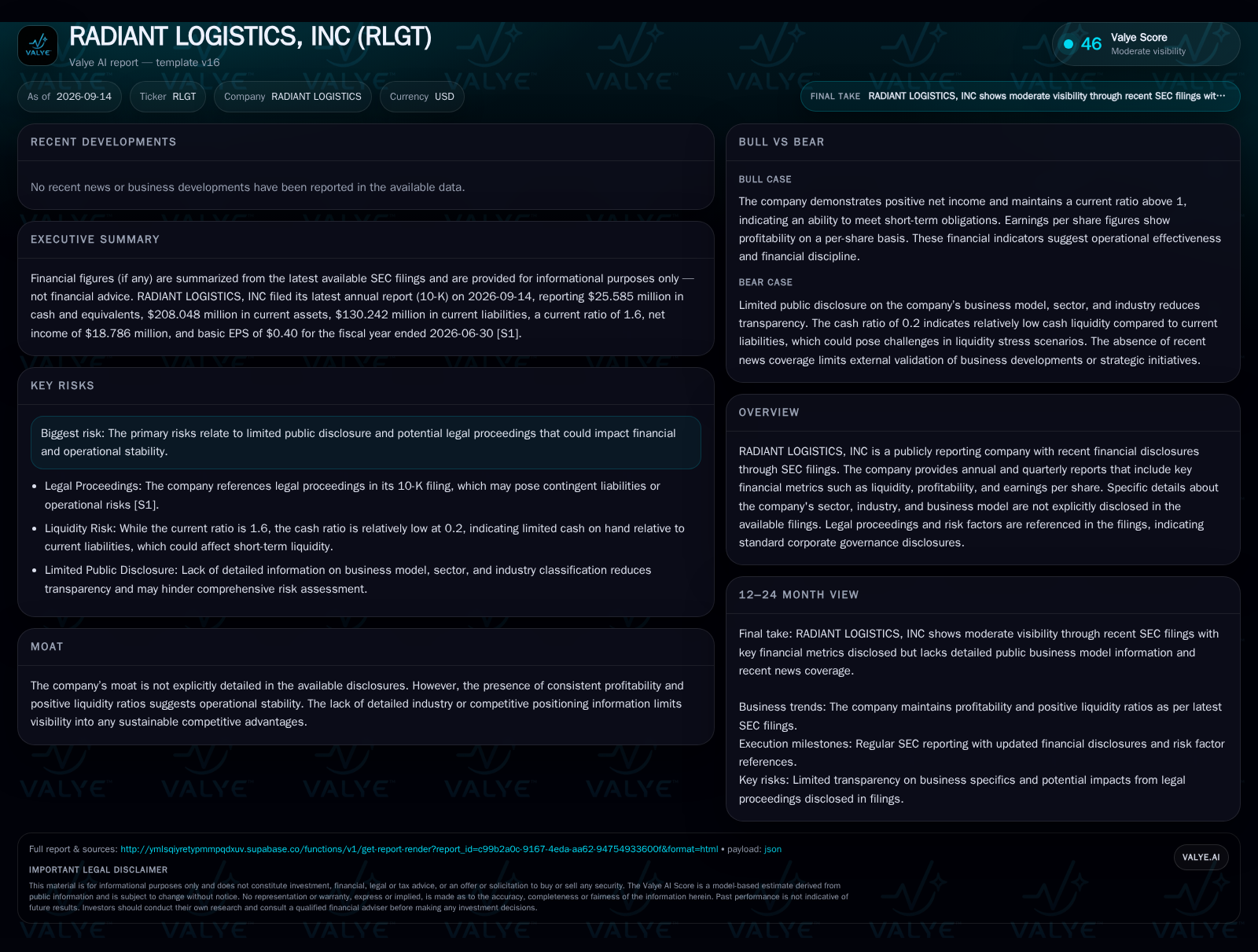
Radiant Logistics, Inc. recently reported a net income of $18.8 million and maintains a current ratio of 1.6, indicating it can cover short-term liabilities. However, a low cash ratio of 0.2 suggests limited immediate liquidity, and the absence of detailed business model or industry information in filings makes it challenging to assess long-term strategy, competitive positioning, or growth drivers. The company also references ongoing legal proceedings, which could pose future risks. Investors should focus on forthcoming disclosures, liquidity management, and clarity on core operations for better thesis validation. [S1]
Radiant Logistics, Inc. presents a paradox familiar in the small- and mid-cap universe: its financials are clear enough to show ongoing profitability and a solid current ratio, yet public disclosures are silent on the company’s sector, operating model, and strategic direction. Investors are left to infer the sustainability and scalability of earnings, as the company’s filings stop short of detailing customer dynamics, revenue streams, or competitive context. This analysis explores what can be gleaned from the numbers, what remains opaque, and which developments could meaningfully shift the thesis as more information emerges.
Recent Financials Spotlight Profitability and Liquidity—but Leave Gaps
Radiant Logistics reported net income of $18.786 million for the fiscal year ending June 30, 2026, with basic and diluted earnings per share of $0.40 and $0.39, respectively. As of the same date, the company held $25.585 million in cash and cash equivalents, with total current assets of $208.048 million and current liabilities of $130.242 million, resulting in a current ratio of 1.6. The cash ratio stands at 0.2, reflecting a relatively low buffer of immediate liquidity against current obligations. Legal proceedings are referenced in the latest 10-K, adding a layer of contingent risk. Notably, there is no recent news or business development disclosure, and filings lack explicit information about the company’s sector, industry, or commercial model. These facts provide a foundation of operational stability but leave considerable uncertainty on strategic positioning and risk exposure. [S1]
Earnings Drivers and Operating Leverage: What the Numbers Suggest and What Remains Unclear
The company’s ability to generate positive net income and maintain a current ratio above 1 suggests effective cost management and a business with at least moderate operating leverage. However, without detail on the revenue model—such as whether income is driven by high-volume, low-margin logistics services, asset-light brokerage, or contractual recurring revenue—it's difficult to gauge the durability or scalability of earnings. If Radiant operates as a third-party logistics provider (3PL), typical in the sector, its economics may depend on transaction volumes, cost pass-throughs, and margin discipline rather than proprietary technology or assets. The cash ratio of 0.2 implies that while receivables and other current assets support liquidity, the company may be exposed to working capital swings or require external financing in periods of stress. Capital needs would likely scale with revenue growth if the business is asset-heavy, or remain moderate if asset-light, but the current filings do not clarify this distinction.
Further analysis of operating leverage would benefit from clarity on fixed versus variable cost structures inherent to Radiant Logistics’ operations. If a significant portion of costs are fixed—such as salaried personnel, leased facilities, or technology infrastructure—the company could experience amplified earnings volatility in response to volume fluctuations. Conversely, a predominantly variable cost base aligned with revenue streams would suggest more stable margins but potentially limited scalability. Additionally, understanding the balance between capital expenditures and operating expenses would illuminate the company’s investment horizon and flexibility. For example, asset-heavy logistics firms often face higher depreciation and maintenance costs, which can constrain free cash flow, whereas asset-light models may prioritize technology and sales investments to drive growth. The absence of segment reporting or cost breakdowns thus impedes a nuanced assessment of profitability drivers and financial resilience.
Competitive Landscape: Unseen Contours and Potential Pressures
The competitive position of Radiant Logistics remains opaque due to a lack of disclosure on industry, peers, or unique value propositions. If the company participates in the logistics sector, it would face intense competition from both global integrators and regional specialists, with pricing power typically limited by customer bargaining leverage and commoditized service offerings. Differentiation in logistics often comes from technology integration, service reliability, network breadth, or niche specialization. Without evidence of proprietary platforms, exclusive customer contracts, or defensible network effects, it's plausible Radiant competes primarily on service and price. Any potential advantages—such as a specialized service niche, technology-enabled efficiencies, or sticky customer relationships—are unconfirmed in current filings. The question is whether operational discipline and profitability stem from sustainable advantages, or simply reflect effective management within a commoditized, margin-sensitive industry.
The competitive dynamics in logistics are often shaped by barriers to entry and customer switching costs, which can vary widely depending on service specialization and geographic footprint. If Radiant Logistics operates in niche markets requiring specialized knowledge, regulatory compliance, or customized solutions, it may benefit from higher customer stickiness and pricing power. In contrast, participation in commoditized freight brokerage or standard transportation services typically results in thin margins and intense price competition. Moreover, technology adoption—such as real-time tracking, predictive analytics, or automated dispatch—can serve as a differentiator, enhancing operational efficiency and customer satisfaction. Without disclosure on technology capabilities or network scale, it is challenging to ascertain whether Radiant can defend against new entrants or substitute services. The company’s ability to adapt to evolving customer expectations and supply chain disruptions would also influence its long-term competitive positioning.
Visibility Improves: Disclosure and Execution Unlock Re-Rating Potential
A favorable scenario would see Radiant Logistics increase public transparency, disclosing sector focus, revenue breakdowns, customer concentrations, and commercial mechanics. If filings reveal a recurring-revenue model, proprietary technology, or a defensible niche—such as managed transportation for high-value goods or complex supply chains—the market could reassess the sustainability and quality of earnings. Evidence of multi-year customer contracts, high retention rates, or a shift toward asset-light, high-margin services would support a re-rating. Confirmation could come through new filings, investor presentations, or independent news coverage detailing strategic initiatives, customer wins, or technology deployments. Falsification would occur if increased transparency exposes a commoditized, low-margin business with high customer churn and limited pricing power.
Ongoing Profitability Amid Limited Strategic Clarity
In the most plausible scenario based on current evidence, Radiant Logistics continues to operate profitably, maintaining adequate liquidity and meeting its obligations, but without significant multiple expansion or strategic inflection. The company remains disciplined in cost controls, but growth is likely constrained by lack of sector differentiation or scalable competitive advantages. Investors receive regular SEC filings but little incremental insight into business mechanics, leaving the stock valued on near-term earnings and liquidity rather than long-term growth or defensibility. This scenario would be confirmed by continued positive net income and stable ratios, but persistent absence of new disclosures, major contract wins, or evidence of business model innovation.
Liquidity Strain or Legal Contingencies Erode Financial Stability
A negative outcome could be triggered by adverse legal developments, a working capital crunch, or a material downturn in operating performance. The low cash ratio exposes Radiant to risk if receivables become impaired or if external financing conditions tighten. Unexpected liabilities from referenced legal proceedings could drain resources or disrupt operations. A sudden loss of major customers, margin compression due to price competition, or operational missteps could push the company into a liquidity shortfall or even covenant breach if debt is present. This downside would be confirmed by declining current ratios, negative operating cash flow, mounting legal expenses, or restatements in financial reporting.
Thesis-Testing Developments for Radiant Logistics: What Could Shift the Outlook
Any new SEC filings or press releases that clarify the company’s business model, sector, or major revenue streams would help test the thesis.
Disclosure of customer concentration, contract structures, or recurring versus transactional revenue, if provided, would illuminate business risk and revenue visibility.
Evidence of technology investment, proprietary platforms, or digital transformation initiatives would suggest potential for margin expansion or differentiation.
Updates on the scope, nature, or resolution of referenced legal proceedings would clarify contingent risks.
Material changes in the cash ratio or working capital structure—particularly if disclosed in quarterly filings—would test liquidity resilience.
Announcements of major new customer wins, partnerships, or strategic initiatives would signal potential growth inflection.
If disclosed, gross margin trends or segment profitability would provide insight into operating leverage and competitive dynamics.
Disclaimer: This is research-only, informational analysis and not investment advice. It may include AI-generated interpretation and general industry context. Always verify important details using primary sources.

Comments