
Childrens Place: Transformation Efforts Collide with Margin Pressure and Liquidity Strain
As The Children’s Place implements cost-saving initiatives amid falling sales and mounting losses, the company’s ability to stabilize its core business and navigate fierce competition will determine whether operational recovery is achievable or further financial distress looms.
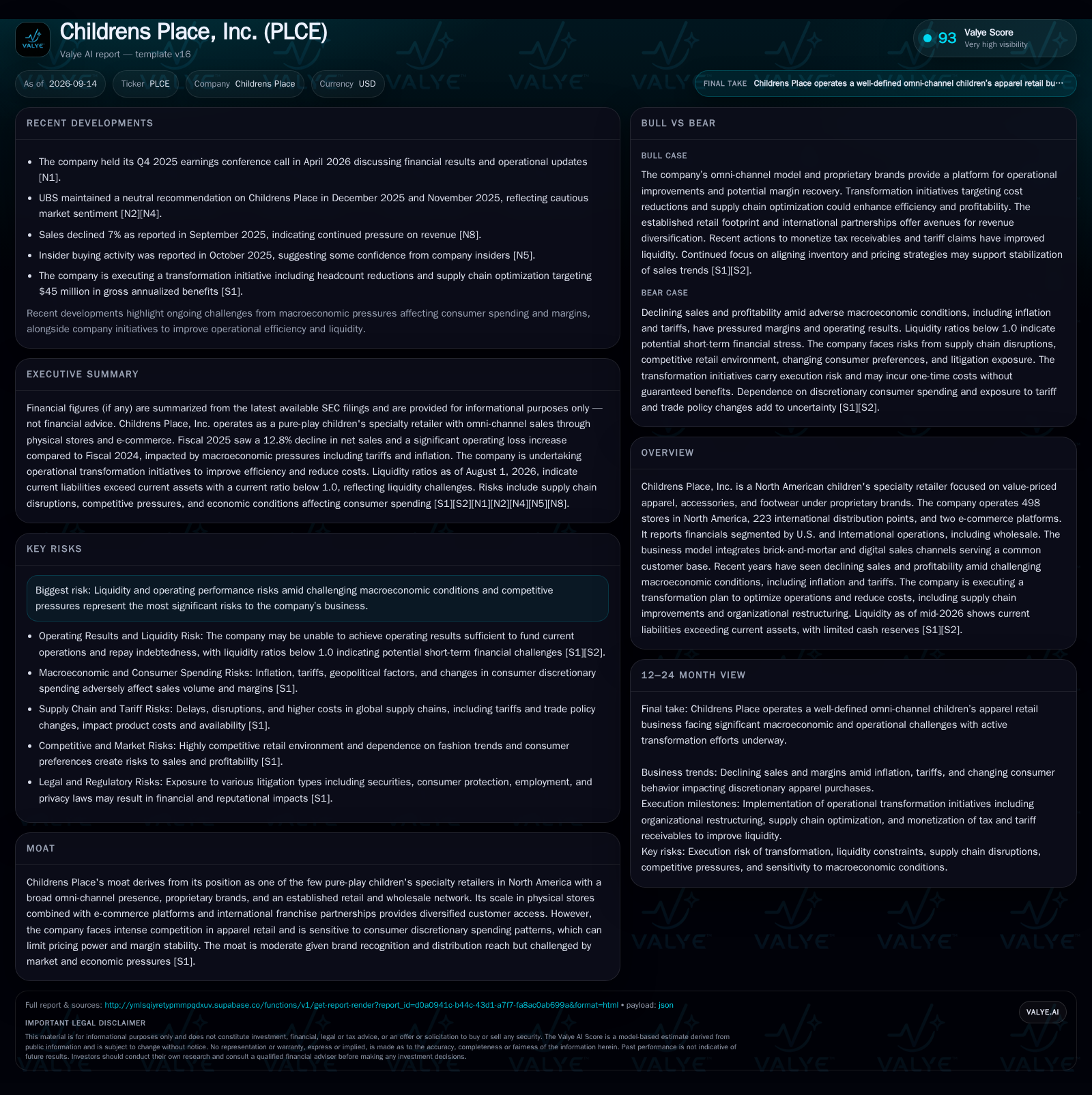
Childrens Place reported a 12.8% decline in net sales and a sharply increased operating loss for Fiscal 2025, with liquidity ratios under 1.0 as of August 2026—indicating near-term financial strain. The company is executing a transformation plan targeting $45 million in annualized cost reductions, but faces ongoing headwinds from inflation, tariffs, and weak consumer demand. Execution risk remains high, and the durability of its omni-channel brand and cost actions will be tested in the coming quarters. [S1] [S2]
The Children’s Place, once a dominant name in North American children’s apparel, is now confronting a convergence of declining sales, margin compression, and acute balance-sheet pressure. With fiscal 2025 net sales down nearly 13% and an operating loss deepening, the company’s recent transformation efforts—including headcount reductions, supply chain optimization, and a new overseas office—are designed to restore profitability and stem liquidity erosion. However, with cash reserves thin and competitive and macroeconomic headwinds persistent, the company’s ability to stabilize remains uncertain. The next phase will test whether operational fixes can meaningfully offset demand weakness and structural retail challenges, or if further distress is inevitable. [S1] [S2]
Recent Financial Strain Underscores Urgency of Transformation
Childrens Place entered the second half of 2026 with a confluence of deteriorating top-line performance and mounting losses. Fiscal 2025 net sales declined 12.8% year-over-year to $1.209 billion, with both e-commerce and brick-and-mortar channels experiencing lower customer traffic and conversion. Gross margin fell by 320 basis points to 29.9%, impacted by increased inventory reserves, tariff headwinds, and aggressive markdowns. Operating loss ballooned to $57.2 million from $13.7 million a year earlier, as fixed costs and deleveraged SG&A outpaced cost reductions. Liquidity remains tight: as of August 1, 2026, the company reported only $7.2 million in cash and equivalents, with current liabilities exceeding current assets (current ratio 0.89), raising questions about near-term potential financial flexibility and runway. [S1] [S2]
Omni-Channel Retail Model Faces Margin Compression and Fixed Cost Drag
The Children’s Place generates revenue through a hybrid model of physical retail, e-commerce, and international franchise/wholesale distribution. Its proprietary brands enable some degree of pricing autonomy, but the core apparel business remains highly sensitive to volume swings and discounting pressure, especially in a value-oriented segment. Fixed costs—including rent, labor, and logistics—are significant, amplifying operating leverage in a negative direction when sales decline. Recent cost-cutting and supply chain initiatives target $45 million in annualized savings, but the bulk of SG&A remains tied to store operations and distribution infrastructure. The company’s ability to convert gross profit into operating income is further challenged by tariff exposure and the need for promotional activity to drive traffic, both of which erode margins. Given the low cash ratio and sub-1 current ratio, any negative working capital cycle or inventory misstep could trigger acute liquidity needs, potentially necessitating asset sales, further borrowing, or capital raises if conditions persist. [S1] [S2]
Brand Reach and Distribution Scale Tested by Shifting Consumer Preferences
Childrens Place’s moat rests on its status as one of the few pure-play children’s specialty retailers with an extensive North American footprint and proprietary brands. Its omni-channel presence and international franchise network provide broad customer access. However, the competitive landscape is fierce: mass merchants, fast fashion, online marketplaces, and vertically integrated direct-to-consumer brands all vie for share in the children's apparel category. Price sensitivity is high, and fashion risk is nontrivial, with rapid shifts in consumer taste and macroeconomic pressures heightening promotional intensity. Digital natives and big-box retailers may benefit from scale-driven cost advantages, more flexible inventory models, and technology-enabled personalization, which could erode Childrens Place’s historical strengths. The company’s international expansion via partners provides incremental reach but may not materially offset North American softness if core brand relevance wanes or if franchisees face similar demand headwinds. [S1]
If Cost Actions and Brand Initiatives Restore Margin, Recovery Is Plausible
A credible recovery for Childrens Place would require a combination of successful execution on transformation initiatives and a stabilization or modest rebound in discretionary apparel demand. If the company realizes the full $45 million in targeted annualized cost savings, and if inventory and pricing discipline reduce the need for margin-dilutive markdowns, operating leverage could work in its favor as volumes recover. Improvement in gross margin—perhaps through streamlined supply chains, favorable tariff developments, or more effective product mix—would be critical. Signs of renewed digital traffic, higher conversion rates, or improved store productivity would support the case that omni-channel investments are resonating with consumers. Upside could be further catalyzed by a more favorable macro environment—such as easing inflation or stronger back-to-school demand—allowing for reduced promotions and recapture of lost share. Evidence for this scenario would include sequential improvement in sales trends, stabilization or expansion of gross margin, and a return to positive operating cash flow. [S1]
Gradual Stabilization Offset by Persistent Margin and Liquidity Constraints
The most plausible path forward is one of gradual stabilization, where transformation efforts slow the rate of decline but do not fully restore historical profitability. Revenue may continue to contract modestly as store traffic and e-commerce conversion remain pressured by weak consumer sentiment and competitive intensity. Gross margin could stabilize at a lower level if inventory and supply chain actions mitigate the worst of the markdowns, but fixed costs and ongoing promotional activity are likely to constrain meaningful margin expansion. Liquidity remains a concern: unless working capital improves or external financing is secured, the risk of covenant breaches or distressed asset sales persists. Confirmation of this scenario would come from continued, but slowing, year-over-year sales declines, modest improvement in expense ratios, and maintenance of operations without further acute liquidity events. Any stabilization would remain fragile, vulnerable to external shocks or execution missteps. [S1] [S2]
Liquidity Erosion and Execution Misses Drive Deeper Distress
The adverse scenario is characterized by continued sales contraction, persistent margin pressure, and a failure to realize transformation savings quickly enough to offset losses. If consumer demand remains weak, inventory mismanagement or further tariff shocks could force deeper markdowns and cash outflows, rapidly depleting already thin reserves. In this case, the company could face a liquidity crisis necessitating emergency financing, asset sales under duress, or even restructuring. Additional risks include adverse litigation, franchise partner pullback, or supply chain disruptions that further impair operations. Signs of this scenario would include accelerating sales declines, further gross margin compression, negative operating cash flow, and worsening current and cash ratios—potentially triggering lender or vendor actions. [S1] [S2]
Milestones That Will Determine If the Transformation Can Succeed
Quarterly net sales and comparable sales trends by channel—especially any inflection in e-commerce traffic or conversion rates—would help gauge demand stabilization.
Gross margin movement, including the impact of inventory reserves, tariffs, and markdown rates, will be critical to tracking profitability restoration.
Progress toward the targeted $45 million in annualized cost savings, and evidence of actual SG&A reduction beyond headcount cuts, would help validate the transformation’s effectiveness.
Liquidity and balance sheet health—specifically cash balances, current ratio, and credit facility utilization—will signal how close the company is to a potential cash crunch.
Store productivity and closure/opening cadence, particularly whether store rationalization is leading to improved sales per square foot or merely loss mitigation.
Inventory turnover rates and levels, as excessive buildup or slow-moving stock could signal further margin risk.
Any updates on franchise or international partner performance, as these may provide incremental growth or highlight broader demand issues.
If disclosed, digital engagement and customer retention metrics, which could indicate whether omni-channel investments are translating into customer loyalty and higher lifetime value.
Disclaimer: This is research-only, informational analysis and not investment advice. It may include AI-generated interpretation and general industry context. Always verify important details using primary sources.

Comments