
Ocean Power Technologies: Autonomous Maritime Solutions at the Crossroads of Recurring Revenue and Execution Strain
OPTT’s integrated hardware-software platform for autonomous ocean monitoring targets defense and commercial clients alike. Despite record backlog and recurring-revenue ambitions, acute liquidity and operational risks threaten the company’s ability to scale and capture the expanding maritime domain awareness market.
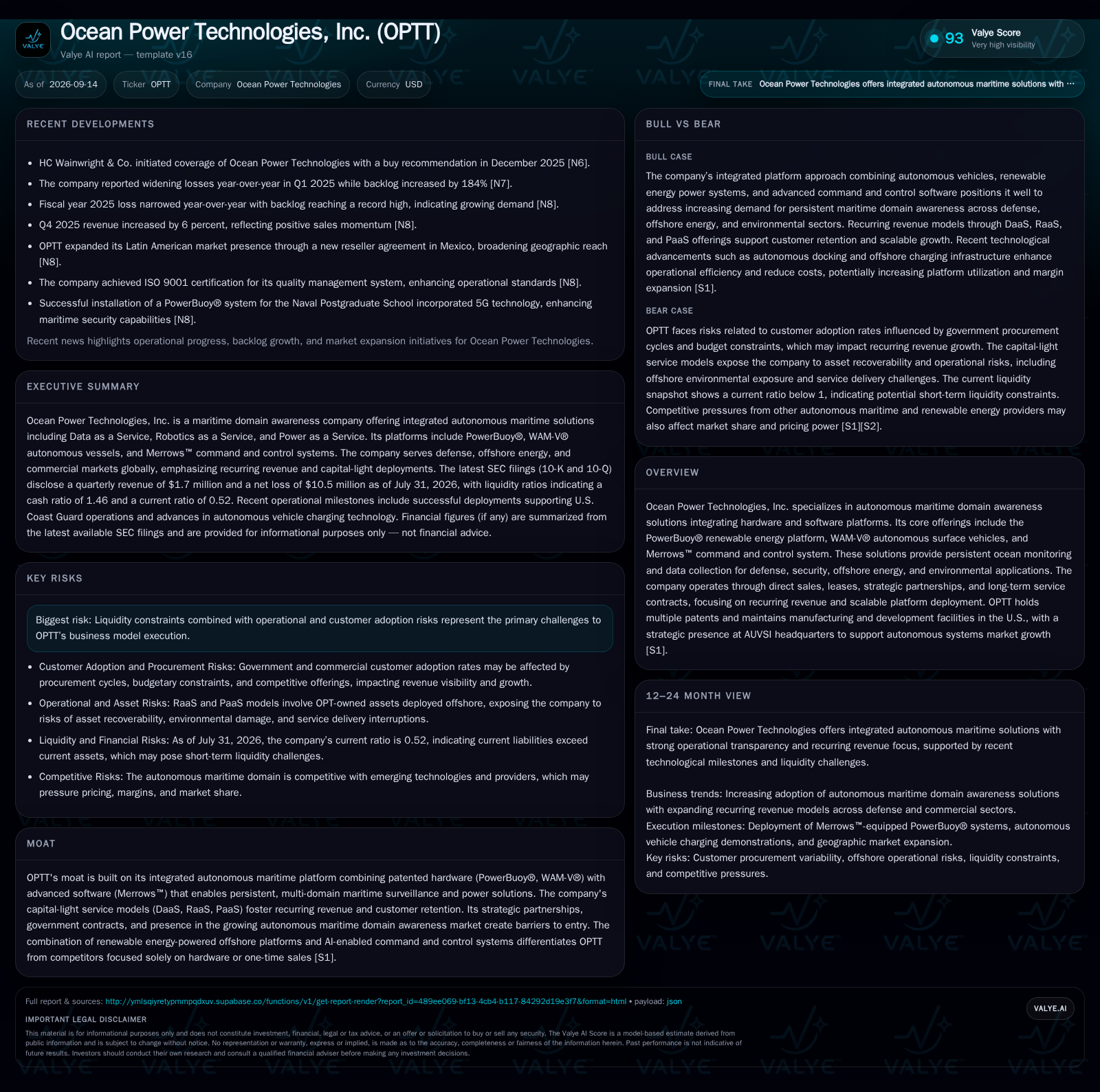
Ocean Power Technologies (OPTT) is advancing autonomous maritime monitoring with its PowerBuoy®, WAM-V®, and Merrows™ platforms, targeting persistent ocean surveillance and data services for defense and commercial customers. The company’s quarterly revenue remains modest at $1.7M, with a net loss of $10.5M and a current ratio of 0.52, signaling liquidity strain. Record backlog and expanding global reach underscore market interest, but success will depend on converting backlog into sustainable recurring revenue, managing capital-light deployments, and navigating procurement and operational risks. Watch for contract execution, customer adoption rates, and further technological validation to determine if OPTT can bridge its financial gap and establish a defensible position in autonomous maritime intelligence. [S1] [S2] [N7] [N8]
Ocean Power Technologies (OPTT) is pushing the frontier of autonomous maritime domain awareness, integrating renewable energy, robotics, and AI-driven command systems to address the growing need for persistent ocean monitoring. While recent backlog growth and technological milestones validate customer interest and platform maturity, the company’s acute liquidity constraints and recurring net losses force a critical examination of its ability to commercialize and scale. The next phase will test whether OPTT’s capital-light, service-driven model can deliver sustainable margins and growth—or whether operational and financial frictions will limit its ambitions.
Liquidity Strain and Growing Backlog Define Near-Term Reality
As of July 31, 2026, OPTT reported $1.703 million in revenue and a net loss of $10.537 million for the quarter. The company’s current ratio stands at 0.52, with $7.356 million in cash and equivalents compared to $29.527 million in current liabilities, signaling a pronounced short-term liquidity squeeze [S2]. Despite these financial headwinds, recent periods have seen record backlog growth—up 184% year-over-year at one point—and geographic expansion with a new reseller agreement in Mexico [N7] [N8]. These developments highlight both the commercial traction of OPTT’s platform and the acute need for successful contract execution and working capital management.
Recurring Revenue Ambitions Meet Capital-Light Realities
OPTT’s stated business model centers on Data as a Service (DaaS), Robotics as a Service (RaaS), and Power as a Service (PaaS), aiming to generate recurring revenue streams by leasing, operating, and maintaining maritime hardware and software for customers [S1]. This approach is intended to reduce upfront capital requirements for clients while fostering long-term relationships and predictable cash flows. However, these capital-light deployments also mean OPTT retains ownership and operational responsibility for assets deployed in challenging offshore environments, introducing risks around asset utilization, maintenance cost, and recoverability.
Revenue mix could theoretically shift toward higher-margin software and services if adoption accelerates, especially as AI/ML integration in the Merrows™ platform enables value-added analytics and operational autonomy. However, current financials reveal that recurring revenues have yet to scale sufficiently to offset persistent losses. The company’s quarterly net loss and negative operating leverage suggest that either contract size, utilization, or pricing must increase materially—or costs must decline—for the business model to become self-sustaining.
Fixed costs related to R&D, manufacturing, and fleet maintenance are likely significant, but the ability to amortize these over a growing installed base is critical for margin expansion. If OPTT can increase asset deployment rates and system utilization without proportional increases in support costs, operating leverage could improve. Conversely, high idle time, maintenance incidents, or slow customer ramp could exacerbate losses.
Integrated Platform Offers Differentiation, But Competitive Barriers Remain Permeable
OPTT’s competitive thesis rests on its integrated approach—combining renewable-powered hardware (PowerBuoy®, WAM-V®), modular sensor payloads, and an AI-enabled command platform (Merrows™)—to deliver persistent, multi-domain maritime surveillance [S1]. This positions the company as a one-stop solution for defense and commercial clients seeking turnkey ocean monitoring, power, and analytics. Patented technology and demonstrated deployments for the U.S. Coast Guard and other agencies provide validation, and recurring revenue models may foster customer stickiness.
However, the autonomous maritime domain is crowded, with competitors ranging from traditional defense contractors and offshore engineering firms to emerging robotics and AI-focused startups. Many offer specialized solutions (e.g., USVs, edge analytics, or satellite data) that could substitute or complement OPTT’s offerings. The durability of OPTT’s moat will hinge on its ability to maintain technical leadership, expand software/service layers, and deepen integration into customer operations. Switching costs for clients may rise if OPTT’s platforms become tightly embedded in mission-critical workflows, but this is not yet proven at scale.
Price competition, procurement cycles, and rapid technology evolution all threaten margin expansion. The company’s ability to defend pricing and renew contracts will depend on demonstrable performance, reliability, and cost-effectiveness relative to both established and emerging alternatives.
If Backlog Converts and Recurring Revenue Accelerates, Margin Expansion Is Plausible
A favorable trajectory for OPTT would see its record backlog converting efficiently into revenue, with high asset utilization across DaaS, RaaS, and PaaS contracts. Success in deploying and operating Merrows™-enabled platforms for major defense and commercial clients could validate the technology and encourage repeat business, anchoring long-term relationships. As recurring revenue grows and service margins expand, the company could amortize fixed costs over a larger installed base, driving operating leverage and reducing per-unit support costs.
Further, if OPTT can demonstrate reliable autonomous operations—such as successful offshore charging, docking, and redeployment—operational risks and downtime may fall, enhancing customer trust and lowering support expense. Geographic expansion, such as the recent move into Latin America, could provide diversification and incremental growth.
Confirming this scenario would require evidence of sequential revenue growth, rising gross margins, recurring contracts with multi-year commitments, and declining cash burn. Large-scale renewals, new multi-year agreements, or publicized contract wins with blue-chip defense or commercial customers would strengthen the case. Conversely, delays in backlog conversion, continued net losses, or customer churn would undermine the upside thesis.
Incremental Adoption and Execution Hurdles Define the Most Likely Path
The most plausible near-term outcome is a gradual scaling of deployments and recurring revenue, tempered by ongoing operational and financial friction. OPTT’s current backlog and customer engagements suggest real demand, but government procurement cycles, budgetary delays, and technical validation periods often result in uneven revenue recognition. Service and maintenance obligations may strain resources and working capital, especially given the company’s low current ratio and persistent net losses.
In this scenario, OPTT manages to convert a portion of its backlog each quarter, with modest revenue growth and incremental gross margin improvement as deployments increase. However, cash burn remains material, and the company may require additional financing or working capital solutions to bridge the gap to self-sufficiency. Margins may improve as platforms mature and operational learning curves flatten, but competitive pricing and customer adoption risks persist.
Supporting evidence would include steady, if modest, sequential revenue growth, improved asset utilization rates (if disclosed), and maintenance of strategic customer relationships. Signs of cost discipline, such as declining SG&A or R&D expense as a percentage of revenue, would also support the base case. Major contract delays, asset write-downs, or inability to obtain additional liquidity would challenge it.
Liquidity Crunch or Asset Failures Could Force Strategic Retrenchment
The adverse scenario for OPTT involves either a failure to convert backlog into cash quickly enough or operational incidents that undermine customer confidence and drive up costs. Acute liquidity strain—already visible in the current ratio—could force the company to curtail deployments, delay R&D, or seek dilutive financing under unfavorable terms. Offshore asset failures, maintenance incidents, or environmental losses could trigger write-downs and erode trust among key clients, particularly in the defense sector where reliability is paramount.
Pricing pressure or loss of competitive bids to better-capitalized or more technologically advanced rivals could further compress margins. If customer adoption stalls, recurring revenue fails to scale, or large contracts are lost or delayed, negative operating leverage would worsen losses and threaten business continuity.
Evidence confirming this scenario would include further deterioration in liquidity ratios, sequential revenue declines, contract cancellations, asset impairment charges, or disclosure of operational incidents. Inability to raise capital or secure bridge financing would force more drastic restructuring or asset sales.
Thesis-Testing Developments for Ocean Power Technologies’ Next Chapter
Sequential revenue growth quarter-over-quarter, especially conversion of record backlog into recognized recurring revenue.
Gross margin trends and the mix of revenue from DaaS, RaaS, and PaaS versus hardware sales (if disclosed).
Asset utilization rates, fleet uptime, and operational incidents for deployed platforms—a useful metric would be fleet-wide availability or downtime.
Customer renewal rates, contract duration, and the proportion of multi-year versus single-year agreements (if disclosed).
Liquidity and capital-raising activity: new financings, credit lines, or working capital infusions.
Evidence of successful deployments and publicized contract wins, especially with large defense or offshore energy customers.
Progress on next-generation WAM-V® architecture and offshore charging infrastructure, as signaled by technological milestone announcements.
Geographic expansion success, such as new reseller agreements or deployments in non-U.S. markets.
Disclaimer: This is research-only, informational analysis and not investment advice. It may include AI-generated interpretation and general industry context. Always verify important details using primary sources.

Comments