
Rapid Line Inc.: High-Stakes Bet on BCI Learning Platform Amid Severe Financial Strain
Rapid Line’s ambitious push into brain-computer interface powered cognitive learning faces a stark reality: no revenue, mounting net losses, and a heavy debt load. The company’s future hinges on translating significant intangible investments into commercial traction before liquidity and solvency risks become acute.
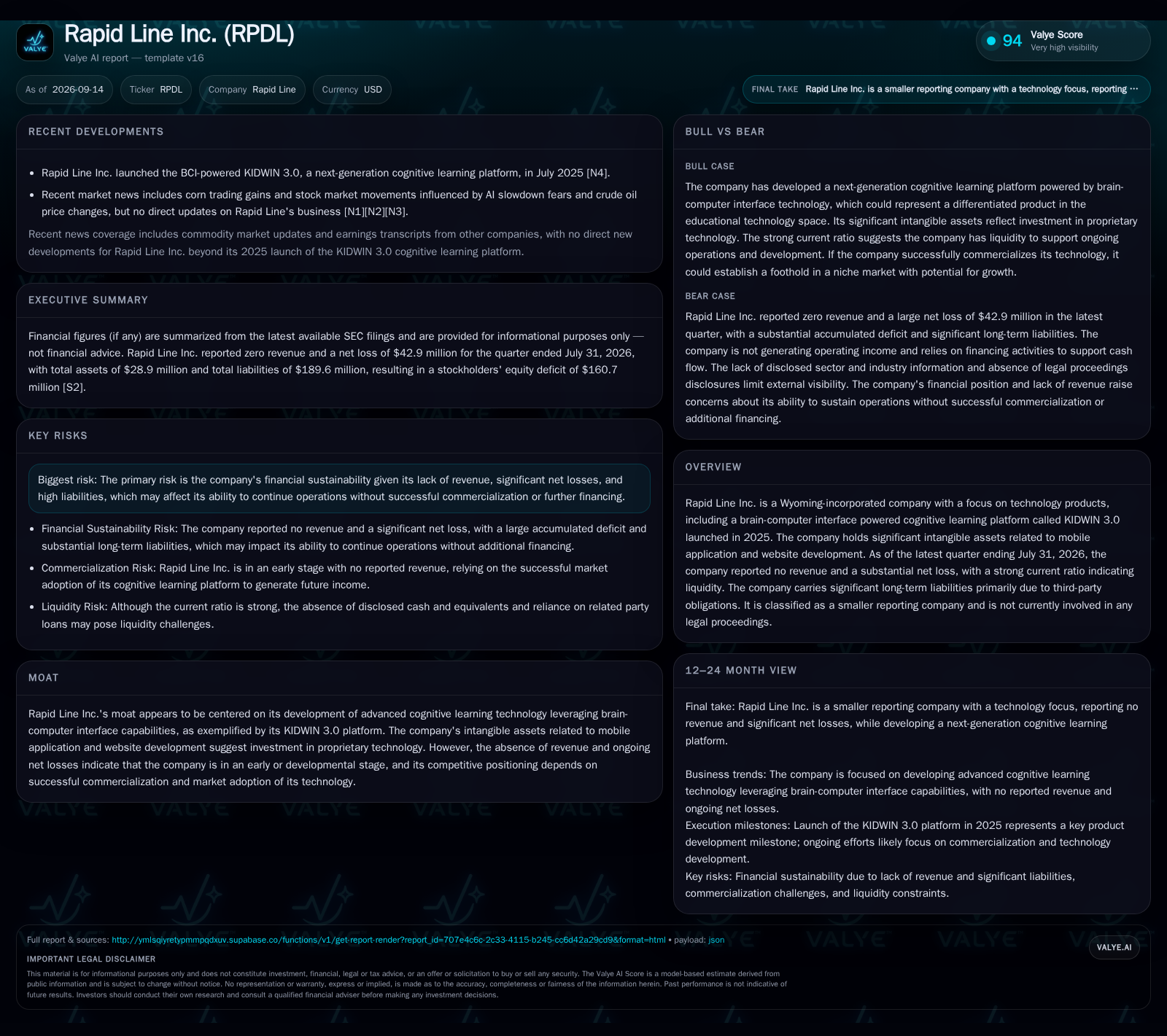
Rapid Line Inc. has launched the KIDWIN 3.0 brain-computer interface learning platform but reported zero revenue and a net loss of $42.9 million for the quarter ended July 31, 2026. With $8.7 million in current assets and $189.6 million in total liabilities, the company faces a severe equity deficit and must rapidly achieve commercialization or secure fresh financing to survive. The technological promise is unproven, and execution risk is high. [S2]
Rapid Line Inc. stands at a precarious juncture: the company has spent heavily on developing advanced cognitive learning technology, notably its KIDWIN 3.0 brain-computer interface platform, yet it has failed to generate any revenue as of its latest quarterly report. With a striking equity deficit and mounting net losses, Rapid Line’s future is contingent on its ability to convert its technological promise into a viable business—either through rapid market adoption or external financing. This analysis dissects the company’s capital structure, commercial prospects, and the mechanisms that will likely determine its survival or failure.
Zero Revenue, Heavy Losses, and a Critical Dependence on Intangible Assets
As of July 31, 2026, Rapid Line Inc. reported zero revenue and a net loss of $42.9 million for the quarter, underscoring its inability to monetize its technology to date [S2]. The company’s balance sheet is severely impaired, with total liabilities of $189.6 million vastly outweighing total assets of $28.9 million, resulting in a negative stockholders’ equity of $160.7 million [S2]. Despite reporting $8.7 million in current assets and a high current ratio of 6.49, there is no explicit disclosure of cash and equivalents, casting doubt on actual liquidity available for operations [S2].
A notable feature is the $41 million in intangible assets tied to mobile application and website development (with $20.8 million already amortized), reflecting a heavy investment in proprietary intellectual property [S2]. The recent launch of the KIDWIN 3.0 brain-computer interface cognitive learning platform in 2025 represents the company’s central product bet, but no evidence of revenue or commercial traction has emerged since [S2].
Commercialization Economics: High Fixed Costs, Unproven Revenue Model, and Capital Dependence
Rapid Line’s business model appears to hinge on the successful commercialization of its KIDWIN 3.0 BCI-powered platform. The economics of such a platform typically involve high upfront R&D and product development costs (as reflected in significant intangible assets), while potential revenue streams could include direct sales, licensing, subscription fees, or service contracts if the product finds market acceptance.
In the absence of any reported revenue, the company’s fixed cost structure is likely absorbing all available resources, with no variable margin to offset losses. The net loss of $42.9 million for a single quarter suggests significant ongoing cash burn, likely driven by continued development, marketing, and administrative costs [S2].
The company’s liabilities are overwhelmingly long-term and owed to third parties ($188.2 million), implying either prior financing or vendor obligations that will require future servicing or restructuring [S2]. With no operating income and no evidence of cash inflows, Rapid Line’s survival is dependent on infusions of external capital or a rapid pivot to revenue generation. If successful commercialization occurs, the business could theoretically benefit from high operating leverage—scaling revenue over a largely fixed cost base—but there is currently no evidence of this dynamic in practice.
BCI EdTech: Potential Differentiation Meets Intense Barriers and Substitution Threats
Rapid Line’s core bet is on differentiation through its KIDWIN 3.0 BCI-powered cognitive learning platform. While brain-computer interface technology in educational software remains a nascent and potentially high-impact field, barriers to adoption are significant: schools and consumers must be convinced of efficacy, safety, and cost-effectiveness—none of which have been demonstrated by the company publicly.
Competition in the educational technology sector is fierce, ranging from established e-learning platforms to emerging AI-powered and neurotechnology startups. Without current revenue or disclosed customer traction, it is unclear whether Rapid Line’s technology offers a compelling enough value proposition to displace entrenched digital learning solutions or to attract early adopters in institutional markets.
Switching costs for educational institutions are typically moderate, and the burden of proof for novel neurotechnology is high. If KIDWIN 3.0’s BCI features prove genuinely transformative—delivering measurable learning improvements or unique engagement—it could carve out a niche. However, in the absence of published efficacy data, partnerships, or reference customers, the competitive advantage remains theoretical.
Breakthrough Adoption: What Would Unlock Rapid Line’s Commercial Potential?
A favorable trajectory for Rapid Line would require rapid and credible demonstration of KIDWIN 3.0’s efficacy, leading to initial commercial wins—perhaps through pilot programs with educational institutions or partnerships with neurotechnology research bodies. Early adopters could validate the platform’s value, driving organic demand and providing case studies for broader market penetration.
Confirmation of this scenario would come from reported revenue, signed commercial contracts, or partnership announcements—none of which have materialized to date. Additional signals would include peer-reviewed studies validating the BCI technology, successful fundraising on the back of commercial momentum, and visible expansion of the customer pipeline.
If the platform’s economics prove attractive, operating leverage could rapidly swing the business towards profitability as fixed costs are absorbed by growing revenue. However, the company must overcome skepticism and inertia in the education sector, as well as address any regulatory or ethical concerns around BCI deployment in learning environments.
Prolonged Development and Capital Search as the Most Likely Outcome
The most plausible near-term future is one of continued cash burn, ongoing product refinement, and a difficult search for commercial partners or investors. Without revenue or evidence of market traction, Rapid Line is likely to remain in a pre-commercial or pilot-testing phase for several quarters.
The company’s high current ratio may offer some operational runway, but the lack of cash flow and the scale of long-term liabilities suggest that new financing—whether equity, debt restructuring, or partnership capital—will be necessary to avoid insolvency [S2].
Confirmation of this scenario would be continued net losses, minimal or no revenue, periodic fundraising announcements, and incremental product development updates without major commercial breakthroughs. Falsification would require evidence of accelerating revenue or significant customer commitments.
Failure to Commercialize: Liquidity Crisis and Potential Restructuring
The principal risk is that Rapid Line fails to convert its technology investment into any meaningful revenue before its liquidity evaporates. As cash balances dwindle, the company could face default on its long-term obligations, forcing a restructuring, asset sale, or even bankruptcy.
Confirmation would come from missed payments, going concern warnings, or abrupt management departures. Other warning signs include layoffs, fire-sale asset dispositions, or a sharp increase in related-party loans to cover operating expenses.
In this scenario, intangible assets may have little salvage value if the technology lacks proven commercial application, and shareholders could be severely diluted or wiped out.
Milestones That Will Determine Whether Rapid Line’s BCI Bet Pays Off or Fails
Disclosure of any revenue, customer pilots, or signed commercial agreements for KIDWIN 3.0 would be a crucial test of commercial traction.
Updates on actual cash balances and cash burn rate, if disclosed, would clarify the company’s true liquidity position and operational runway.
Announcements of new financing, debt restructuring, or strategic partnerships would signal external confidence and extend the company’s survival timeline.
Published efficacy results, user testimonials, or independent validation of the BCI platform would strengthen the case for adoption.
Evidence of institutional or large-scale customer adoption—such as contracts with schools or government bodies—would validate market demand.
Disclosure of customer acquisition costs and potential gross margin structure, if available, would help test scalability assumptions.
Any regulatory, ethical, or safety concerns raised about BCI use in education would be material risks to monitor.
Disclaimer: This is research-only, informational analysis and not investment advice. It may include AI-generated interpretation and general industry context. Always verify important details using primary sources.

Comments