
Where Food Comes From: Certification Expansion, Margin Dynamics, and the Volatility Challenge
Where Food Comes From, Inc. is navigating a mixed operating environment—growing certification services and launching new programs, while digital asset and industry-specific headwinds introduce volatility. The company’s ability to convert service breadth into durable economic advantage and margin resilience will determine its next phase.
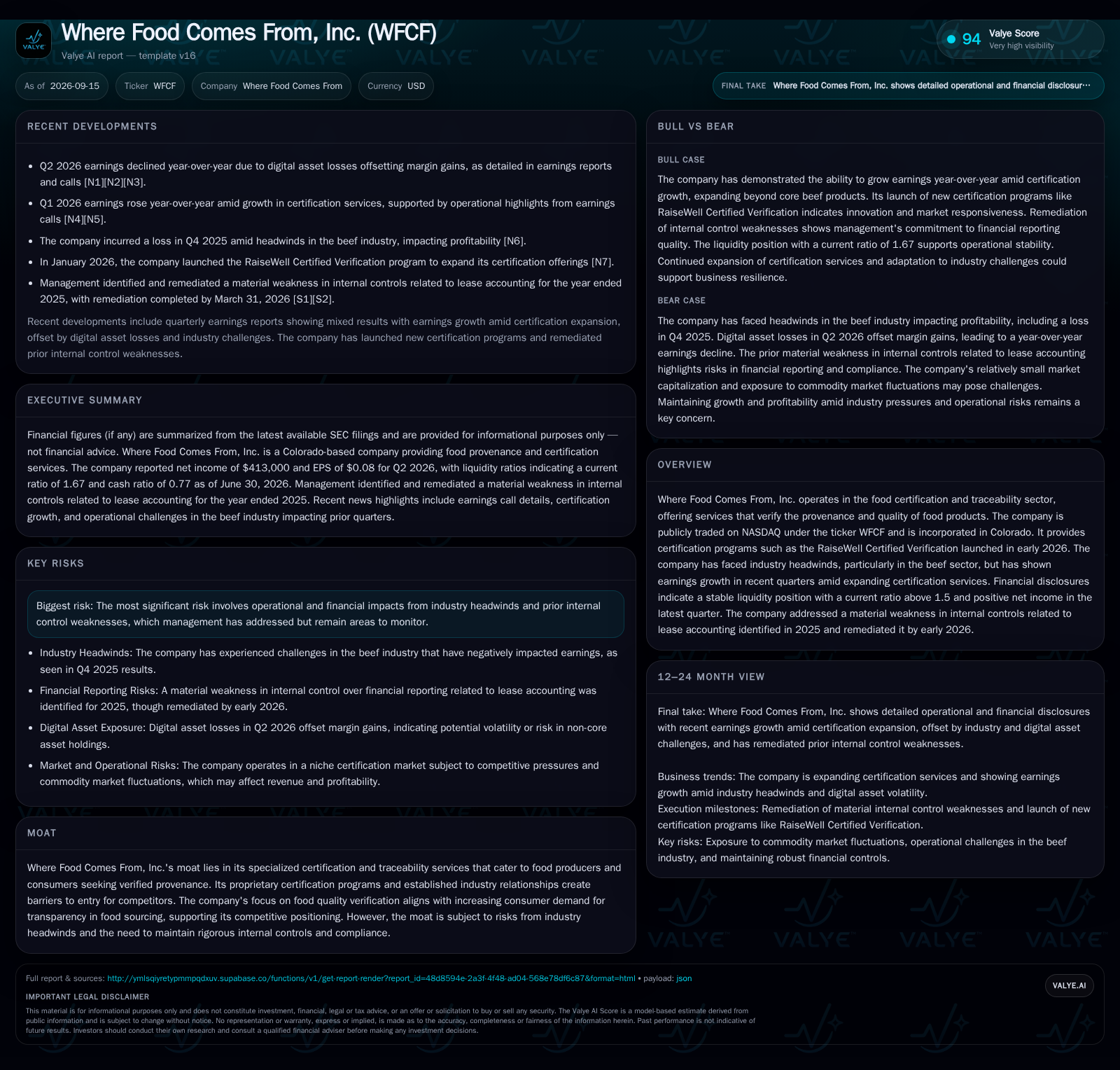
Where Food Comes From, Inc. reported positive net income for Q2 2026 amid ongoing expansion of its food certification portfolio, including the new RaiseWell Certified Verification program. However, digital asset losses offset margin gains, leading to a year-over-year earnings decline for the quarter. The company remediated a material internal control weakness identified in 2025, and its liquidity position remains stable with a current ratio of 1.67. The sustainability of margin improvement and certification growth, alongside risk management in non-core assets, will shape the company’s outlook. [S2] [N1] [N7]
Where Food Comes From, Inc. stands at a crossroads of opportunity and risk as it expands its food provenance and certification services in a market increasingly demanding transparency. The launch of new programs such as RaiseWell Certified Verification demonstrates strategic responsiveness, while the company’s stable liquidity and positive net income for Q2 2026 reflect operational resilience. Yet, digital asset losses and persistent beef industry headwinds raise questions about earnings durability and risk management. The company’s ability to translate certification growth into sustainable margin improvement—and to manage volatility in both core and non-core activities—will define its competitive and financial trajectory.
Recent Developments: Certification Growth Meets Margin Volatility
Where Food Comes From, Inc. reported net income of $413,000 for Q2 2026, with basic and diluted EPS of $0.08. However, this quarter’s earnings declined year-over-year as digital asset losses offset operational margin gains. The company’s liquidity position remains stable, with $3.417 million in cash and a current ratio of 1.67 as of June 30, 2026. Operationally, the company launched its RaiseWell Certified Verification program in January 2026, broadening its portfolio and signaling a push into new certification domains. The company also remediated a material weakness in internal controls related to lease accounting, restoring compliance confidence by March 31, 2026. These developments underscore the company’s dual challenge: capturing certification-driven growth while managing volatility from both industry and non-core exposures. [S2] [N1] [N7] [S1]
How Certification Services Could Drive Margin Structure and Cash Flow
Where Food Comes From, Inc. generates revenue primarily by providing third-party verification and certification services for food producers seeking to differentiate their products on provenance, sustainability, and quality. The economics of such certification businesses are typically characterized by relatively high variable costs—inspections, audits, and program management—offset by the potential for operating leverage as customer counts and renewal rates rise. Pricing power is often a function of the perceived brand value and regulatory or retail requirements for verification, but the company’s ability to raise prices or upsell additional services depends on the competitive landscape and the strength of its industry relationships.
The fixed cost base is modest, with capital needs focused on software infrastructure, compliance, and talent for auditing and certification. Launching new programs such as RaiseWell could expand the addressable market and improve mix if these programs command higher fees or attract higher-value clients. However, the company’s exposure to digital asset losses in Q2 2026 suggests some diversification into non-core financial assets, which introduces earnings volatility and may distract from core service profitability. The path to sustained margin expansion likely hinges on scaling certification volume, improving customer retention, and managing non-core risk exposures.
Niche Positioning in Food Traceability—Barriers and Counterforces
Where Food Comes From operates in a specialized segment of the food value chain, providing traceability and certification at a time when consumer, retailer, and regulatory demands for transparency are rising. Its proprietary certification programs and industry relationships create switching frictions for established clients—particularly if those certifications are recognized by major retailers or exporters. This can provide a barrier to entry for generic or less-recognized certifiers.
However, the market is fragmented, with competition from both large multinational testing and assurance firms and smaller regional or niche players. Technology-based traceability solutions (such as blockchain-enabled provenance platforms) pose a potential substitution threat if they offer automation or lower-cost verification. Furthermore, Where Food Comes From’s exposure to specific commodity sectors, particularly beef, makes it vulnerable to industry cycles and shifts in demand or regulation. The company's ability to maintain its moat will depend on continued innovation in program offerings, demonstrable audit rigor, and the ability to embed its services deeper into customer supply chains—thereby increasing switching costs.
Unlocking Margin Expansion Through Certification Scale and Program Innovation
A favorable scenario would see Where Food Comes From leveraging its expanded certification portfolio—such as the RaiseWell program—to capture a larger share of food producers seeking premium market access or regulatory compliance. If new certifications attract higher-value clients or enable cross-selling of bundled services, operating leverage could improve, driving both top-line growth and margin expansion. The ability to demonstrate strong customer retention and recurring revenue streams would further bolster this dynamic.
Evidence supporting this scenario would include sustained growth in certification revenue, improving gross and operating margins, and a declining proportion of revenue from non-core activities (such as digital assets). Additional proof points would be new major customer wins, higher renewal rates, or industry partnerships that embed the company as a preferred verification provider. A useful metric would be the mix of recurring versus project-based revenue and customer concentration trends, if disclosed.
Certification Growth Offsets Sector Headwinds, but Volatility Persists
The most plausible trajectory is continued expansion of certification services, offsetting but not fully neutralizing volatility from industry-specific headwinds and non-core exposures. Where Food Comes From’s stable liquidity and earnings growth in Q1 and Q2 2026 reflect resilience, but recurring digital asset losses and fluctuations in beef sector demand temper the outlook. The company may continue to grow by launching new programs and deepening relationships with existing customers, but margin improvement could be gradual due to ongoing investment needs, pricing pressure, and volatility in ancillary revenue streams.
Confirmation of this scenario would be steady, albeit modest, year-over-year growth in certification revenue and net income, stable liquidity ratios, and absence of material new internal control issues. However, continued mention of digital asset or sector-specific losses in earnings reports would indicate that volatility remains a persistent feature of the business.
Margin Erosion if Industry Shocks and Non-Core Losses Compound
A negative scenario could unfold if beef industry headwinds intensify or spread to other certified sectors, resulting in revenue contraction or customer attrition. Simultaneously, unresolved or recurring losses from non-core holdings—such as digital assets—could erode margins and distract management focus. If the company fails to maintain compliance rigor or faces renewed internal control weaknesses, confidence among customers and partners could suffer, increasing churn and compressing pricing.
Evidence of this downside would include sequential declines in certification revenue, operating losses, deterioration in liquidity ratios, or the re-emergence of internal control deficiencies. Negative trends in customer retention, adverse regulatory developments, or publicized audit failures would further validate this scenario.
Milestones That Will Clarify Where Food Comes From’s Margin and Growth Path
Quarterly certification revenue growth rates—especially from new programs like RaiseWell—would help test the scalability of the service portfolio.
Recurring versus project-based revenue mix, if disclosed, as an indicator of business model durability and potential operating leverage.
Gross and operating margin trends, particularly in the context of new service launches and cost management initiatives.
Size and impact of digital asset or other non-core financial holdings on earnings volatility in subsequent quarters.
Customer retention rates and major contract renewals or expansions, if disclosed, as signals of switching costs and competitive strength.
Any new internal control findings or audit comments in future filings that might affect compliance confidence.
Sectoral revenue breakdowns—especially beef versus other commodities—to gauge exposure to industry-specific shocks.
Liquidity ratio trends, especially if current or cash ratios begin to deteriorate, which could signal mounting financial pressure.
Disclaimer: This is research-only, informational analysis and not investment advice. It may include AI-generated interpretation and general industry context. Always verify important details using primary sources.

Comments