
Forgent Power Solutions: Expansion, Vertical Integration, and the Test of Margin Durability Amid Electrification Tailwinds
Forgent Power Solutions, Inc. stands at a critical inflection point, leveraging recent capital raises to expand manufacturing and deepen vertical integration—just as demand for data center and industrial electrification surges. The challenge: converting growth tailwinds into sustainable margins in the face of raw material volatility, supply chain uncertainties, and evolving competitive pressures.
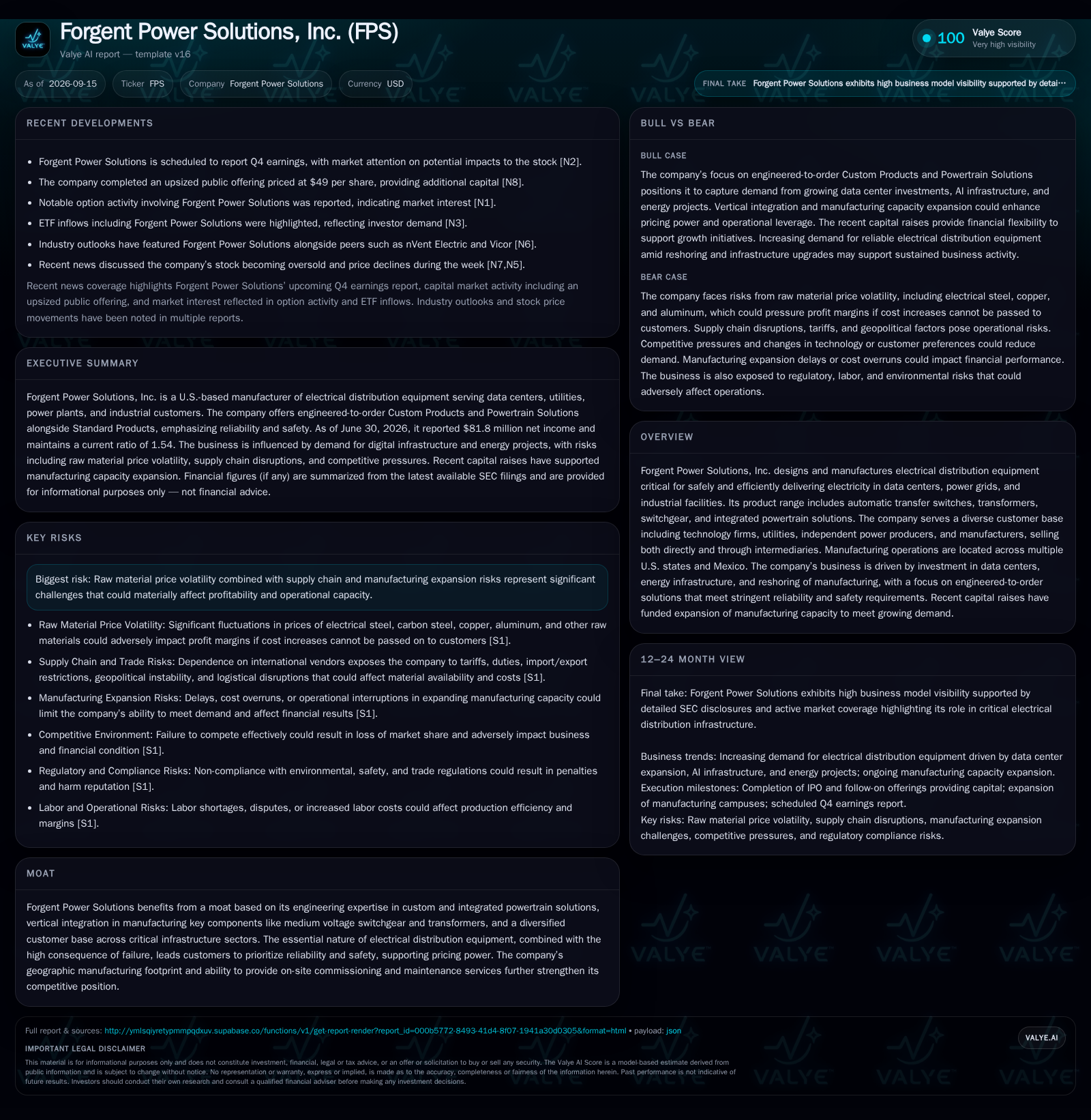
Forgent Power Solutions manufactures essential electrical distribution equipment for data centers, utilities, and industrial facilities. Recent IPO and follow-on offerings have funded manufacturing expansion as the company seeks to capture demand from digital infrastructure and reshoring trends. Custom and powertrain solutions contribute higher margins, but profitability remains sensitive to raw material costs and supply chain disruptions. The next phase depends on executing capacity growth without margin erosion, just as industry demand accelerates and competitors adapt. [S1] [S2] [N8]
Forgent Power Solutions, Inc. has rapidly moved to capitalize on booming demand for critical electrical distribution equipment, fueled by the digital infrastructure buildout and the reshoring of U.S. manufacturing. Fresh from an IPO and a follow-on offering, the company is channeling new capital into manufacturing expansion and vertical integration, aiming to secure a larger share of high-margin custom and powertrain projects. Yet, the path forward is not without hazards: margin durability is threatened by raw material price swings and the complexities of scaling up production. As the company prepares to report Q4 earnings and the industry faces both tailwinds and volatility, investors will watch closely for signs that Forgent can translate its growth initiatives into lasting profitability.
Recent Capital Raises and Margin Profile Shape Forgent’s Strategic Position
Forgent Power Solutions completed both an IPO and an upsized public offering in early 2026, raising significant capital to fund expansion and redeem interests from prior owners. As of June 30, 2026, the company reported $97.5 million in cash, a current ratio of 1.54, and net income of $81.8 million for the fiscal year. This influx of funds is being directed toward expanding manufacturing capacity at campuses in the U.S. and Mexico, positioning Forgent to address growing demand from data centers, utilities, and industrial facilities. Notably, Custom Products and Powertrain Solutions—offering higher margins due to engineering and integration complexity—remain central to the business mix. However, profitability is exposed to raw material price volatility and operational risks tied to expansion. [S1] [S2] [N8]
How Forgent Makes Money: The Leverage and Fragility in Custom Electrification
Forgent Power Solutions derives revenue from a mix of engineered-to-order Custom Products, Powertrain Solutions, and more commoditized Standard Products. The economics of Custom and Powertrain offerings are attractive: engineering complexity and integration requirements generally command premium pricing and higher margins, especially for mission-critical applications in data centers and industrial power infrastructure. The company’s on-site commissioning and maintenance services may provide additional recurring revenue streams, but the report does not specify the commercial structure or renewal cadence.
Vertical integration—especially in manufacturing medium voltage switchgear and transformers—offers potential control over quality and costs, supporting margin stability in theory. However, the business is highly exposed to input cost volatility: electrical steel, copper, and aluminum are globally traded commodities, and the company’s supply chain is exposed to tariffs and geopolitical risk. While some cost increases may be pass-through to customers, the lag and competitive dynamics could compress margins if inflation is acute or persistent.
Recent capital raises have funded manufacturing expansion, but the economics of scaling up depend on cost control, utilization rates, and the ability to maintain premium pricing as capacity comes online. Fixed costs will rise with new facilities, potentially increasing operating leverage—but this also amplifies downside risk if demand softens or execution falters.
Engineering Depth and Vertical Integration—But Competitive Pressure Is Relentless
Forgent’s potential moat stems from three sources: deep engineering expertise in custom and integrated powertrain solutions, vertical integration in key manufacturing processes, and critical infrastructure customer relationships. In this market, reliability and safety are paramount—customers are often willing to pay for proven performance, especially for data centers and power grids where failures are unacceptable.
Yet, these advantages are not unassailable. The company competes with diversified electrical equipment manufacturers, specialized engineering firms, and global OEMs—many of whom are also investing in capacity and digital integration. Industry-wide capacity constraints may temporarily bolster pricing, but as more players ramp up production, price-based competition could intensify. Technology shifts, such as increased adoption of modular or software-defined power distribution, could also pressure legacy product lines unless Forgent stays ahead in innovation and integration.
Distribution is a mix of direct sales and intermediaries (OEMs, contractors, distributors), which can buffer customer concentration risk but may also limit pricing power if intermediaries exert leverage. The company’s geographic manufacturing footprint could help mitigate regional supply chain disruptions and provide logistical advantages, but only if execution is robust.
Margin Expansion Through Capacity Execution and Electrification Supercycle
A favorable outcome for Forgent would unfold if the company successfully executes its manufacturing expansion, maintaining cost discipline and operational uptime while capturing the surge in demand from data center and industrial electrification. In this scenario, vertical integration delivers both quality assurance and some insulation from input cost volatility. Custom and Powertrain Solutions continue to outpace Standard Products in mix, preserving or even expanding margins as customers prioritize reliability and speed to deployment.
Evidence that would confirm this scenario includes: sustained revenue growth outpacing industry averages, stable or rising gross margins despite raw material volatility, and positive commentary on order backlogs or capacity utilization in quarterly reports. Additional signs would be strong uptake of new capacity, limited operational hiccups, and continued inclusion alongside industry leaders in sector outlooks. [S2] [N6]
This thesis would be challenged if margin improvement stalled, order growth lagged industry benchmarks, or expansion projects encountered significant delays or cost overruns.
Maintaining Share and Margins in a Volatile, Capacity-Constrained Market
The most plausible path is that Forgent Power Solutions sustains moderate growth in line with overall market trends for data center and industrial electrification. The company’s expanded manufacturing footprint allows it to fulfill incremental demand, but raw material and labor cost pressures periodically squeeze margins. Vertical integration and engineering reputation help maintain a premium for Custom and Powertrain Solutions, but pricing power is not absolute—especially as competitors bring new capacity online.
Margins remain within historical ranges but are volatile quarter to quarter, reflecting swings in input costs and the timing of large project deliveries. Operating leverage is achieved gradually, offset by higher SG&A and public company expenses.Liquidity remains neutral—sufficient to; these figures do not by themselves establish operating, investment, or financing capacity, but not so strong as to enable aggressive M&A or outsized share repurchases.
This scenario would be confirmed by steady, if lumpy, revenue and earnings progression, regular capacity updates, and management commentary focused on cost discipline and project pipeline visibility. It would be challenged if sustained raw material inflation eroded margins, capacity ramp-up lagged demand, or if the company lost major project bids to competitors.
Margin Compression and Execution Missteps Undercut Growth Ambitions
The adverse scenario materializes if raw material price spikes—particularly in electrical steel, copper, or aluminum—outstrip Forgent’s ability to pass through costs, leading to sustained margin compression. Simultaneously, manufacturing expansion could encounter delays, cost overruns, or operational disruptions, limiting the company’s ability to capture new demand just as the market accelerates.
Competitive pressures may intensify as rivals invest in capacity or undercut on price, especially in more commoditized Standard Products. If technological shifts or customer preferences move toward alternative power distribution approaches, legacy platforms could face obsolescence risk.
Confirmation of this scenario would include: declining or negative gross margins, missed project delivery milestones, warnings about cost overruns or supply chain interruptions in filings, and market share loss reflected in peer comparisons. Deteriorating liquidity ratios—due to working capital build or lower cash conversion—would further signal stress.
Milestones and Metrics That Will Validate Forgent’s Margin and Growth Story
Gross margin trends by product category—especially Custom and Powertrain Solutions—would help test the durability of pricing power and the impact of raw material volatility, if disclosed.
Capacity utilization rates and on-time delivery metrics for new and expanded manufacturing campuses would indicate the effectiveness of recent capital deployment.
Order backlog or pipeline disclosures (if provided) would clarify visibility into future revenue and the pace of demand from data center and industrial customers.
Quarterly commentary on raw material sourcing, input cost pass-through, and supply chain disruptions would reveal management’s ability to navigate volatility.
SG&A and operating expense growth relative to revenue should be monitored to assess whether scale is delivering expected operating leverage.
Customer concentration and win/loss rates on large projects would illuminate the competitive landscape and potential vulnerability to lost bids.
Any shift in product mix toward higher- or lower-margin offerings, as indicated in filings or management updates, would affect overall profitability.
Liquidity and working capital trends—especially inventory and receivables days—would flag operational strain or discipline during expansion.
Disclaimer: This is research-only, informational analysis and not investment advice. It may include AI-generated interpretation and general industry context. Always verify important details using primary sources.

Comments