
Skkynet Cloud Systems: Small-Scale Cloud Integration Ambition Meets Profitability and Transparency Hurdles
With modest revenues, persistent net losses, and limited public disclosure, Skkynet Cloud Systems, Inc. operates in a technical niche but faces acute challenges in scaling its cloud integration business. The company's liquidity; these figures do not by themselves establish operating, investment, or financing capacity, but business model opacity and lack of clear competitive differentiation are central risks.
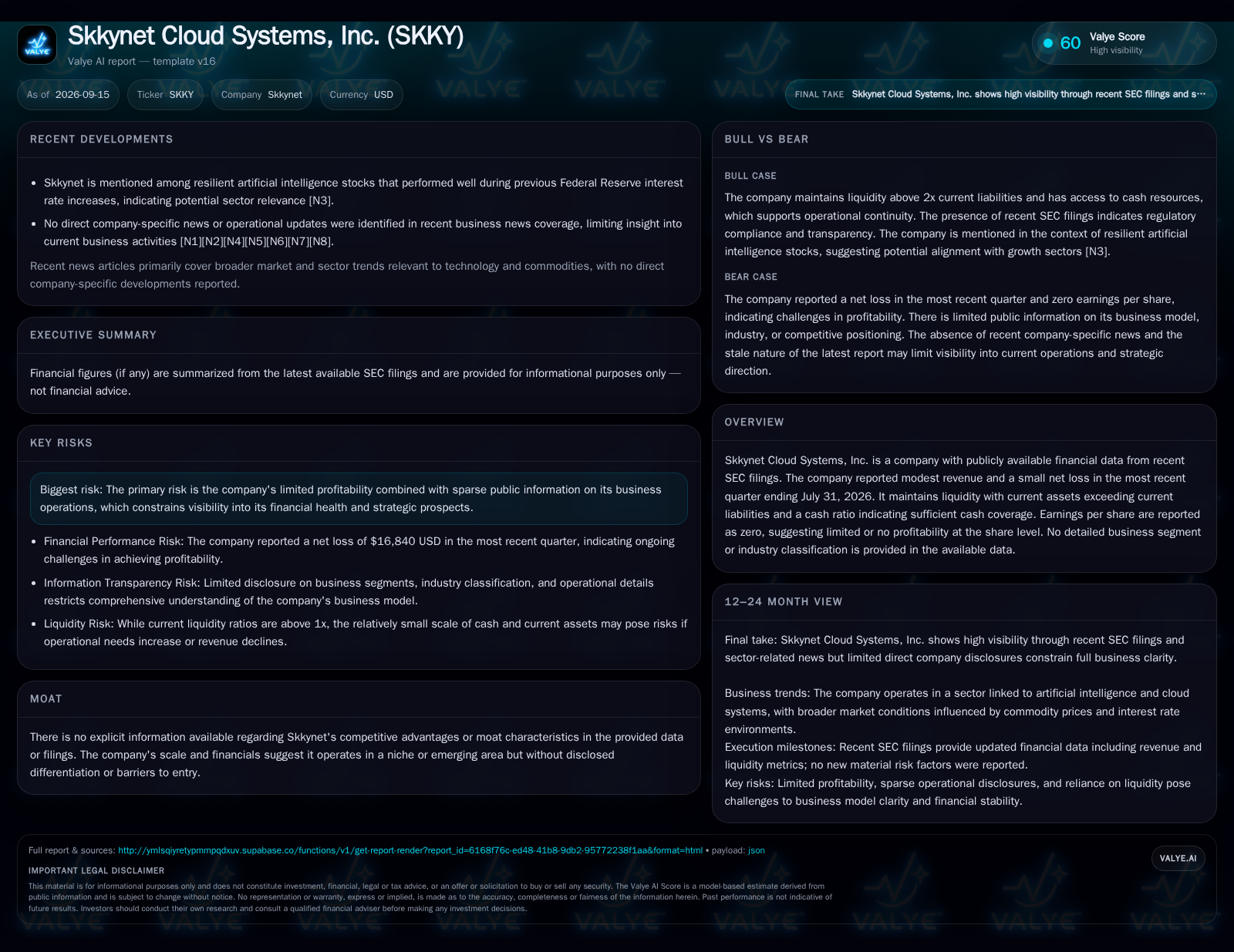
Skkynet Cloud Systems, Inc. reported $560,504 in revenue and a $16,840 net loss for the quarter ended July 31, 2026, with liquidity ratios above 1x but no profitability at the share level. The company's business model centers on integrating legacy and cloud systems, but sparse disclosure limits insight into its commercial mechanics, customer base, or competitive positioning. Scalability, margin structure, and recurring revenue potential remain open questions.
Skkynet Cloud Systems, Inc. remains a small-scale player in the cloud integration and industrial connectivity space, reporting modest revenue and ongoing losses for the most recent quarter. While its liquidity ratios exceed 1x, suggesting coverage for current obligations, the company's limited public disclosure on its business model and markets leaves fundamental questions about scalability and profitability unanswered. This opacity—coupled with zero earnings per share—positions Skkynet as a technical niche operator whose path to sustainable value creation is not well illuminated by recent filings.
Recent Financials Reveal Modest Scale and Persistent Losses
For the quarter ended July 31, 2026, Skkynet Cloud Systems, Inc. reported revenue of $560,504 and a net loss of $16,840. While these figures confirm that the company is generating some level of operational activity, the scale remains limited and the business is not profitable at the net income or per-share level. Liquidity metrics—current assets of $1,896,680 versus current liabilities of $797,885—yield a current ratio of 2.38 and a cash ratio of 1.79, suggesting that the company has sufficient coverage for short-term obligations. However, there have been no material updates to risk factors or business segment disclosures, and earnings per share remained at zero for the period, underscoring the absence of meaningful shareholder returns and the persistence of operating losses [S1] [S2].
Potential Revenue Streams and the Challenge of Scale Economics
Skkynet’s stated purpose is to integrate legacy business lines and customer systems with cloud-based infrastructure. In theory, this could involve revenue from software licenses, cloud subscriptions, integration services, or support contracts. However, the report does not specify whether revenue is derived from recurring (subscription) sources, one-time integration fees, or a mix of both. The company’s modest revenue base and net losses suggest that fixed costs—such as R&D, compliance, and support—are not yet being leveraged across a sufficiently large customer set to achieve profitability. If Skkynet operates a SaaS-like model, operating leverage could improve materially with scale, as incremental customers would add high gross margin revenue. Conversely, if the business is service-heavy or project-based, variable costs may rise in proportion to revenue, limiting margin expansion. The lack of segment or margin disclosure means that the true mix and scalability of Skkynet’s economics remain opaque.
A critical factor influencing Skkynet’s ability to scale profitably lies in its cost structure and customer acquisition strategy. If the company relies heavily on bespoke integration projects, each new client may require significant upfront engineering and customization efforts, which would constrain operating leverage and prolong the path to profitability. Conversely, developing standardized integration modules or platform features that can be rapidly deployed across multiple clients would reduce marginal costs and enhance scalability. The degree to which Skkynet can automate deployment, monitoring, and updates within its cloud integration offerings will also materially affect its margin profile and competitive positioning over time.
Another dimension to consider is the potential for network effects or ecosystem lock-in, which could amplify customer lifetime value if present. For example, if Skkynet’s platform facilitates seamless interoperability among various legacy and cloud systems, creating switching costs through data integration or operational dependencies, this could translate into recurring revenue streams and higher retention rates. However, absent proprietary standards or unique integration capabilities, customers may find alternative solutions with comparable functionality, limiting pricing power and growth potential. Therefore, the company’s ability to cultivate a robust partner ecosystem or embed itself deeply within client workflows is pivotal to shifting from transactional engagements to sticky, subscription-based relationships.
Fragmented Market Pressures and the Absence of a Clear Moat
The integration of legacy systems with cloud infrastructure is a crowded and highly competitive field, with incumbent IT services firms, industrial automation vendors, and cloud-native platforms all vying for share. Skkynet’s filings do not disclose any specific differentiators, intellectual property, or established customer relationships that would indicate a defensible competitive moat. In the absence of scale, brand recognition, or proprietary technology, switching frictions for customers may be low—especially if integration projects are not deeply embedded or contractually recurring. The company’s small scale could limit its ability to invest in R&D, sales, or ecosystem partnerships, further eroding any potential for sustainable competitive advantage.
What Would It Take for Skkynet to Achieve Breakout Growth?
A favorable scenario for Skkynet would likely require a clear shift toward recurring, high-margin software or cloud subscription revenue, supported by a growing base of industrial or enterprise customers. Evidence of multi-year contracts, increasing average deal size, or expanding gross margins would confirm that the company is capturing value from its integration expertise at scale. Strategic partnerships with larger cloud platforms or industrial conglomerates could accelerate adoption and confer credibility. If Skkynet were to report quarter-over-quarter revenue growth above its current base, coupled with improving profitability metrics and customer retention disclosures, this would suggest a path toward sustainable operating leverage.
Sustained Modest Operations with Limited Visibility and Slow Progress
The most plausible near-term path for Skkynet is continued operation at modest scale, with revenue fluctuating around current levels and persistent net losses. Liquidity coverage should allow the company to meet near-term obligations, but absent a step-change in customer acquisition or product differentiation, the business is unlikely to achieve meaningful profitability. Without additional disclosure on business model or commercial wins, investors may continue to face limited visibility into the company’s true potential or risk profile. Incremental improvements in efficiency or small-scale customer wins could slow cash burn, but are unlikely to materially shift the economic trajectory without a broader strategic pivot or capital infusion.
Revenue Stagnation or Decline Could Accelerate Liquidity Pressure
In an adverse scenario, Skkynet could see revenue stagnate or decline—whether due to competitive encroachment, customer churn, or broader market softness. Given the small cash and asset base, any material drop in topline or unexpected increase in expenses could quickly erode the current liquidity buffer. The absence of recurring revenue contracts or long-term customer commitments would exacerbate volatility. If net losses widen or cash outflows accelerate, the company may be forced to seek additional financing under less favorable terms, or to pursue asset sales or restructuring. Confirmation of this scenario would come from declining revenues, rising net losses, or disclosure of going-concern uncertainties in future filings.
Milestones That Will Clarify Skkynet’s Business Trajectory
Quarterly revenue growth or contraction versus the current $560,504 baseline [S2].
Gross margin disclosure—if provided—would help distinguish between high-margin software and lower-margin services.
Evidence of recurring revenue contracts, multi-year customer agreements, or expanding backlog—if disclosed.
Customer concentration data, which would clarify reliance on a small number of clients.
Operating expense trends, particularly whether R&D and SG&A are scaling in line with revenue.
Cash burn and liquidity runway updates in future filings, especially if cash balances fall below 1x current liabilities.
Any indication of strategic partnerships, channel expansion, or new product launches.
Disclosure of customer retention or churn rates would be a critical test of platform stickiness.
Disclaimer: This is research-only, informational analysis and not investment advice. It may include AI-generated interpretation and general industry context. Always verify important details using primary sources.

Comments