
Longevity Diversified Holdings: Blank-Check Ambition Meets Acute Funding Constraints and Execution Risk
With no operations, zero cash, and significant liabilities, Longevity Diversified Holdings faces an existential test: can it source and consummate a viable business combination before capital constraints and execution risk foreclose its options?
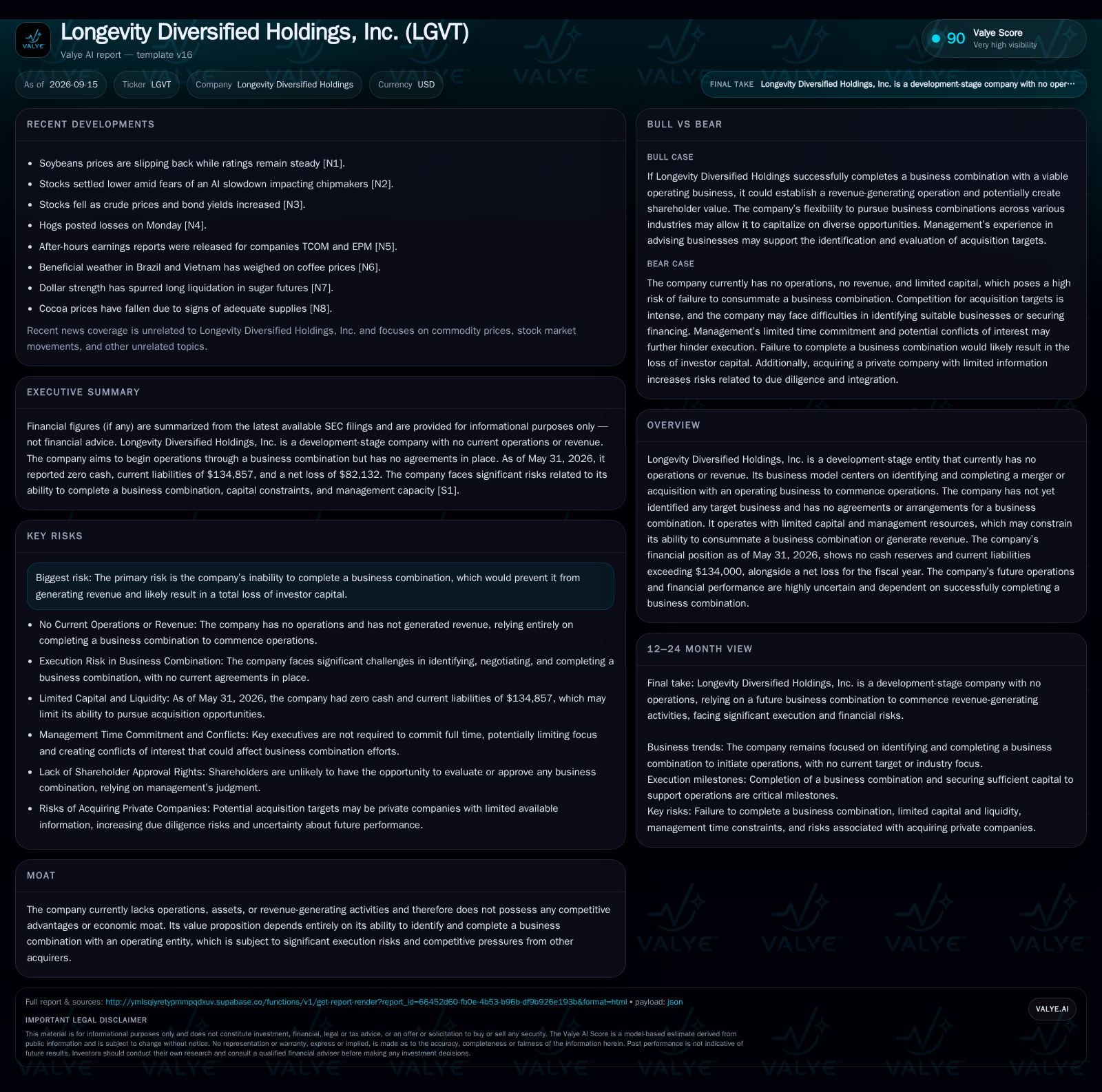
Longevity Diversified Holdings, Inc. remains a development-stage entity with no cash, no operations, and notable current liabilities. Its only path to value creation is completing a merger or acquisition, but management's limited time commitment and lack of any target or arrangement amplify the risk of failure. The company's broad sector-agnostic mandate allows flexibility, but also heightens uncertainty and due diligence risk. Without a business combination soon, the company is likely to exhaust its options and investor capital. [S1]
Longevity Diversified Holdings, Inc. occupies the most speculative rung of the public-market ladder: it is a blank-check entity with no operations, no revenue, and a depleted balance sheet. Its entire future hinges on identifying and closing a merger or acquisition with an operating business, yet as of its most recent filings there are no arrangements, no ongoing negotiations, and no committed management team to drive the process. With current liabilities exceeding $130,000 and no cash, the company faces a steep uphill battle to source, negotiate, and fund a deal before financial constraints and execution risks overtake it. This analysis examines the mechanisms, challenges, and potential outcomes for Longevity Diversified Holdings as it seeks to convert a shell into a functioning enterprise.
Acute Liquidity Shortfall and Absence of Operating Activity Define the Starting Point
As of May 31, 2026, Longevity Diversified Holdings, Inc. reported zero cash or cash equivalents and $134,857 in current liabilities, alongside a net loss of $82,132 for the fiscal year. The company has not generated any revenue and has no active business operations. Its only stated plan is to pursue a merger or acquisition, but there are no current agreements, targets, or even negotiations underway. Management does not commit full time to the company, raising questions about bandwidth and execution capacity. These facts are material because they highlight the acute funding shortfall, the absence of a commercial engine, and the heavy reliance on uncertain future events for any value realization. [S1]
How Value Could Emerge: The Economics of a Blank-Check Business
The company’s economics are currently hypothetical, as there are no operations, products, or revenue streams. The only plausible path to value creation is through acquiring or merging with an operating business. In this model, economics depend entirely on the quality, sector, and structure of the acquired entity. If the company acquires a business with positive operating leverage—where incremental revenues outpace costs—it could generate cash flow and potentially support debt or equity financing.
However, the company’s lack of cash and high current liabilities mean any acquisition will likely require external financing or a highly dilutive equity transaction. The economics of the resulting entity would be shaped by the acquired business’s revenue model (e.g., recurring vs. transactional, product vs. service), cost structure (fixed vs. variable), and capital intensity. If the acquired business is capital-light with strong gross margins, operating leverage could materialize quickly. Conversely, a capital-intensive or distressed acquisition could perpetuate liquidity strain and operational risk. The company’s economics are thus a blank slate, with the eventual outcome dependent on the profile and performance of the future target.
Competing for Targets: Structural Disadvantages in the Acquisition Marketplace
Longevity Diversified Holdings faces formidable headwinds in the competition for acquisition targets. The blank-check universe is crowded, especially post-SPAC boom, with many entities chasing a finite pool of viable private companies. Larger or better-capitalized acquirers can offer more attractive terms, faster deal certainty, and post-merger support. The company’s acute cash shortfall and lack of deal pipeline are significant disadvantages.
Additionally, sellers may prefer acquirers with sector expertise, operational resources, or a clear value-add proposition. Longevity Diversified’s sector-agnostic mandate provides theoretical flexibility but also signals a lack of focus or differentiated sourcing advantage. Without a compelling competitive angle—such as proprietary sourcing channels, management track record, or unique capital structure—the company is likely to be outbid or overlooked for the most attractive targets. The risk of being relegated to distressed, opaque, or lower-quality deals is high.
If a High-Quality Acquisition Materializes: What a Successful Deal Could Unlock
An upside scenario would require Longevity Diversified Holdings to rapidly source and close a business combination with a fundamentally sound, cash-flow-generating company. For this to occur, the company would need to overcome its funding gap—potentially via bridge financing, a capital raise concurrent with the deal, or a structure that heavily incentivizes the target’s owners with post-merger equity.
If such a transaction is completed, the combined entity could benefit from public market access, potentially lower cost of capital, and a platform for further growth. The newly merged business would need to demonstrate credible revenue, margin durability, and a path to profitability. Confirmation would come from a definitive merger announcement with a named operating business, disclosure of financing terms that address the current liabilities, and evidence of post-transaction revenue generation. Falsification would occur if the company continues without a deal or is forced to accept a low-quality, distressed target with no credible path to sustainable operations.
Stalled Search and Dilution: The Most Likely Outcome Absent a Transformative Deal
Given the absence of cash, the lack of any identified target, and the minimal management commitment, the most plausible scenario is ongoing inertia and eventual value erosion. The company may continue to search for a target but is likely to encounter repeated obstacles: inability to fund due diligence, lack of credibility in competitive processes, and an unattractive negotiating position due to financial constraints.
If a deal emerges, it is likely to be highly dilutive to current shareholders, as external capital would be required to cover both acquisition costs and existing liabilities. The acquired business could be of marginal quality, with limited information and elevated integration risks. Confirmation of this scenario would be continued delays, sporadic or no deal announcements, or disclosure of a highly dilutive financing structure. Falsification would require a tangible, high-quality business combination with sustainable economics and manageable dilution.
Failure to Transact: The Path to Capital Exhaustion and Investor Loss
The adverse scenario is straightforward: Longevity Diversified Holdings fails to identify, negotiate, or finance a business combination, and its limited resources are depleted by ongoing administrative and compliance costs. With no revenue, no operations, and no ability to raise additional capital on favorable terms, the company would be forced toward dissolution or bankruptcy, resulting in a near-total loss for investors.
This outcome would be confirmed by the absence of any deal activity over successive reporting periods, growing current liabilities, and eventual auditor warnings or corporate actions indicating the cessation of business pursuit. Early warning signs include further management disengagement, resignation of directors, or a formal process to wind down operations.
Milestones and Data Points That Will Define the Blank-Check Outcome
Disclosure of any signed letter of intent or definitive agreement for a business combination, including details of the target and deal structure, would be a pivotal development.
Filing of new capital raise documentation or announcements of bridge financing would clarify whether the company can fund transaction costs and ongoing liabilities.
Changes in management engagement—such as the appointment of a full-time CEO or deal team—would signal increased execution bandwidth.
A useful metric would be the timeline from target identification to deal close, if disclosed, as delays can erode deal quality and increase dilution risk.
Disclosure of post-transaction pro forma financials—especially revenue, EBITDA, and cash flow—would help test the viability of any acquired business.
Shareholder communications regarding approval rights, dilution, and post-merger governance would clarify the risk-reward balance for existing investors.
SEC filings indicating a going concern warning or plans for corporate dissolution would be clear signals of downside realization.
Tracking current liabilities and any vendor or legal disputes could provide early warning of capital exhaustion or operational distress.
Disclaimer: This is research-only, informational analysis and not investment advice. It may include AI-generated interpretation and general industry context. Always verify important details using primary sources.

Comments