
Hi-Great Group: Ambitious Agritourism and Supplement Model Faces Funding and Execution Hurdles
Hi-Great Group Holding Co aims to blend proprietary health supplements with a novel weekend family farming resort and franchising play. While the concept targets durable trends in agritourism and wellness, acute liquidity constraints and the unproven U.S. market adoption for such offerings put its business model to a rigorous test.
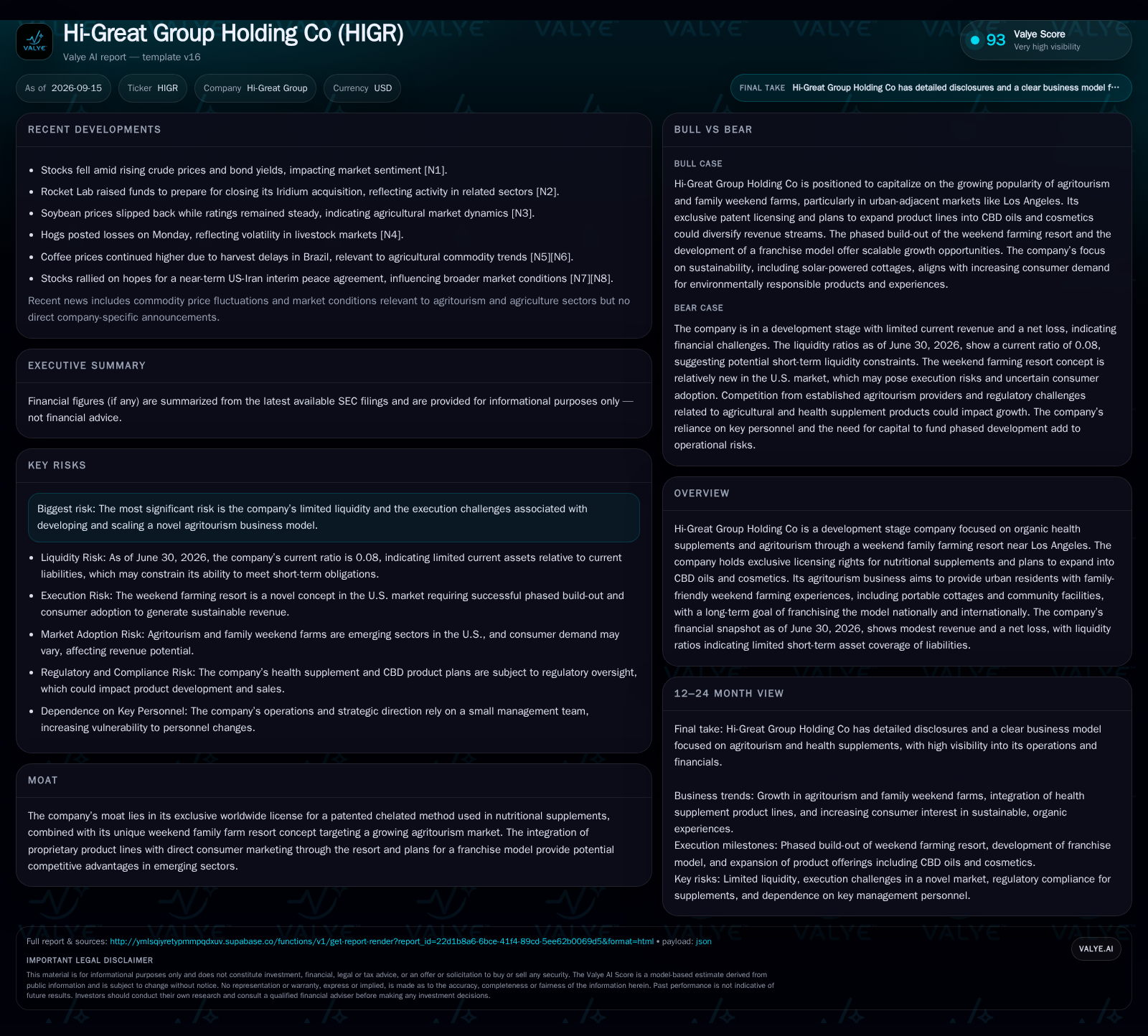
Hi-Great Group is developing a phased weekend farming resort concept near Los Angeles, integrating exclusive health supplement offerings and targeting future franchising. Despite holding a patent license and tapping into emerging agritourism trends, the company’s recent financials reveal very limited liquidity and modest revenues, underscoring high execution and funding risk as it seeks to scale a novel business model in the U.S. market. [S2]
Hi-Great Group Holding Co has positioned itself at the intersection of agritourism, health supplements, and direct-to-consumer wellness, with an ambitious plan to build and franchise weekend family farming resorts starting in California. The company’s proprietary supplement formulations and planned expansion into CBD and cosmetics offer theoretical product diversification. However, recent financials show acute liquidity constraints and minimal revenue, highlighting a business model that is both capital-intensive and unproven in the U.S. context. Whether Hi-Great can bridge the gap between vision and commercial viability hinges on its execution in a novel and still-maturing market segment. [S2]
Acute Liquidity Constraints and Early-Stage Revenue Define the Current Backdrop
As of June 30, 2026, Hi-Great Group reported current assets of $15,836 against current liabilities of $200,689, resulting in a current ratio of just 0.08 and a cash ratio of 0.34. Revenue for the period was $6,955, with a net loss of $12,337. These figures underscore the company’s development-stage status and acute liquidity pressure, with little cash cushion to absorb setbacks or fund growth. The company’s core initiatives—phased resort construction and proprietary supplement sales—remain in their infancy, and the resource gap raises questions about the feasibility and timing of planned expansion. [S2]
How Hi-Great’s Integrated Resort and Supplement Model Could Generate Value
Hi-Great’s business model is predicated on two intertwined revenue streams: (1) sales of proprietary nutritional supplements (with planned expansion into CBD oils and cosmetics), and (2) experiential revenue from a weekend farming resort, including cabin rentals, family garden parcels, and entertainment or community facilities. The supplement business, if executed as direct-to-consumer e-commerce, may offer variable-cost advantages and scalable gross margins, especially if the proprietary chelated method delivers product differentiation or premium pricing. However, the resort build-out is capital intensive, likely requiring significant upfront investment for land development, facility construction, and marketing before meaningful revenue accrues. If the resort achieves scale and occupancy, it could benefit from high fixed-cost leverage, but this presumes both strong demand and efficient operating execution. The planned franchise model could, if realized, shift capital needs to franchisees, improving scalability and reducing direct capital exposure. However, franchise uptake depends on early proof points and clear unit economics.
Unique Licensing and Conceptual Differentiation—But Competitive and Regulatory Barriers Loom
Hi-Great’s exclusive worldwide license for a patented chelated supplement formulation provides a potential product moat in the crowded supplement industry, assuming the method translates into perceived consumer value or regulatory advantage. The weekend farming resort concept is relatively novel in the U.S., with most domestic agritourism offerings focused on pick-your-own, farm stays, or educational tours, rather than modular, franchise-ready weekend getaways. This uniqueness could help Hi-Great stand out if it can establish brand recognition and operational credibility. However, competition for leisure spending is fierce, with alternatives ranging from traditional resorts and vacation rentals to established agritourism operators and wellness retreats. Further, the supplement and CBD markets are saturated and highly regulated, with large incumbents, variable consumer trust, and evolving legal frameworks. Regulatory compliance, especially in supplements and CBD, could add friction and delay to product commercialization.
If Early Resort Phases Succeed, Franchising and Product Synergy Could Drive Rapid Scale
In the most favorable scenario, Hi-Great successfully completes the initial phases of its Los Angeles-area resort, generating strong consumer interest and positive guest experiences. This would validate the weekend farming model in the U.S. and provide a showcase for potential franchisees, accelerating national or international expansion without proportionate capital outlay. Supplement and wellness product sales could benefit from direct marketing to resort guests, cross-selling, and brand association with sustainability and family recreation. If the patented chelation method could support premium pricing or efficacy claims, the supplement line could achieve attractive margins. Confirmation would come from completed build-out milestones, meaningful occupancy and guest satisfaction metrics, growing e-commerce supplement sales, and signed franchise agreements. Falsification would be evident if the initial resort phases fail to attract sufficient demand, or if franchise interest does not materialize after launch.
Gradual Progress with Ongoing Funding Needs and Uncertain Market Adoption
The most plausible path is one of incremental progress: Hi-Great may complete some elements of its phased resort build-out, but with delays and cost overruns typical for novel, capital-intensive projects. Supplement sales may grow modestly, but without major brand traction or channel breakthroughs, especially given limited marketing resources and regulatory hurdles. The franchise model may attract inquiries but see slow uptake until the flagship resort demonstrates consistent profitability and guest interest. Ongoing liquidity constraints mean the company will likely require additional capital infusions—via equity, debt, or strategic partners—to sustain operations and expansion. Evidence supporting this scenario would include slow but steady increases in revenue, partial resort opening, and modest supplement sales with continued net losses. Falsification would occur if the company either rapidly scales or fails to deliver any operational milestones.
Capital Shortfall or Market Rejection Could Stall Both Resort and Product Ambitions
In the adverse scenario, Hi-Great is unable to secure the necessary capital to fund even the first phases of its resort, or construction is delayed by permitting, regulatory, or cost issues. Supplement and CBD product sales may underperform due to lack of consumer awareness, regulatory delays, or ineffective marketing. Without a functioning resort as a proof point, the franchise concept fails to gain traction, and the company remains stuck at a subscale, loss-making stage. In this case, the acute liquidity strain could force downsizing, asset sales, or even restructuring. Confirmation would come from missed development milestones, further deterioration in liquidity ratios, and stagnant or declining revenues. Falsification would require clear evidence of capital secured, facility build-out, and initial customer adoption.
Milestones That Will Determine Whether Hi-Great’s Agritourism Vision Can Take Root
Progress on the phased construction of the Los Angeles-area weekend farming resort, including completion of communal facilities, cabin showrooms, and individual garden parcels.
Reported occupancy rates, guest bookings, and customer satisfaction levels once the resort is operational—if disclosed.
Growth in direct-to-consumer supplement sales, including any traction in new product lines such as CBD oils and cosmetics.
Updates on franchise inquiries, signed agreements, or the launch of franchise locations outside the initial resort.
Evidence of new capital raised or partnerships formed to fund build-out and operating expenses.
Any regulatory developments or delays affecting supplement, CBD, or resort operations.
Turnover or changes within the small management team, given dependence on key personnel.
Disclosure of unit-level economics for both the resort and supplement lines, which would help test scalability and profitability assumptions.
Disclaimer: This is research-only, informational analysis and not investment advice. It may include AI-generated interpretation and general industry context. Always verify important details using primary sources.

Comments