
Karbon-X Corp.: Explosive Growth in Carbon Credit Trading Meets Liquidity and Concentration Hurdles
Karbon-X Corp. has rapidly scaled its carbon credit trading platform and climate tech solutions, leveraging blockchain and subscription offerings to drive revenue. However, acute liquidity strain, heavy customer concentration, and operational challenges threaten the company's ability to sustain momentum.
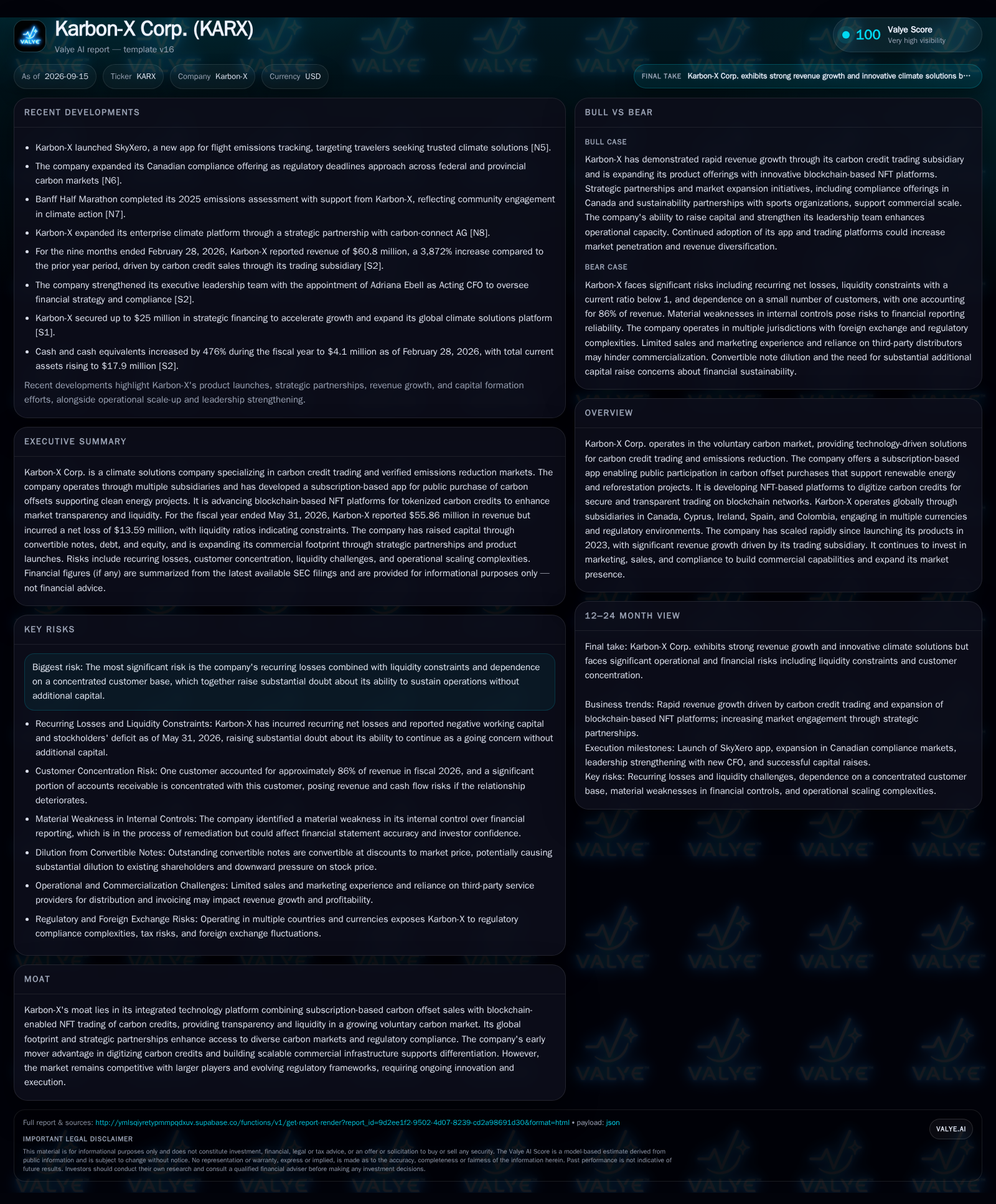
Karbon-X Corp. reported remarkable revenue growth driven by its carbon credit trading subsidiary and new tech-enabled offerings, including an app and blockchain-based carbon credit NFTs. Despite these advances, the company faces severe liquidity constraints, recurring losses, and heavy reliance on a single customer. Its future hinges on diversifying revenue, improving internal controls, and successfully raising capital to fund ongoing operations and innovation.[S1] [S2]
Karbon-X Corp. has emerged as a technology-driven player in the voluntary carbon market, boasting explosive revenue growth on the back of its carbon credit trading operations and innovative digital solutions. The company’s public app and push into blockchain-based tokenization of carbon credits position it at the intersection of climate finance and fintech. Yet, beneath this growth lies a precarious foundation: severe liquidity constraints, recurring losses, and a business highly dependent on a single customer. As Karbon-X attempts to scale and diversify, the company’s ability to convert innovation into a sustainable, diversified revenue base while managing risk and funding needs will determine whether its early momentum is fleeting or foundational.
Recent Financial Results Highlight Both Opportunity and Imminent Risk
Karbon-X posted a dramatic increase in revenue to $60.8 million for the nine months ended February 28, 2026—a 3,872% jump over the prior-year period—primarily fueled by carbon credit sales through its trading subsidiary.[S2] However, this top-line expansion has not translated to profitability: for the year ended May 31, 2026, the company reported a net loss of $13.59 million and a negative EPS of $0.16.[S1]
Liquidity remains a critical issue. As of May 31, 2026, Karbon-X’s current assets stood at $6.06 million against $10.10 million in current liabilities, resulting in a current ratio of 0.6 and a cash ratio of 0.51—well below standard benchmarks for operational safety.[S1] This shortfall, combined with recurring losses, led management to state there is substantial doubt about the company’s ability to continue as a going concern.[S1]
Customer concentration is acute: one customer accounted for 86% of fiscal 2026 revenue, magnifying business risk if the relationship weakens or dissolves.[S1] The company has sought to address capital needs through convertible notes, long-term debt, and equity sales, but these measures create their own risks, notably potential shareholder dilution as notes convert at discounts to market price.[S1]
How Karbon-X’s Model Could Scale—And Where It May Break
Karbon-X’s business model is centered on monetizing the voluntary carbon market through both direct carbon credit trading and technology-enabled consumer and enterprise platforms. Revenue primarily comes from brokering and selling verified emissions reduction (VER) credits, with additional upside from subscription-based consumer offerings and the planned NFT-based trading platform. The company’s cost structure is a mix of variable costs—such as credit procurement and transaction fees—and scaling fixed costs in marketing, compliance, and technology development as operations expand.[S2]
Operating leverage could theoretically emerge if the company succeeds in growing a high-margin digital platform or recurring subscription base, since marginal costs for software-based products tend to be low. However, the present economics are stressed: operating expenses have surged due to aggressive marketing, professional fees, and hiring, outpacing revenue growth and contributing to ongoing losses.[S2]
With a current ratio below 1, Karbon-X is dependent on external funding to sustain operations and invest in growth; these balance-sheet figures do not by themselves establish operating, investment, or financing capacity. Convertible notes and long-term debt have provided runway, but discounted conversion terms threaten dilution and may limit future equity financing options.[S1]
The company’s pathway to sustainable margins likely depends on (a) diversifying its customer base to reduce concentration risk, (b) shifting revenue mix toward technology and subscription products, and (c) achieving operational scale without proportionally rising fixed costs. The NFT-based credit trading platform, if successfully commercialized, could offer high incremental margins, but its adoption and regulatory acceptance remain unproven.
Positioning in a Crowded, Evolving Voluntary Carbon Market
Karbon-X’s principal competitors are other carbon credit traders, climate tech startups, and established environmental service providers, many of whom are expanding digital offerings and building partnerships with corporates and governments. Large exchanges, fintech entrants, and blockchain-based carbon marketplaces are also vying for share in the same rapidly evolving space.
The company’s early foray into blockchain-enabled tokenization of carbon credits distinguishes it from traditional brokers, potentially enhancing transparency, auditability, and liquidity—features increasingly valued in the voluntary carbon market. Its app-based subscription model aims to democratize access to offsets, appealing to both retail and enterprise customers seeking to manage their carbon footprint.
However, barriers to entry in digital carbon markets are falling, with technology and data standards improving across the sector. Larger incumbents have stronger balance sheets, deeper relationships, and more robust compliance infrastructure. Karbon-X’s limited sales and marketing experience, combined with reliance on third-party distributors, may constrain its ability to build lasting brand equity or defend pricing as the market matures.[S1]
The company’s global footprint and regulatory agility could be an asset if it leverages local partnerships and adapts quickly to shifting standards, but also exposes it to complex compliance, tax, and FX risks that established players are better equipped to manage.
If Platform Adoption Accelerates and Customer Base Diversifies, Margins Could Expand Rapidly
A favorable scenario would see Karbon-X’s NFT-based carbon credit trading platform gain traction among both retail and institutional users, driving high-margin transaction volume and recurring subscription revenue. Broader adoption of the app, especially if paired with innovative offerings like SkyXero for flight emissions tracking, could create network effects and embed Karbon-X in daily climate action behaviors.[N5]
Strategic partnerships—such as those with sports teams, airlines, or enterprise sustainability platforms—could unlock new distribution channels, reducing reliance on any single customer and stabilizing cash flow.[N8] Expansion into compliance-driven markets (e.g., Canadian carbon regulation) may open additional, more predictable revenue streams if Karbon-X can navigate the standards and secure multi-year agreements.[N6]
Evidence that would confirm this trajectory includes: (a) a declining share of revenue from the top customer, (b) sustained growth in subscription and platform transaction revenue, (c) positive operating cash flow, and (d) successful onboarding of diverse enterprise clients.
Most Likely Outcome: Volatility Persists as Karbon-X Juggles Growth, Funding, and Operational Gaps
The most plausible near-term path is continued revenue volatility as Karbon-X attempts to scale, diversify its customer base, and convert innovation into recurring revenue streams. While the company could maintain double-digit growth from trading and new product launches, heavy reliance on a small number of customers and the need for ongoing capital infusions will likely persist.[S1] [S2]
Operational scaling—especially in compliance, sales, and technology—will likely keep expenses high and margins thin, at least until the company achieves greater revenue stability and operating leverage. Remediation of internal control weaknesses and improvement in liquidity ratios will be critical to restoring investor confidence and supporting future fundraising.
Confirmation of this scenario would come from: (a) ongoing but slowing revenue growth, (b) persistent net losses, (c) incremental customer diversification but continued concentration risk, and (d) regular capital raises to bridge liquidity shortfalls.
Concentration and Liquidity Risks Trigger a Crisis Despite Top-Line Growth
An adverse scenario is triggered if Karbon-X’s largest customer reduces or ceases purchases, causing a sudden revenue and cash flow shortfall that cannot be offset by new business quickly enough. The company’s negative working capital position and recurring losses then force urgent asset sales, unfavorable financings, or even restructuring.[S1]
If the NFT platform and consumer apps fail to gain traction or face regulatory hurdles, the company’s diversification efforts may stall, reinforcing dependence on transactional trading and further exposing Karbon-X to margin pressure and competitive pricing dynamics.
Evidence supporting this scenario would include: (a) a sharp decline in revenue or accounts receivable from the top customer, (b) inability to raise new capital on reasonable terms, (c) worsening liquidity ratios, and (d) material delays or failures in product/platform launches.
Benchmarks for Testing Karbon-X’s Ability to Build a Sustainable, Diversified Climate Platform
The proportion of total revenue attributable to the largest customer—declining concentration would signal improved business resilience.
Subscription app user growth and retention rates, if disclosed, would help test adoption and recurring revenue potential.
Gross margin trends by business segment (trading, app, NFT platform) to assess scalability and unit economics.
Operating cash flow and free cash flow, as positive inflections would indicate better self-funding capacity.
Progress and timing of NFT-based carbon credit platform commercialization, including regulatory acceptance and transaction volume.
Customer acquisition cost (CAC) and payback period, if disclosed, to evaluate marketing efficiency and scaling prospects.
Remediation of material weaknesses in internal controls, as evidenced by unqualified audit opinions or management disclosures.
Ability to secure follow-on capital at non-punitive terms, particularly in the context of convertible note conversions and dilution risk.
Disclaimer: This is research-only, informational analysis and not investment advice. It may include AI-generated interpretation and general industry context. Always verify important details using primary sources.

Comments