
Londax Corp.: From Software Aspirant to AI Infrastructure Contender—Can a Capital-Starved Shell Execute a Strategic Pivot?
Londax Corp. faces a decisive crossroads: with its legacy software business generating minimal revenue and persistent losses, the newly controlled entity is evaluating a leap into AI and digital infrastructure—a sector demanding deep capital and operational muscle. The path forward hinges on funding, execution, and credible differentiation in fiercely competitive markets.
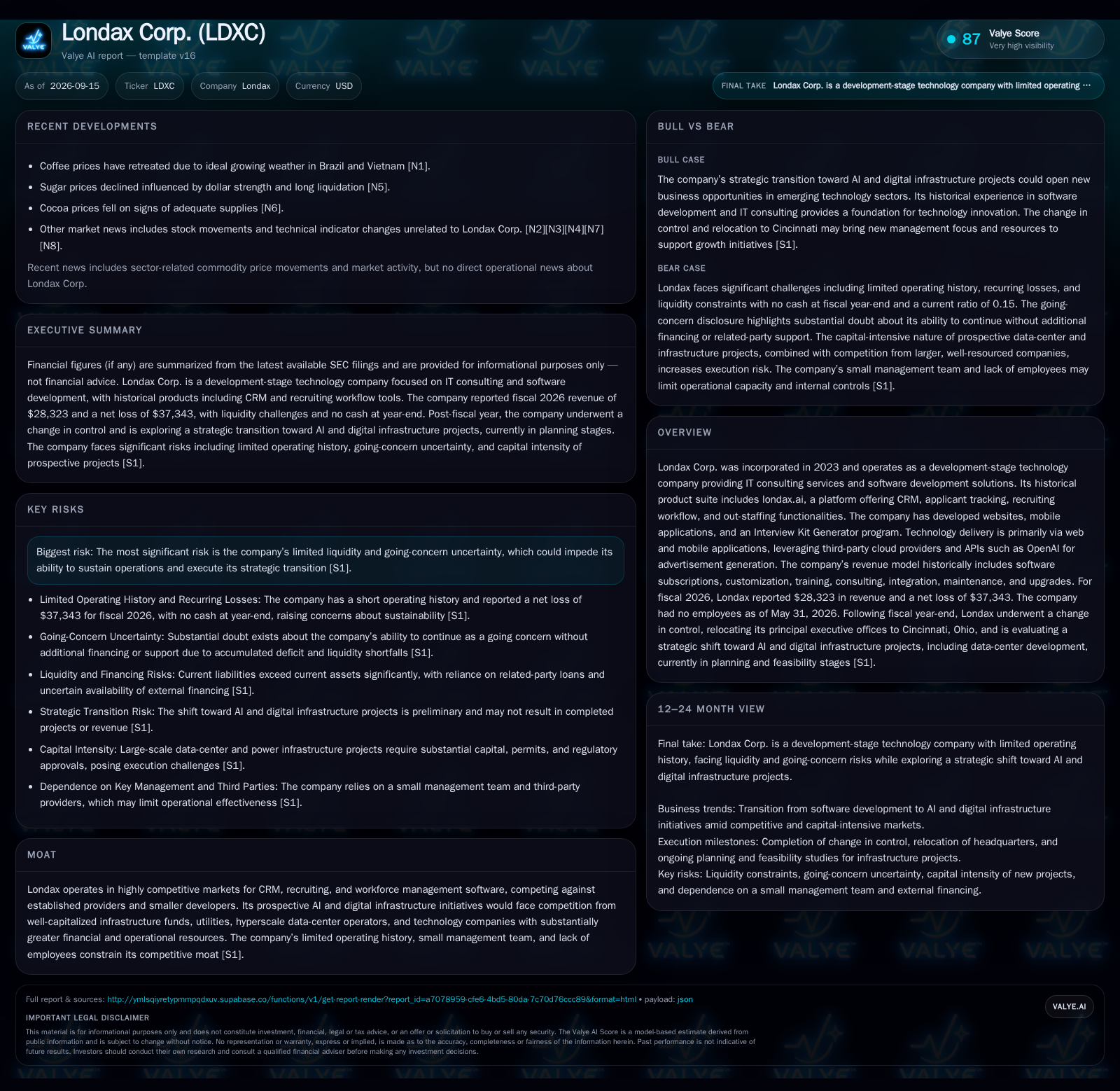
Londax Corp. reported $28,323 in revenue and a net loss of $37,343 for fiscal 2026, with no cash at year-end and a current ratio of 0.15, raising severe liquidity concerns. After a change in control and headquarters relocation, the company is evaluating a strategic shift from software and IT consulting to AI and data center infrastructure, but this transition is still in planning stages and exposes Londax to capital intensity and execution risk in highly competitive industries [S1].
Londax Corp. sits at a pivotal inflection point. Its legacy as a development-stage software and consulting provider has yielded minimal revenue and persistent losses, culminating in a severe liquidity crunch with no cash at the close of fiscal 2026. A recent change in control and headquarters relocation hint at a strategic reset, with the company now eyeing the capital-intensive AI and digital infrastructure sector. However, this planned transition faces daunting obstacles: funding shortfalls, operational capacity, and entrenched competition. The coming quarters will test whether Londax can secure the resources and executional discipline necessary to transform from a struggling software shell into a credible infrastructure player—or whether financial constraints will force a retreat before the pivot is meaningfully underway.
Strategic Reset Amid Liquidity Crisis and Control Shift
Londax Corp.’s fiscal 2026 results underscore an urgent financial predicament: the company reported just $28,323 in revenue against a net loss of $37,343, with no cash on hand and a current ratio of 0.15 at year-end. This liquidity strain is compounded by an accumulated deficit of $40,622 and reliance on $37,741 in related-party loans, leading auditors to express substantial doubt about Londax’s ability to continue as a going concern without new financing [S1].
Following year-end, a change in control transferred majority ownership to Alpha Investment Inc., accompanied by a relocation of principal offices to Cincinnati, Ohio. This governance overhaul signals a possible break from the company’s underperforming software roots, with management now evaluating a strategic pivot toward high-growth AI and digital infrastructure—specifically, power-intensive data center projects, though these initiatives remain in early feasibility stages [S1].
The combination of acute financial distress, a change in leadership, and a stated interest in capital-intensive new markets sets the stage for a binary outcome: rapid revitalization if funding and execution align, or further contraction if financial and operational hurdles persist.
Economic Model: From Low-Scale Software to Capital-Intensive Infrastructure
Historically, Londax’s economics have been shaped by small-scale IT consulting and SaaS-like software subscriptions—offering CRM, applicant tracking, and workflow tools. The revenue model included subscriptions, customization, training, integration, and maintenance. However, with $28,323 in annual revenue, the business model failed to achieve scale, likely resulting in high fixed costs per dollar of revenue and negligible operating leverage [S1].
The planned strategic shift to AI and digital infrastructure—especially data centers—would fundamentally alter Londax’s economic profile. Data center development is highly capital intensive, requiring large upfront investments in land, power, equipment, and regulatory compliance. Margins can be attractive at scale due to recurring colocation, cloud, or hosting revenues, but initial phases demand heavy outlays and long lead times before revenue generation. The capital structure for such projects typically involves significant debt or equity financing, and early-stage entrants often struggle to secure competitive cost of capital.
Londax’s lack of employees and dependence on third-party technology and related-party loans further complicate both legacy and prospective business models. The company’s ability to move beyond a shell status and capture high-value infrastructure economics hinges on successfully raising capital and establishing operational credibility.
Competitive Realities: From Crowded SaaS to Hyperscale Infrastructure Arms Race
In its legacy software business, Londax competed in mature and crowded markets for CRM and workforce management tools, facing entrenched players with established customer bases, broad feature sets, and significant brand recognition. The barriers to entry are low for basic offerings but rise rapidly for differentiated or enterprise-grade solutions, leading to price compression and high churn risk for undifferentiated entrants.
The contemplated pivot to AI and digital infrastructure would place Londax in direct competition with some of the largest and best-capitalized entities in technology and real estate—hyperscale data center operators, infrastructure funds, cloud providers, and utilities. These incumbents benefit from scale-driven procurement, brand trust, deep technical expertise, and privileged access to power and land, making it extremely difficult for new entrants to win major contracts or achieve sustainable margins.
Londax’s current lack of employees, limited operating history, and reliance on related-party or third-party support leave it at a significant disadvantage. Without a distinctive value proposition—such as unique site access, proprietary technology, or a novel partnership model—the company is vulnerable to both price and execution risk in any infrastructure development effort.
How a Funding Infusion Could Catalyze a Viable Infrastructure Play
The most plausible path to upside is contingent on successful external fundraising and credible execution of the AI/digital infrastructure strategy. If Londax were able to secure substantial capital—either through strategic investors, private equity, or a joint venture with a larger infrastructure player—it could fund initial site acquisition, permitting, and early-stage data center buildout. Early wins in permitting or anchor customer commitments (such as pre-leased capacity to cloud or AI tenants) would validate the business model and enable further capital raising at improved terms.
Execution would require rapid recruitment of experienced infrastructure and operations personnel, establishment of robust internal controls, and demonstration of technical capability—potentially leveraging the company’s historical software expertise to create differentiated automation or management layers for its facilities.
Evidence that would support this scenario includes: public disclosure of significant new funding, announcements of site acquisitions or anchor tenants, hiring of industry-veteran management, and progress on regulatory or permitting milestones.
Transition Drag: Incremental Progress, Persistent Constraints
The most likely near-term outcome is a slow and uncertain transition. Londax may pursue feasibility studies and preliminary planning for AI and data center projects, but progress is likely hampered by ongoing liquidity constraints and lack of operational capacity. Absent a transformative capital raise, the company could continue to operate as a shell, seeking partnerships or small consulting contracts to fund basic overhead while searching for a breakthrough opportunity.
The legacy software business, lacking scale or a differentiated niche, is unlikely to drive material growth or profitability. Meanwhile, the data center and AI infrastructure ambitions remain largely aspirational unless accompanied by visible project milestones and external validation.
Confirmation of this scenario would come from continued low revenue and persistent net losses, limited new project announcements, and ongoing reliance on related-party loans or small-scale consulting income.
Liquidity Crunch Forces Strategic Retreat or Dissolution
The most adverse scenario is a failure to secure new financing or related-party support, triggering acute liquidity distress. In this case, Londax could face forced asset sales, loss of public listing status, or even dissolution if creditors move to recover outstanding loans. The absence of operating cash, employees, or tangible assets would further constrain options, making a going-concern exit or distressed sale the most likely outcomes.
This scenario would be confirmed by further deterioration in the current ratio, loss of related-party loan support, auditor or exchange actions, or a formal announcement of liquidation, wind-down, or bankruptcy proceedings.
Milestones That Will Define Londax’s Viability and Direction
Any disclosure of a substantial capital raise, strategic investment, or joint venture agreement would be pivotal for testing the viability of the infrastructure pivot.
Announcements regarding the acquisition of land, site control, or regulatory approvals for data center or digital infrastructure projects would provide evidence of execution beyond the planning stage.
Hiring of experienced infrastructure development, engineering, or operations personnel—if disclosed—would signal increased operational capacity and seriousness of intent.
Public identification of anchor customers, pre-leasing agreements, or partnerships with established technology or cloud companies would validate the new business model.
Reversal of the company’s negative working capital position—evidenced by an improved current ratio or positive cash balance—would indicate improved financial stability.
Reduction in related-party loan dependence and demonstration of access to third-party funding on market terms would test the company’s ability to operate independently.
Any indication of persistent shell status, auditor resignation, or regulatory scrutiny would raise red flags about long-term sustainability.
Disclaimer: This is research-only, informational analysis and not investment advice. It may include AI-generated interpretation and general industry context. Always verify important details using primary sources.

Comments