
Transglobal Management Group: Golf Tech Ambition Meets Financial Strain and Competitive Hurdles
TMGI’s pivot to a vertically integrated golf technology and operations model offers clear strategic logic and market opportunity, but severe liquidity constraints and a crowded competitive field test both its execution capacity and long-term viability.
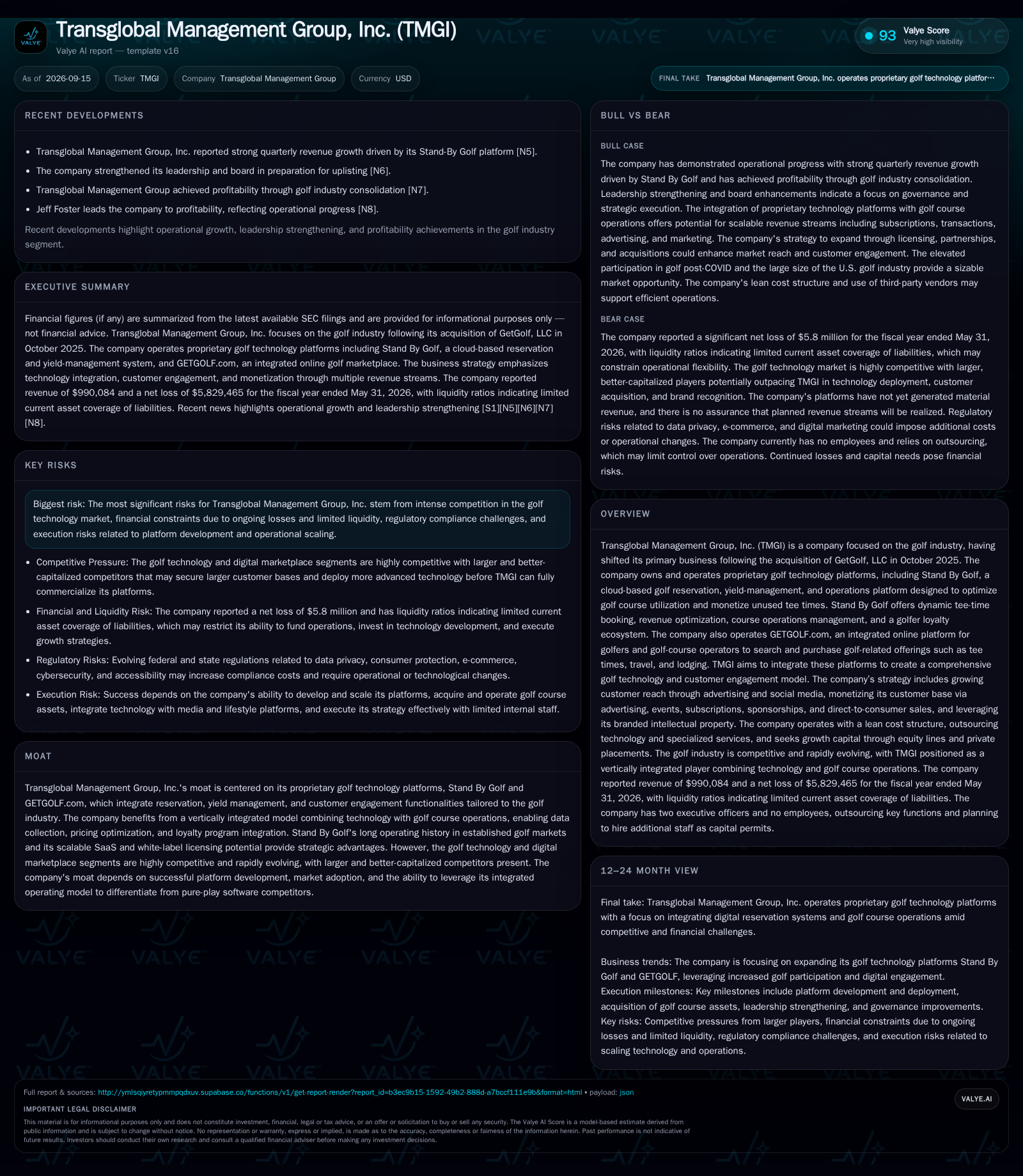
Transglobal Management Group (TMGI) has repositioned itself as a golf industry technology and operations player after acquiring GetGolf, LLC and launching proprietary digital platforms such as Stand By Golf and GETGOLF.com. Despite recent revenue growth and operational milestones, the company faces acute liquidity challenges, ongoing losses, and stiff competition from larger, better-capitalized rivals. Its future hinges on scaling its platforms, securing capital, and demonstrating sustained user and partner adoption in a rapidly evolving market [S1] [N5] [N6] [N7].
Transglobal Management Group, Inc. (TMGI) is betting that a vertically integrated approach—combining proprietary golf technology platforms with direct course operations and digital engagement—can unlock new value in the $95 billion U.S. golf industry. Since acquiring GetGolf, LLC, TMGI has launched Stand By Golf and GETGOLF.com to capture both enterprise and consumer segments. However, the company’s ambitions are checked by severe liquidity constraints, ongoing losses, and a competitive landscape crowded with larger, nimbler rivals. The next phase will test whether TMGI can translate platform innovation and operational consolidation into sustainable growth before its financial runway runs out [S1] [N5] [N6] [N7].
Recent Strategic Moves and Financial Stress Define TMGI’s Present
TMGI’s acquisition of GetGolf, LLC in October 2025 marked a decisive pivot toward the golf industry, with the company now focusing on two core digital platforms: Stand By Golf—a cloud-based tee-time, yield-management, and operations tool—and the integrated GETGOLF.com marketplace [S1]. The Stand By Golf platform has delivered strong quarterly revenue growth, indicating early product-market fit in both B2B and consumer-facing channels [N5]. However, the company’s financial foundation is precarious: as of May 31, 2026, TMGI reported just $165,532 in cash against $7,969,799 in current liabilities, resulting in a current ratio of 0.03 and a net loss of $5.8 million for the year [S1]. This acute liquidity stress, coupled with ongoing losses and negative working capital, raises substantial doubt about ongoing operations absent new financing or dramatic revenue acceleration [S1]. Leadership changes and board strengthening in preparation for an uplisting suggest an urgent focus on governance and capital markets access [N6].
Platform Economics: SaaS, Marketplace, and Course Operations—But Can They Scale?
TMGI’s business model is designed around multi-pronged monetization: SaaS licensing and white-label deals for Stand By Golf, transaction and advertising revenue from GETGOLF.com, and potential direct margin from operating or acquiring golf courses [S1]. The Stand By Golf platform’s dual role as an enterprise tool and consumer marketplace enables both recurring (licensing/subscription) and variable (transactional, advertising) revenue streams. If the platform achieves critical mass, yield management and loyalty features could drive higher course utilization and customer lifetime value, creating positive network effects. However, the company operates with minimal internal staff, outsourcing key functions, which may limit gross margin expansion and operational control if scale is reached [S1]. The capital intensity of acquiring and operating golf courses adds further funding needs, and with high fixed costs, operating leverage will only benefit TMGI if user and partner adoption accelerate meaningfully. Without scale, negative margin dynamics and recurring losses may persist.
Crowded Fairways: Navigating a Fragmented and Intensifying Golf Tech Market
TMGI enters a digital golf marketplace that is already highly contested by large booking aggregators, established course management SaaS providers, and a new cohort of technology-driven startups. Larger competitors may enjoy greater brand recognition, deeper integration with golf course operators, and the capital to invest in advanced features or aggressive customer acquisition [S1]. The company’s proprietary platforms offer differentiation through vertical integration—combining reservation tech, yield management, and direct course operations—but these advantages are theoretical until TMGI can demonstrate substantial adoption, defend its IP, and deliver a superior user experience at scale. The risk is that better-capitalized incumbents could quickly replicate or out-innovate TMGI’s offerings, eroding any early-mover advantage. Regulatory complexity around e-commerce, consumer data, and digital marketing adds another barrier to sustainable differentiation [S1].
How a Virtuous Cycle Could Unlock Profitable Growth
If TMGI successfully integrates Stand By Golf and GETGOLF.com, rapidly expands its network of course partners, and leverages data-driven yield management to drive higher utilization and loyalty, the company could create a defensible ecosystem with multiple revenue streams [S1]. Confirmation would come from accelerating platform adoption by both golf courses (measured by SaaS contracts or active partners, if disclosed) and end users (transaction volume, repeat bookings, and engagement metrics). Additional signals would include the successful acquisition and profitable operation of golf course properties, demonstrating the model’s synergy benefits. Achieving positive free cash flow and meaningful improvements in liquidity ratios would further validate the upside case. Evidence of growing advertising and sponsorship revenue, as well as expanded white-label partnerships, would suggest that the platform model is scaling beyond initial markets.
Stretched Runway: Execution Progress Tempered by Capital and Adoption Friction
The most plausible trajectory for TMGI is one of incremental platform adoption and operational improvement, but with persistent funding constraints and competitive headwinds. The company may grow its digital platform user base and sign additional course partners, but at a measured pace constrained by limited marketing, R&D, and working capital. Revenue may increase quarter over quarter, but recurring losses will likely continue unless TMGI secures additional capital or rapidly achieves scale. Confirmation would include modest but consistent growth in platform metrics (partners, bookings, SaaS revenue, if disclosed), evidence of cost control, and progress on governance and reporting. Falsification would be signaled by stagnating user or partner growth, inability to close new equity or debt financing, or further deterioration in liquidity ratios.
Liquidity Crisis and Competitive Displacement Threaten Survival
The most acute risk for TMGI is that liquidity constraints become existential before the business model matures. If the company cannot raise new capital or generate sufficient cash flow, it may be forced to curtail operations, delay platform development, or surrender strategic assets under distressed terms. In this scenario, larger competitors could accelerate customer acquisition and technological innovation, further marginalizing TMGI’s value proposition. Early warning signs would include failure to close anticipated financings, missed payroll or vendor payments (if disclosed), rapid increases in accounts payable, or management turnover. Regulatory setbacks or data breaches could compound these pressures, triggering compliance costs or reputational damage that the company is ill-equipped to absorb.
Milestones That Will Reveal TMGI’s Staying Power and Scalability
Quarterly growth in active golf course partners using Stand By Golf—if disclosed, this would be a direct proxy for B2B adoption and SaaS revenue potential.
Monthly active users, transaction volume, and repeat booking rates on GETGOLF.com—key indicators of consumer traction and platform stickiness.
Gross margin and net cash flow trends as the business attempts to scale—evidence of operating leverage or persistent negative economics.
Successful acquisition and profitable management of golf course properties—would validate the vertically integrated model.
Securing new rounds of equity or debt financing on favorable terms—critical for ongoing operations given current liquidity constraints.
Expansion of white-label or enterprise partnerships—would suggest broader acceptance of the platform by established industry players.
Churn rates for both course partners and consumers—a useful metric would be renewal percentages or customer retention, if disclosed.
Regulatory or legal developments affecting digital reservations, data privacy, or consumer protection—could alter the compliance cost structure or require operational changes.
Disclaimer: This is research-only, informational analysis and not investment advice. It may include AI-generated interpretation and general industry context. Always verify important details using primary sources.

Comments