
Winchester Bancorp: Profitability Amidst Opaque Disclosures and the Limits of External Visibility
Winchester Bancorp posts solid net income and maintains a sizable cash position, but sparse business model disclosures constrain external confidence in its long-term trajectory. The next phase hinges on transparency, capital deployment, and the potential for differentiated banking economics.
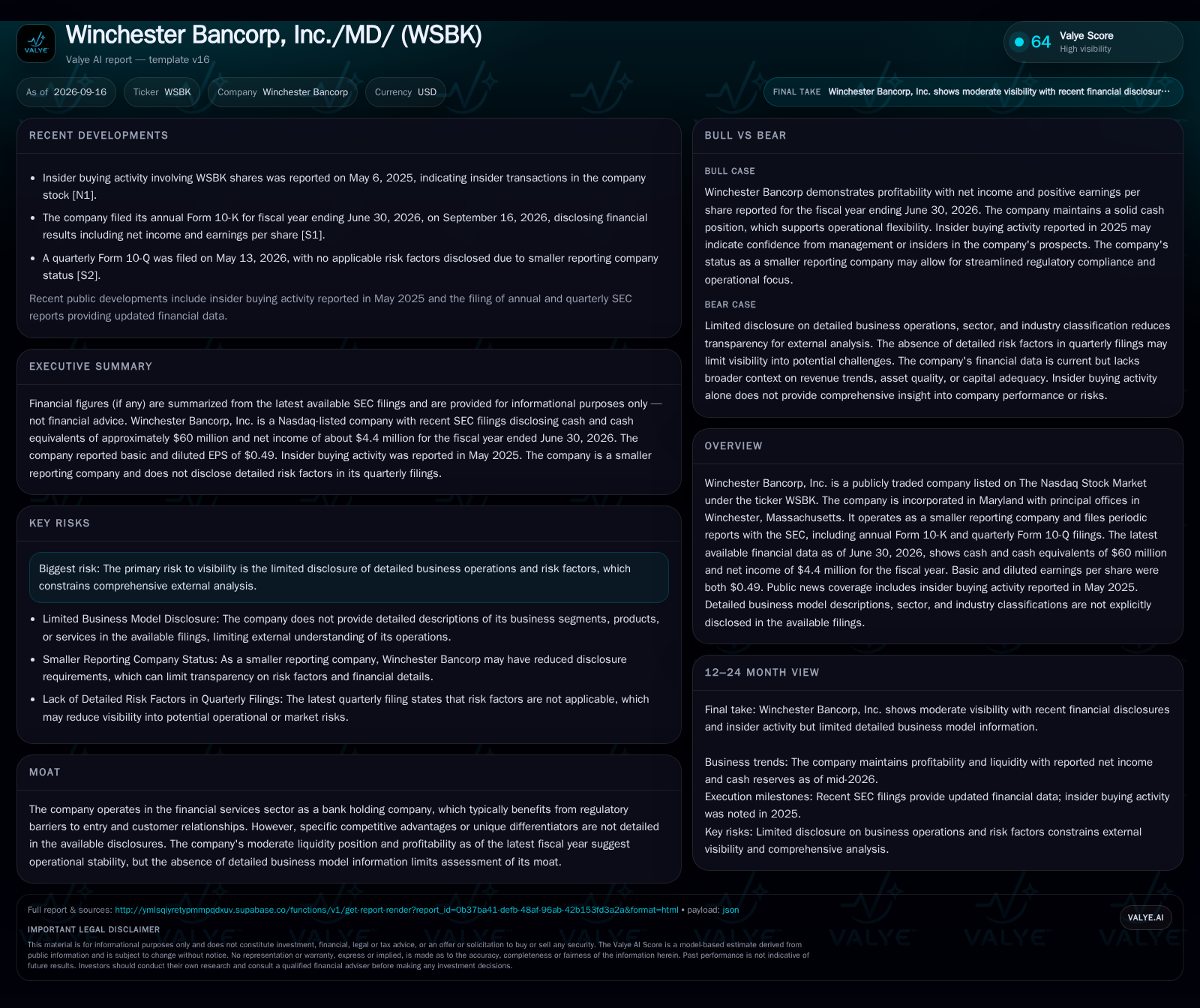
Winchester Bancorp reported $4.4 million in net income and held $60 million in cash as of June 2026, with earnings per share at $0.49. Insider buying in 2025 provides a confidence signal, but a lack of detailed operational disclosure limits external analysis of sustainability, risk, and growth prospects. The company’s status as a smaller reporting company reduces mandatory transparency, making future capital allocation and disclosure practices pivotal to the thesis. [S1] [N1]
Yet, the company’s sparse business model disclosures and reduced reporting obligations as a smaller reporting company create a significant information gap for investors. With limited insight into its revenue streams, asset quality, or lending practices, the durability of current profitability and Winchester’s potential to carve out a sustainable competitive advantage remain open questions. The company’s next chapter will be defined by whether it chooses to shed more light on its operations and deploy capital in ways that differentiate it from peers.
Latest Financials Highlight Profitable Operations Amidst Limited Disclosure
Winchester Bancorp reported $4.4 million in net income for the fiscal year ending June 30, 2026, with basic and diluted earnings per share of $0.49. The company held $60 million in cash and cash equivalents at period end, reflecting a reported liquidity position for a smaller reporting company.Insider transaction activity was reported in the cited source; this activity does not by itself establish insider confidence. However, the company does not disclose its revenue breakdown, asset composition, or detailed business model, which severely constrains external analysis of its operational drivers and risk profile. [S1] [N1]
Banking Economics: Profit Drivers, Capital Needs, and the Leverage Equation
In the absence of detailed segment or product disclosures, Winchester Bancorp’s core economics likely resemble those of a traditional community or regional bank. The primary revenue streams would plausibly be net interest income (spread between loan yields and deposit costs), non-interest income (fees, service charges), and possibly investment securities gains. Profitability in such models is highly sensitive to loan volume, asset quality, cost of funds, operating efficiency, and credit loss provisions.
Operating leverage can be significant: fixed costs (branches, IT, compliance) are high relative to incremental revenue, so growth in earning assets or fee-based services could yield outsized bottom-line impact if credit quality remains stable. Conversely, substantial loan losses or funding cost spikes could rapidly erode profitability. The company reported cash and liquidity metrics for the period; these figures do not by themselves establish operating runway, investment capacity, financial flexibility, or financing capacity. [S1]
If, instead, capital is being actively lent or invested, the future trajectory will depend on underwriting discipline, sector mix, and local economic trends.
Beyond the traditional revenue and cost drivers, an important consideration in banking economics is the quality and diversification of the loan portfolio. Concentration risk in specific sectors or geographic regions can amplify vulnerability to economic downturns or regulatory changes. Without disclosure, it is difficult to assess whether Winchester Bancorp’s asset mix is balanced or skewed toward higher-risk segments.
Competitive Landscape: Regulatory Barriers, Relationship Banking, and Digital Disruption
As a bank holding company, Winchester Bancorp operates in a sector with meaningful regulatory barriers to entry and high switching costs for core banking relationships. Incumbent banks typically benefit from customer inertia and deep local relationships. However, the lack of disclosed business focus—whether retail, commercial, mortgage, or wealth management—prevents a clear assessment of Winchester’s differentiation.
Competitive threats are twofold: traditional peers (community/regional banks, credit unions) and non-bank fintechs offering digital lending, payments, or deposit alternatives. The competitive advantage for a small bank today often hinges on service quality, niche focus, or technology adoption. If Winchester is slow to digitize or relies on legacy processes, it could be vulnerable to share loss. Conversely, a focus on underserved segments or innovative digital offerings could enhance retention and margin.
The competitive dynamics in regional banking are also influenced by evolving customer expectations and technological innovation. If Winchester Bancorp’s business model does not adapt to digital banking trends—such as mobile platforms, automated underwriting, or data-driven customer segmentation—it risks falling behind more agile competitors. Conversely, a focused investment in technology could enable cost efficiencies, improved risk management, and enhanced client experiences, creating a virtuous cycle of retention and growth. However, the scale and timing of such investments must be carefully balanced against capital constraints and the risk of execution missteps.
Unlocking Value: How Transparency and Capital Deployment Could Drive Rerating
The most favorable path for Winchester Bancorp would involve leveraging its reported liquidity and profitability to invest in core franchise growth or targeted digital transformation. If the company begins to disclose more granular detail—such as loan book composition, deposit growth, asset quality, or digital product rollout—it would enable investors to more confidently underwrite future earnings and risk. Capital could be deployed into higher-yielding assets, technology upgrades, or selective acquisitions, driving both top-line growth and operating leverage.
Confirmation of this scenario would require new disclosures around revenue mix, loan/deposit growth, and cost/income ratios. Evidence of above-peer growth in deposits, low net charge-offs, or increasing fee income would further support the case that Winchester is not only profitable but also building a differentiated, defensible banking platform. Conversely, continued opacity or a lack of capital redeployment would falsify the upside, limiting the potential for valuation expansion.
Sustained Profitability Without Breakout Growth or Differentiation
The most plausible path is that Winchester Bancorp continues to operate profitably but does not materially change its disclosure practices or strategic posture. The company maintains a conservative balance sheet, steady net interest margins, and disciplined cost control, but lacks the transparency or innovation necessary to command a premium valuation or unlock rapid growth.
Supporting this view would be continued reporting of modest net income, stable cash balances, and minimal expansion in disclosed operational metrics. Falsification would come from either a sudden increase in transparency, revealing new growth drivers, or from emerging risks (asset quality deterioration, funding stress) that force a strategic pivot or capital raise.
Opacity Masks Deterioration: Risks of Hidden Asset Quality or Funding Strains
The adverse scenario is that limited disclosure is concealing underlying risks—such as credit losses, deposit outflows, or regulatory capital shortfalls. If Winchester’s net income is being maintained by one-off gains or underprovisioning for loan losses, reported profitability could prove unsustainable. A sudden spike in loan defaults, rising funding costs, or a regulatory event could erode both earnings and capital, especially in a higher-rate, more volatile macro environment.
This scenario would be confirmed by a future decline in net income, cash balances, or the emergence of non-performing asset disclosures. A forced capital raise, dividend suspension, or regulatory action would further indicate underlying fragility. The lack of segmented reporting and risk factor disclosure leaves investors vulnerable to adverse surprises.
Milestones and Metrics That Will Define Winchester Bancorp’s Trajectory
Disclosure of loan portfolio composition, including non-performing assets, would help test the durability of current profitability.
Deposit growth trends, if disclosed, would provide insight into customer loyalty and Winchester’s competitive standing.
Net interest margin data, if released, would clarify the company’s core banking economics and sensitivity to rate changes.
Updates on digital initiatives or technology investments would signal efforts to defend or expand the franchise against fintech disruption.
Evidence of new product launches, partnerships, or market expansion would indicate a proactive growth strategy.
Any change in regulatory capital ratios or new capital raises would provide early warning of underlying stress or planned expansion.
Management commentary on risk appetite, credit standards, or strategic priorities would help clarify future direction.
Further insider transactions—buying or selling—could provide incremental signals about insider sentiment, though not a substitute for operational transparency.
Disclaimer: This is research-only, informational analysis and not investment advice. It may include AI-generated interpretation and general industry context. Always verify important details using primary sources.

Comments