
Marathon Bancorp’s Post-Conversion Playbook: Capital Return, Structural Change, and the Realities of Community Banking
Marathon Bancorp’s recent multi-step conversion and stock repurchase initiatives mark a pivotal transition, but the company’s long-term value hinges on its ability to navigate competitive, regulatory, and interest rate headwinds typical of regional banks. The question is whether capital return and governance moves can translate into sustainable growth or merely signal prudent stewardship amid sectoral constraints.
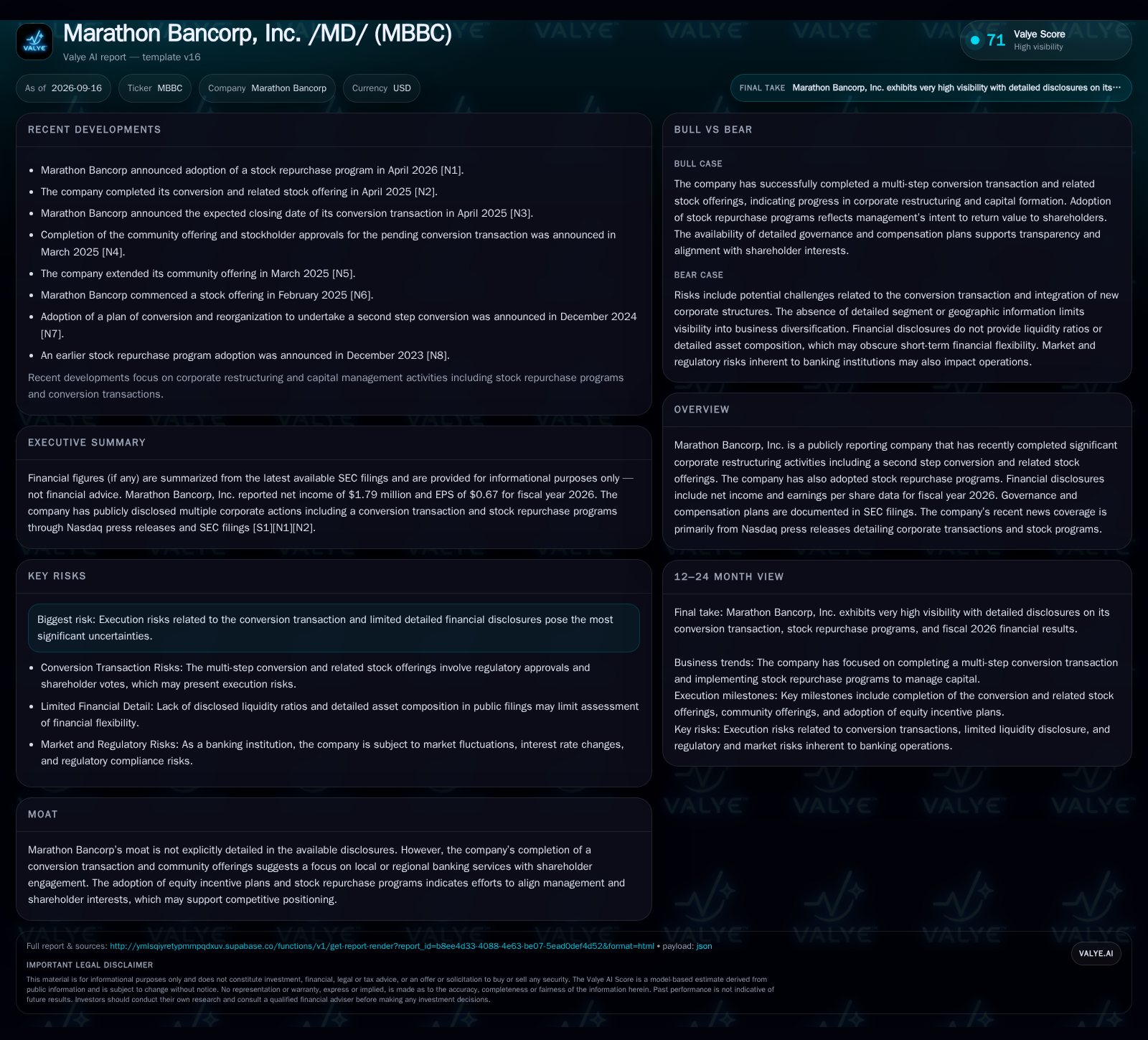
Marathon Bancorp has completed a significant conversion and related stock offerings, adopted multiple stock repurchase programs, and reported $1.79 million in net income for fiscal 2026. These actions reflect a focus on capital management and shareholder alignment, but the absence of detailed operating or asset disclosures leaves open questions about the underlying profitability drivers and resilience to sector-specific risks. The company’s next phase will test whether its structural changes deliver durable competitive advantages or simply optimize within prevailing industry limits. [S1] [N1] [N2]
Marathon Bancorp, Inc. stands at a strategic crossroads after a transformative period marked by a multi-phase conversion, public stock offerings, and a renewed focus on capital management through repurchase programs. With $1.79 million in net income and new governance structures in place, the company has reset its corporate foundation. However, as a community bank operating in a sector beset by margin compression and regulatory scrutiny, the real test will be whether these structural moves foster genuine competitive advantage or merely optimize for the realities of a challenging industry landscape.
Structural Reset: Conversion, Repurchases, and the New Baseline
Three developments define Marathon Bancorp’s current state: the completion of a multi-step conversion and related stock offering (finalized in April 2025), the adoption of stock repurchase programs in both late 2023 and April 2026, and the reporting of $1.79 million in net income for fiscal 2026, translating to $0.67 in basic EPS. [S1] [N1] [N2] [N8] The corporate restructuring has shifted the company’s ownership, governance, and potentially its capital flexibility. The adoption of repurchase programs signals management’s willingness to return capital to shareholders, a notable move in the context of community banking where capital allocation options are often limited. These actions collectively set a new baseline for both financial performance and shareholder engagement.
Earnings Power and Capital Allocation: Banking Model Under the Microscope
Marathon Bancorp’s core economics, like most community banks, likely hinge on the spread between interest earned on loans and investments versus the cost of deposits and borrowings. The reported net income of $1.79 million for 2026 provides a starting point for evaluating post-conversion profitability, but the absence of segment or asset-mix detail means the drivers—commercial versus residential lending, noninterest income, deposit cost controls—remain unclear. [S1]
The successful completion of a second-step conversion and stock offerings could expand capital, supporting asset growth or providing a buffer for credit losses. However, the repeated adoption of stock repurchase programs suggests management currently sees limited high-return organic growth opportunities or is focused on optimizing capital ratios and shareholder returns. In a low-to-moderate growth environment, repurchases can boost EPS, but may cap future asset expansion if retained earnings are not robust.
Fixed costs in community banking (compliance, personnel, technology) are significant, but local scale can offer operating leverage if loan growth resumes. Conversely, if deposit costs rise faster than asset yields, margin compression may erode profitability. The company’s future economics thus depend on balancing prudent capital return with the flexibility to support growth and absorb shocks.
Beyond interest margin dynamics, the composition and quality of the loan portfolio critically influence earnings stability and capital needs. If Marathon Bancorp’s assets skew toward commercial real estate or construction lending, cyclical sensitivity and regulatory capital charges may be elevated, constraining growth. Conversely, a diversified loan mix with consumer and small business exposures could moderate volatility but might compress yields. Additionally, the bank’s approach to noninterest income generation—such as service fees, interchange income, or wealth management—would help offset margin pressures. Without clarity on these income streams, it remains uncertain whether the bank can sustain profitability if net interest income growth slows or deposit costs rise.
Community Banking in Context: Competitive Edges and Sectoral Pressures
Marathon Bancorp’s conversion and community offering history imply a regional or local banking footprint, facing competition from other community banks, credit unions, and increasingly, digital-first financial platforms. While the adoption of equity incentive plans and detailed governance structures can help align management and shareholder interests, they do not by themselves confer a durable moat.
Potential advantages may include established customer relationships, local market knowledge, and a reputation for service, but these are increasingly challenged by technology-driven competitors and the commoditization of core banking products. Without evidence of unique digital capabilities, specialized lending niches, or above-peer efficiency, Marathon’s competitive position likely remains tied to traditional strengths—relationship banking and community presence—rather than structural cost or product advantages.
The company’s ability to defend or expand its share will depend on its response to sectoral headwinds: rising deposit costs, regulatory burden, and the risk of disintermediation by fintechs and larger banks.
Unlocking Value: When Capital Return Meets Growth Reacceleration
A favorable outcome for Marathon Bancorp would require its capital return strategy—via repurchases—complemented by a resumption of profitable loan growth and improved efficiency. If the post-conversion capital base enables prudent risk-taking, the bank could capture share in its core markets, drive operating leverage, and generate above-peer returns.
Confirmation would come from sequential growth in net interest income, stable or improving net interest margin despite sectoral pressures, and tangible book value per share growth even after buybacks. Additional evidence would include disclosures showing asset growth outpacing deposit growth without a deterioration in credit quality, and any emergence of fee-based revenue streams.
Falsification would occur if repurchase-driven EPS growth masks stagnation or contraction in the underlying loan book, or if capital return is forced to slow due to regulatory constraints or unexpected credit losses.
Optimizing Within Constraints: Prudent Stewardship Amid Sector Headwinds
The most plausible path for Marathon Bancorp is that of a conservatively managed community bank optimizing capital allocation through buybacks and careful loan deployment, but constrained by broader industry challenges. Modest organic growth, stable but unspectacular returns, and incremental improvements in efficiency are likely, given the absence of transformative product or technology disclosures.
Evidence supporting this scenario would include steady net income, maintenance of regulatory capital ratios, and continued implementation of shareholder-friendly policies. Falsification would arise if sector shocks (such as deposit flight or credit losses) force a retrenchment from capital return, or if loan demand in core markets weakens materially.
When Margin Compression and Regulatory Drag Erode Value
Adverse outcomes for Marathon Bancorp could arise if rising deposit costs outpace asset yields, leading to net interest margin compression and eroding core profitability. Regulatory changes or compliance missteps could increase operating costs or constrain capital deployment, while sector-wide shocks—such as regional real estate corrections or peer bank failures—could trigger credit losses or deposit outflows.
This scenario would be confirmed by declining net income, shrinking net interest margin, elevated provision for credit losses, or suspension of buyback programs to preserve capital. Persistent lack of disclosure on liquidity or asset quality could also signal hidden vulnerabilities.
What Will Define Marathon Bancorp’s Post-Conversion Trajectory
Sequential trends in net interest margin—if disclosed—will signal whether the company is able to defend its earnings power against rising funding costs.
Loan growth versus deposit growth: A useful metric would be quarterly disclosure of loan and deposit balances to assess core franchise vitality and funding mix.
Size and pace of stock repurchases: Monitoring actual buyback activity versus authorization will clarify management’s capital allocation discipline.
Credit quality trends, including nonperforming asset ratios or provision expense if disclosed, are crucial for assessing potential downside risks.
Operating expense trajectory: Evidence of efficiency gains or cost control would support the case for operating leverage post-conversion.
Any new product, technology, or fee-income initiatives: Disclosure of digital banking or noninterest revenue streams would test for emerging competitive advantages.
Regulatory capital ratios and commentary on capital adequacy if disclosed, to confirm flexibility for both growth and capital return.
Management commentary or disclosures on market expansion, M&A, or strategic shifts—any sign of movement beyond status quo community banking.
Disclaimer: This is research-only, informational analysis and not investment advice. It may include AI-generated interpretation and general industry context. Always verify important details using primary sources.

Comments