
LuxExperience B.V.: Subsidiary Leverage, Ownership Complexity, and the Challenge of Post-YNAP Integration
LuxExperience B.V. faces the dual challenge of integrating its transformative YNAP acquisition and navigating concentrated shareholder oversight, all while recent losses and revenue volatility put its holding-company model to the test.
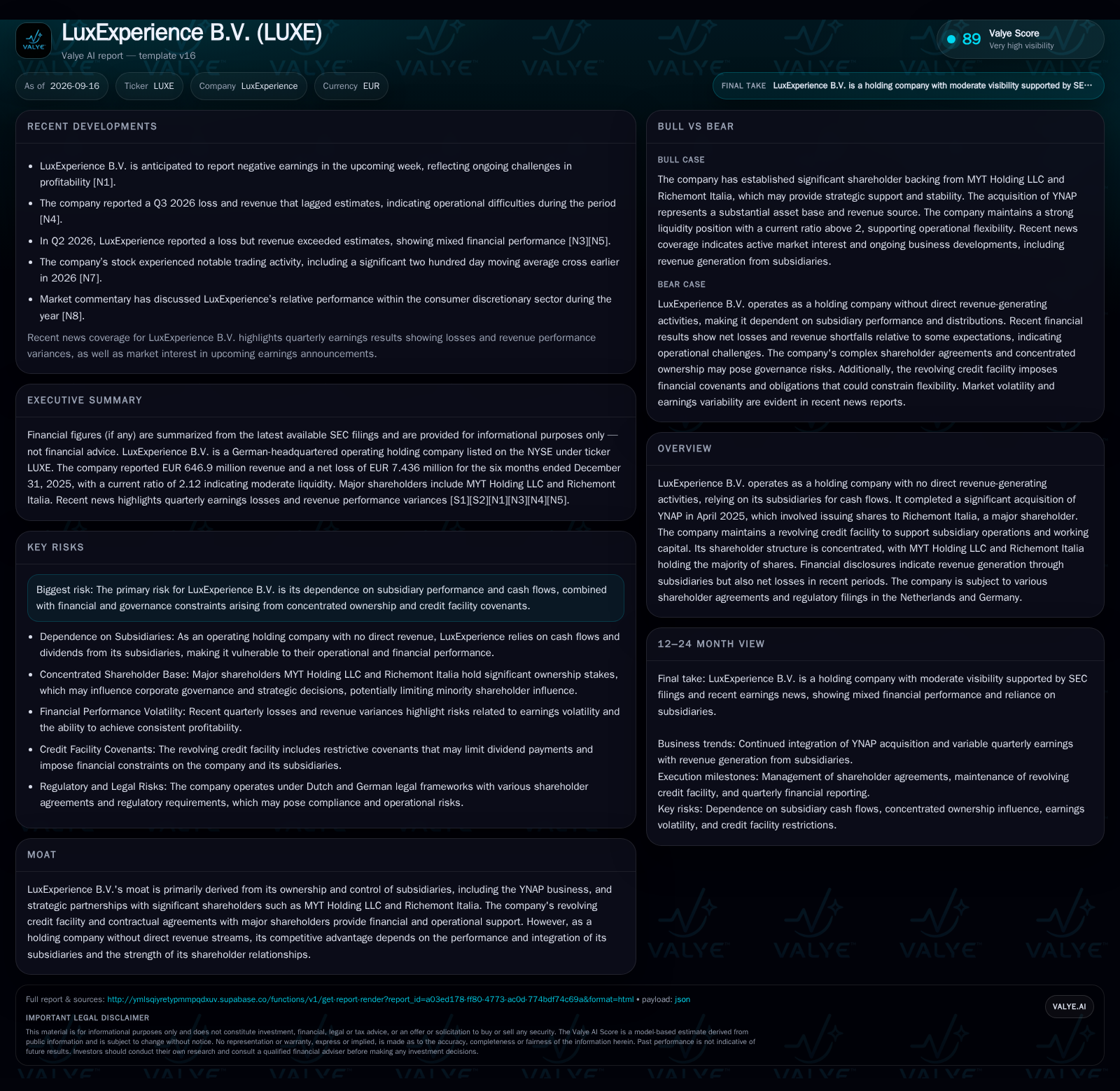
LuxExperience B.V., a German-based holding company, relies entirely on its subsidiaries for revenue and cash flow, having completed the significant YNAP acquisition in April 2025. Despite EUR 646.9 million in revenue for the six months ending December 2025, it reported a net loss and continues to face earnings volatility. Major shareholders MYT Holding LLC and Richemont Italia collectively control over 80% of shares, shaping both strategic direction and governance.
LuxExperience B.V. stands at a crossroads after its landmark acquisition of YNAP, which has reshaped its financial profile and governance landscape. Despite robust revenue from subsidiaries, the company has yet to establish a path to sustained profitability, reporting a net loss for the most recent half-year period. With over 80% of its shares controlled by two strategic investors—MYT Holding LLC and Richemont Italia—LuxExperience must balance the expectations of powerful stakeholders against the operational reality of integrating a major acquisition. The holding-company structure magnifies both the upside and risk of subsidiary performance, leaving the company exposed to volatility and dependent on efficient cash flow transmission from its operating units.
Recent Financial Markers and Strategic Shifts
LuxExperience B.V.’s business landscape was fundamentally altered by its April 2025 acquisition of YNAP, which resulted in the issuance of shares to Richemont Italia, making it a significant shareholder with a 35.6% stake [S1]. The company reported EUR 646.9 million in revenue and a net loss of EUR 7.4 million for the six months ended December 2025 [S2]. The company reported a current ratio of 2.12 for the period. [S2] [S1] However, recent quarters have seen earnings misses and revenue volatility, suggesting integration challenges and the need for operational improvement [N3] [N4] [N5] [N1]. These facts matter because they highlight the company’s dependence on successful subsidiary performance post-acquisition and the potential limits of potential financial flexibility imposed by both market performance and credit facility covenants.
How the Holding Model Amplifies Subsidiary Economics
As a pure holding company, LuxExperience B.V. does not generate operating income directly; its economic fate is tied to the capacity of its subsidiaries to deliver profits and, crucially, to upstream cash through dividends or inter-company transfers [S1]. This structure means its own revenue and cash flow depend on the health, capital intensity, and payout policies of its operating arms. The YNAP business, likely an e-commerce or luxury retail platform given Richemont's involvement, may have a mix of fixed and variable costs, with margin pressures typical in digital luxury retail—where logistics, marketing, and customer acquisition costs are high and pricing power is contingent on exclusivity and brand relationships. The integration of YNAP could increase operating leverage if synergies are realized, but could also amplify losses if revenue growth stalls or if integration costs run high. Capital needs may rise if YNAP requires investment to stay competitive, and LuxExperience’s ability to fund such needs is ultimately capped by subsidiary performance.
The holding company’s reliance on subsidiary cash flows introduces a layered risk profile, where operational setbacks at the subsidiary level can cascade upwards, constraining LuxExperience’s strategic flexibility. For example, if YNAP’s capital expenditure requirements increase due to intensifying competition or the need for technology upgrades, LuxExperience may face a trade-off between reinvestment in growth initiatives and maintaining dividend flows. This dynamic underscores the importance of subsidiary capital allocation decisions and payout policies, which must balance reinvestment needs with the holding company’s liquidity demands.
Furthermore, LuxExperience’s holding structure can amplify financial leverage effects. While subsidiaries may carry their own debt levels, the holding company’s credit profile is indirectly influenced by the subsidiaries’ operational cash generation and balance sheet strength. If subsidiaries underperform, LuxExperience might face increased borrowing costs or tighter covenant conditions, limiting its potential financial flexibility. Conversely, strong subsidiary performance could enable LuxExperience to optimize its capital structure, potentially accessing capital markets on favorable terms. The interplay between subsidiary operational metrics and holding company financing conditions highlights the necessity for integrated financial planning and rigorous monitoring of subsidiary performance indicators beyond headline revenue and profit figures.
Ownership, Partnerships, and the Search for Sustainable Advantage
LuxExperience’s competitive posture is shaped less by direct market-facing activities and more by its ability to control and optimize its portfolio companies. The recent YNAP acquisition could position it as a significant player in luxury e-commerce, where scale, brand partnerships, and logistics integration are critical. However, the sector is intensely competitive, with platforms like Farfetch, Net-a-Porter, and Richemont’s own historical assets vying for market share. LuxExperience’s concentrated shareholder base—MYT Holding LLC (47.5%) and Richemont Italia (35.6%)—creates both potential strengths and vulnerabilities: strategic alignment with powerful partners can accelerate growth or turnaround efforts, but may also limit the company’s independence and agility. Unlike vertically integrated luxury brands, LuxExperience must extract value through financial and operational discipline, not direct brand-building or product innovation. Its ability to negotiate favorable terms with brands and logistics partners, attract high-value customers, and defend margins will depend on how effectively it leverages its shareholder relationships and subsidiary capabilities.
Unlocking Integration Synergies and Shareholder-Led Expansion
A favorable outcome for LuxExperience would hinge on successful integration of YNAP, yielding operating synergies such as cost rationalization, improved logistics, and enhanced digital capabilities. If the company leverages Richemont’s luxury ecosystem and MYT Holding’s strategic oversight, it could secure exclusive brand partnerships, drive higher-margin sales, and accelerate customer acquisition. Revenue growth outpacing sector peers and a shift to consistent profitability would confirm this scenario—especially if accompanied by increased cash distributions from subsidiaries and evidence of cost discipline. Announcements of new strategic alliances, improved gross margins, or expansion into new markets would further support the bull case. Conversely, persistent losses, weak subsidiary cash generation, or inability to realize integration benefits would challenge the upside thesis.
Subsidiary-Driven Volatility and Incremental Improvement
The most plausible trajectory is continued operational variability as LuxExperience works through the complexities of YNAP integration. Subsidiary performance will likely fluctuate with broader luxury e-commerce trends, consumer demand shifts, and the pace of digital transformation. The company may report periodic revenue gains but struggle to deliver sustained profitability, with net results oscillating near break-even. Incremental improvements—such as tighter working capital management, gradual margin expansion at YNAP, and disciplined cost control—could stabilize financials. Confirmation would come from narrowing quarterly losses, steady or rising cash balances, and evidence of stable subsidiary cash flows. Falsification would involve accelerating losses, declining liquidity, or evidence of governance friction among major shareholders.
Integration Stumbles and Shareholder Complexity Fuel Prolonged Losses
The adverse scenario would see YNAP integration falter, with higher-than-expected costs, customer attrition, or competitive pressures eroding revenue. If LuxExperience’s subsidiaries fail to generate sufficient cash, the holding company could face mounting losses and be unable to service the revolving credit facility without asset sales or dilutive equity issuance. Concentrated ownership could exacerbate governance disputes or strategic gridlock, further impairing responsiveness. Evidence confirming this scenario would include repeated revenue and earnings misses, deteriorating liquidity, breach of credit covenants, or public disputes among major shareholders. A cut in subsidiary distributions or the need to renegotiate financing would also validate the bear thesis.
Milestones That Will Shape LuxExperience’s Post-Acquisition Trajectory
Quarterly trends in subsidiary cash flows and dividend distributions—if disclosed—will be critical for assessing holding company health.
Progress on YNAP integration initiatives, including cost synergies and technology upgrades, would help test whether operational value is being unlocked.
Gross margin and operating margin at the subsidiary level (especially YNAP), if disclosed, would provide a window into profitability improvement.
Any updates to shareholder agreements, voting blocks, or lock-up expirations could foreshadow shifts in governance or potential strategic realignments.
Evidence of new or expanded brand partnerships, geographic expansion, or exclusive product launches at YNAP would indicate competitive progress.
Resolution of any reported disputes or public commentary from major shareholders could help clarify future strategic direction.
Disclosure of capital expenditure plans and investment in digital infrastructure would illuminate long-term growth priorities and capital needs.
Disclaimer: This is research-only, informational analysis and not investment advice. It may include AI-generated interpretation and general industry context. Always verify important details using primary sources.

Comments