
Evolution Petroleum: Portfolio Diversification and Non-Operator Leverage in a Volatile Energy Market
Recent Permian and Louisiana acquisitions, a strategic equity raise, and selective divestitures have reshaped Evolution Petroleum’s asset mix. The company’s non-operated, mineral-heavy model offers both resilience and unique risks as it balances capital returns with the uncertainties of commodity cycles and operator dependence.
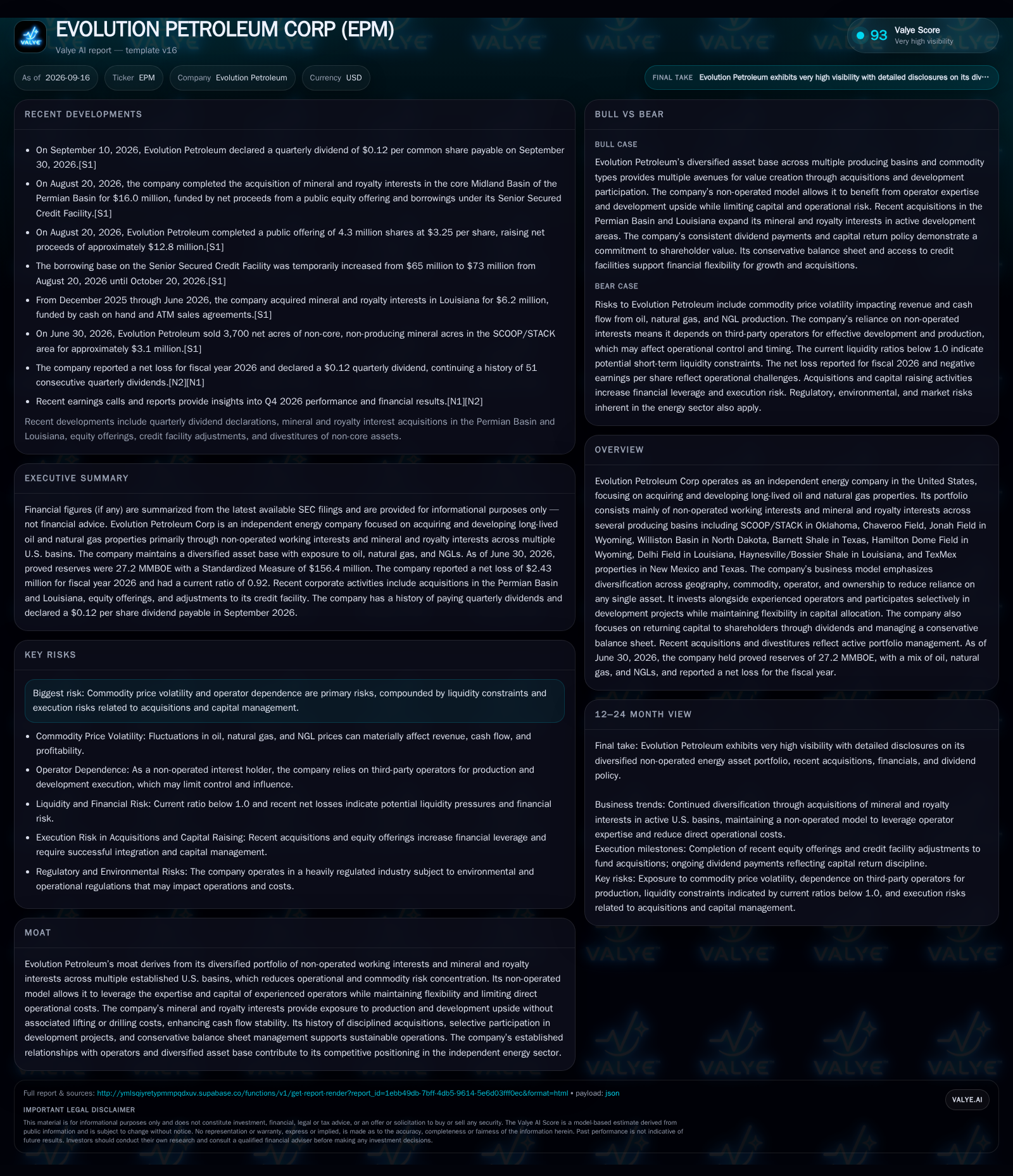
Evolution Petroleum (EPM) has recently executed significant acquisitions in the Permian and Louisiana, funded by an equity offering and expanded credit facility, while divesting non-core assets. The company’s future will hinge on commodity price trends, operator execution, and the ability to integrate new assets while maintaining capital discipline.[S1]
Evolution Petroleum’s recent actions — a $16 million Permian Basin mineral/royalty acquisition, a $12.8 million equity raise, and the sale of non-core Oklahoma acreage — reflect a business model built for flexibility in a volatile energy environment. The coming quarters will test whether Evolution’s capital discipline and asset mix can deliver returns in a market shaped by unpredictable price cycles and intensifying competition.[S1] [N2]
How Recent Acquisitions, Capital Actions, and Liquidity Shape the Strategic Landscape
Evolution Petroleum’s August 2026 acquisition of mineral and royalty interests in the Permian Basin’s Midland core for $16 million — funded by a $12.8 million equity raise and a temporary increase in its credit facility — is a transformative move, expanding exposure to the most active U.S. oil play.[S1] The company also invested $6.2 million in Louisiana minerals and divested 3,700 net acres of non-core, non-producing SCOOP/STACK assets for $3.1 million.[S1] These actions reflect an ongoing shift toward high-quality, lower-risk royalty assets and active portfolio rotation.
The company reported cash and liquidity metrics for the period; these figures do not by themselves establish operating runway, investment capacity, financial flexibility, or financing capacity. [S1] [N2]
This conditional analysis helps clarify the firm's runway for sustaining acquisitions, funding capital calls on working interests, and managing dividend commitments without resorting to dilutive equity raises or onerous debt terms. Moreover, the timing and sequencing of portfolio rotations must be aligned with liquidity availability to avoid financial strain during market troughs.
Non-Operator Model and Mineral Interests: The Double-Edged Sword of Asset-Light Energy Economics
Evolution Petroleum’s business model centers on non-operated working interests and mineral/royalty interests, allowing the company to invest alongside experienced operators without bearing direct drilling or lifting costs on mineral assets.[S1] This structure can create attractive incremental margins and capital efficiency, especially in times of commodity price strength since mineral revenues are mostly cost-free after severance taxes. However, non-operated working interests still expose EPM to capital calls and variable operating expenses, with less direct control over timing or field-level optimization.
The company’s focus on acquiring long-lived, developed reserves (82.2% of proved reserves are developed) and a commodity mix of 39% oil, 45% natural gas, and 16% NGLs diversifies cash flows but also introduces exposure to the full volatility of U.S. energy markets.[S1] Evolution’s funding strategy — combining equity raises, credit facility draws, and opportunistic divestitures — reflects the capital intensity and cyclicality of the sector. Operating leverage is inherently limited by the non-operated, royalty-heavy model, but the downside is that revenue growth depends substantially on third-party operator activity, basin-level development, and commodity prices rather than internal project execution.
The reliance on third-party operators introduces a layer of operational risk that is inversely correlated with Evolution’s capital intensity. While the mineral-heavy model mitigates direct operating expenses, it also limits the company’s ability to influence development pace and cost efficiency, which can be pivotal during commodity downturns. The non-operated working interests, though providing some upside leverage to operator capital programs, expose Evolution to unpredictable capital calls that can disrupt cash flow stability if not prudently managed. A useful metric would be the ratio of discretionary capital calls to total liquidity, which would help assess the firm's buffer against unexpected funding demands in volatile market environments.
Diversification Across Basins and Counterparty Operators: Buffer and Constraint
Evolution’s competitive positioning is defined by broad geographic, commodity, and operator diversification, spanning the Permian, SCOOP/STACK, Williston, Barnett, Haynesville/Bossier, and other basins.[S1] This reduces reliance on any single field or operator, insulating the company from isolated operational or regulatory setbacks.
The non-operated strategy allows EPM to piggyback on the technical capabilities and capital programs of leading operators such as Continental Resources, EOG Resources, and Ovintiv USA, potentially giving it access to development upside without direct execution risk.[S1] However, this model also means Evolution must accept the pace, priorities, and cost structures set by its operator partners — a fundamental limitation compared to vertically integrated or operated peers.
Competition comes from both public and private mineral aggregators, royalty trusts, and other non-operated portfolio players, as well as from direct operators with more control but higher capital risk. The crucial differentiator is the ability to consistently source, underwrite, and integrate accretive mineral and non-operated working interest deals in a market crowded with capital and increasingly efficient data-driven buyers.
Geographic and operator diversification, while generally advantageous, can also dilute focus and complicate asset integration efforts. The heterogeneity of basin economics, regulatory frameworks, and operator execution quality means that portfolio-wide performance is contingent on multiple moving parts aligning favorably. This complexity requires robust underwriting models that incorporate basin-specific decline curves, operator capital efficiency, and commodity price sensitivity. Additionally, the competitive landscape’s evolution towards data-driven mineral acquisition strategies elevates the importance of proprietary geological and operational intelligence. Evolution’s ability to leverage such data to identify underpriced assets or anticipate operator development plans will be a key determinant of sustained competitive advantage.
If Operator Activity Surges and Integration Succeeds, Cash Flows Could Outpace Expectations
The most favorable scenario for Evolution Petroleum involves a combination of sustained or rising oil and gas prices, robust drilling and completion activity by operator partners in the Permian and other core basins, and successful integration of recently acquired mineral assets. In this world, royalty income would rise with increased production volumes and higher commodity realizations, while the asset-light mineral model would keep incremental cash flow margins high.
Confirmation would come from sequential growth in production and cash flow per share, reduced net loss or a return to profitability, and evidence of stable or improved dividend payments.
Integration missteps or unexpected capital calls could also undermine the upside case.
Portfolio Rotation Offsets Some Commodity Pressure, But Returns Remain Sensitive to Operator Performance
The most plausible scenario is that Evolution continues to execute a measured rotation into higher-quality mineral and royalty interests, offsetting declines or volatility in legacy non-operated working interest assets. Commodity prices remain volatile but not catastrophic, and operator activity in the Permian and Louisiana supports modest production and revenue growth.
The company likely maintains its dividend but at a cautious pace, with liquidity ratios gradually improving as new assets are integrated and non-core sales bolster the balance sheet. Net income may remain near breakeven, with upside or downside hinging on basin-level development activity and the timing of new operator projects.
Evidence supporting this scenario includes further portfolio transactions, stable production volumes, and management commentary emphasizing capital discipline. Divergence from this path could occur if commodity prices deviate sharply, operator partners delay projects, or integration of acquisitions fails to deliver expected cash flows.
Liquidity Stress and Operator Delays Could Force Defensive Moves
A negative scenario would unfold if commodity prices decline sharply or if operator partners reduce drilling and completion activity, leading to lower royalty and working interest revenues.
Other downside risks include integration challenges with new mineral assets, unforeseen capital requirements from non-operated working interests, or adverse regulatory changes affecting key basins.
Falsification would require stabilization or improvement in liquidity, a return to profitability, and confirmation that operator activity is at least maintaining current production levels.
Milestones That Will Define Evolution Petroleum’s Value Trajectory
Sequential growth in production volumes — especially from recently acquired Permian and Louisiana mineral interests — as confirmation that operator activity is translating into cash flow.
Net income and cash flow per share trends; a return to positive earnings would demonstrate the effectiveness of portfolio management and integration.
Additional portfolio transactions, including new acquisitions or divestitures, and the valuation multiples achieved in these deals.
Operator activity levels and capital spending in Evolution’s core basins, as disclosed by leading operator partners or through industry data.
Realized commodity price trends (oil, gas, NGLs) relative to hedging activity, if disclosed, to assess revenue sensitivity.
Evidence of successful integration of recent acquisitions, measured by realized production, cash flow, and reserve growth attributable to new assets.
Disclaimer: This is research-only, informational analysis and not investment advice. It may include AI-generated interpretation and general industry context. Always verify important details using primary sources.

Comments