
RYVYL Inc. and RTB Merger: Payment Processing Meets Crypto-Enabled Digital Media—A New Hybrid Business Model in Flux
RYVYL’s recent merger with RTB Digital transforms its profile from a niche fintech processor serving higher-risk verticals to a complex hybrid entity exposed to digital media platform economics and material cryptocurrency volatility. With modest revenue, persistent net losses, and operational and regulatory headwinds, the company’s path depends on execution in both payment and media segments—and its ability to convert platform innovation into durable, scalable revenue.
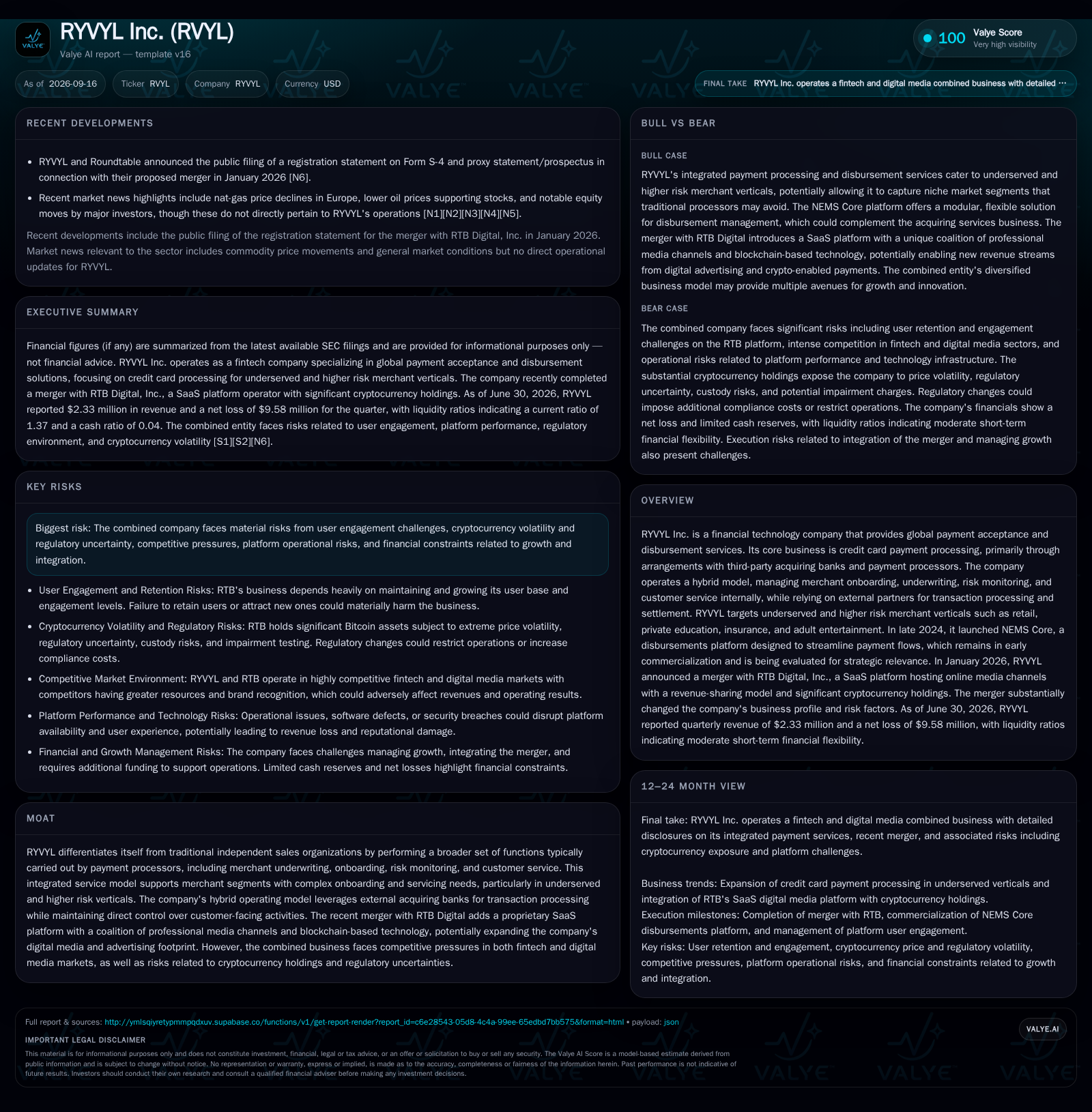
RYVYL Inc. has merged with RTB Digital, shifting from a specialized credit card processor for underserved sectors to a hybrid operator combining fintech and digital media SaaS with significant crypto exposure. The combined entity’s economics and risk profile are now shaped by user engagement, crypto market swings, regulatory shifts, and execution challenges in both payment and media operations. Quarterly revenue remains modest, losses are ongoing, and reported liquidity position, making near-term performance highly sensitive to integration and platform milestones. [S1] [S2] [N6]
RYVYL Inc. is undergoing a fundamental transformation. Once focused on niche payment processing for high-risk merchants, the company’s merger with RTB Digital launches it into the volatile intersection of fintech, digital media SaaS, and cryptocurrency. While this hybrid model offers new addressable markets and technology leverage, it also brings heightened operational complexity, regulatory exposure, and execution risk. With limited cash, ongoing losses, and no proven flywheel in either segment, RYVYL’s future will hinge on its ability to integrate platforms, drive user engagement, and manage crypto volatility without overextending its financial and organizational capacity.
Merger with RTB Digital and Financial Position: A Pivotal Strategic Shift
RYVYL’s merger with RTB Digital, announced in January 2026, fundamentally alters its business profile. RTB operates a SaaS platform for online media channels with revenue-sharing and substantial cryptocurrency holdings—primarily Bitcoin—transferring both digital media operations and material crypto exposure to the combined entity. RTB shareholders are expected to own approximately 85% of the new company, indicating a dramatic shift in strategic control and business mix [S1] [N6].
As of June 30, 2026, RYVYL reported $2.33 million in quarterly revenue, a net loss of $9.58 million, cash and equivalents of $492,000, current assets of $15.13 million, and current liabilities of $11.04 million. The company reported cash and liquidity metrics for the period; these figures do not by themselves establish operating runway, investment capacity, financial flexibility, or financing capacity. [S2]
This merger not only diversifies revenue sources but also raises the company’s risk profile, with new dependencies on platform user engagement, crypto asset valuation, and integration execution.
How RYVYL and RTB Could Generate Profits—And Where Economic Friction Lurks
RYVYL’s legacy economics are based on payment processing: earning transaction fees from credit card payments, especially for merchants underserved by traditional processors. The company’s hybrid model internalizes underwriting, onboarding, and risk management, potentially supporting higher pricing, but also exposes it to greater compliance and loss risk when serving higher-risk verticals.
RTB’s SaaS business introduces a distinct model: it hosts media channels operated by Platform Partners, who create and monetize content. RTB’s revenues are tied to a share of advertising and service fees, with Partners responsible for content costs. The company also facilitates payments—including crypto—leveraging its proprietary Web3 technology. This structure could allow for variable cost leverage (as Partners bear most content costs), but makes RTB’s economics highly dependent on user engagement, advertising demand, and the regulatory climate for crypto payments.
The integration of RTB’s crypto holdings adds a new layer of volatility and accounting complexity. Gains and losses on Bitcoin remeasurement flow through earnings, potentially swamping operational results in periods of crypto market turbulence. Platform development costs are partially capitalized, but the need for ongoing investment in technology, compliance, and user acquisition suggests continued funding requirements.
Both businesses require scale to achieve sustainable operating leverage, but current revenue is modest and net losses are substantial. The company’s ability to generate cash from operations remains unproven, and further capital raises or strategic pivots may be needed if integration and growth do not materialize quickly.
Niche Focus and Platform Ambitions: Strengths, Weaknesses, and Rival Forces
On the payment side, RYVYL’s focus on underserved and higher-risk verticals (retail, private education, insurance, adult entertainment) differentiates it from mainstream processors. This specialization can yield higher margins and customer stickiness if underwriting and risk management are effective, but also exposes the company to regulatory scrutiny and potential loss spikes.
In digital media, RTB faces a crowded landscape of SaaS platforms, content management systems, and programmatic advertising networks. Its Web3 orientation and crypto payment capability may appeal to a subset of creators and advertisers seeking alternative monetization models, but mainstream platforms typically offer greater reach, brand safety, and stability. Competing with larger, more established players will require both technological edge and strong network effects.
The crypto asset component is a double-edged sword: it may attract some partners and users but introduces price, custody, and regulatory risks that many competitors avoid. Regulatory shifts targeting crypto payments or digital advertising could rapidly alter the competitive landscape.
The combined entity’s moat relies on its ability to integrate payment and media services in a way that could increase switching costs or unique value for creators, merchants, and advertisers—an outcome that remains to be proven.
If Platform Integration Unlocks Network Effects and Crypto Monetization
The most favorable scenario is one in which RYVYL successfully integrates its payment services with RTB’s SaaS platform, creating a seamless environment for content creators to monetize audiences, access flexible payments (including crypto), and benefit from tailored financial products. If the NEMS Core disbursement platform gains traction in high-risk verticals and RTB’s media ecosystem attracts and retains a growing base of Platform Partners, the company could achieve scale-driven operating leverage.
Key evidence for this scenario would include: accelerating user and partner growth on the RTB platform; rising transaction and advertising revenue; growing adoption of crypto payment features; and improving gross margins as a result of higher platform utilization. If the company can demonstrate recurring revenue growth, reduced customer churn, and positive cash flow from operations, the upside thesis would gain support.
A successful integration would likely also be accompanied by partnerships or ecosystem deals that validate the company’s hybrid value proposition and drive incremental network effects.
Business Model Complexity Brings Integration Challenges and Prolonged Losses
The most plausible near-term trajectory is one of operational and market friction. Payment processing in high-risk verticals continues to generate modest revenue but remains constrained by intense competition, regulatory oversight, and the need for ongoing investment in compliance and technology. RTB’s media platform achieves incremental growth but struggles to reach critical mass due to competitive pressure and the inherent volatility of crypto-enabled business models.
Net losses persist as the company juggles technology investments, integration costs, and the volatility of crypto holdings. Cash flow remains negative, and the company faces periodic funding needs. The merger integration process encounters delays or inefficiencies, slowing the realization of potential synergies and limiting the company’s ability to deliver on the promise of its hybrid model.
Confirmation of this scenario would come from continued modest top-line growth, persistent quarterly net losses, stagnant user or partner growth, and little improvement in cash generation or margin structure.
If User Churn, Crypto Losses, and Regulatory Shocks Compound Integration Strain
The adverse scenario materializes if RTB’s platform fails to retain or grow its user base, leading to declining advertising and transaction revenue. High churn among Platform Partners, coupled with weak adoption of crypto payment features, could undermine the network effects needed for SaaS economics to scale. Meanwhile, a sharp decline in Bitcoin prices or regulatory action targeting crypto assets could trigger substantial write-downs and force-fire sales, further eroding the company’s financial position.
Operationally, integration challenges may result in technology disruptions, customer attrition, or brand damage—especially if platform reliability or security is compromised. Persistent net losses and limited access to capital could precipitate cost-cutting, asset sales, or strategic retrenchment, potentially diluting shareholders or undermining long-term prospects.
Evidence confirming this scenario would include declining or volatile revenue, large impairment charges on crypto assets, rising operating losses, negative cash flow, and disclosure of material customer or partner losses or regulatory penalties.
Milestones and Metrics That Will Reveal Whether RYVYL’s Hybrid Model Can Deliver
Quarterly growth in active Platform Partners and content creators on the RTB media platform—if disclosed—would indicate network effects and user engagement traction.
Trends in payment processing volume and merchant acquisition in RYVYL’s core high-risk verticals, which would show whether the legacy business is scaling or stagnating.
Gross margin progression for both payment and SaaS platform segments, highlighting whether operating leverage or pricing power is emerging.
Crypto asset fair value and realized gains/losses, as well as any impairment charges, to gauge the impact of market volatility on reported results.
User or partner churn rates for RTB’s platform—if disclosed—to test the stickiness of the SaaS model and the durability of engagement.
Updates on regulatory developments affecting crypto payments, digital advertising, or high-risk merchant processing, which could materially alter the company’s opportunity set or cost base.
Disclosure of material integration milestones, technology platform upgrades, or customer wins that provide evidence of successful merger execution.
Disclaimer: This is research-only, informational analysis and not investment advice. It may include AI-generated interpretation and general industry context. Always verify important details using primary sources.

Comments