
Guardian Metal Resources: Strategic Tungsten Ambition Backed by U.S. Policy, Capital, and Project Momentum
Guardian Metal Resources PLC is advancing two major Nevada tungsten projects—Pilot Mountain and Tempiute—supported by U.S. government funding, robust project economics, and fresh equity capital. As global supply chains tighten and critical mineral security rises on the agenda, the company’s ability to transition from exploration to commercial production will determine whether its assets become core to the next phase of U.S. industrial independence.
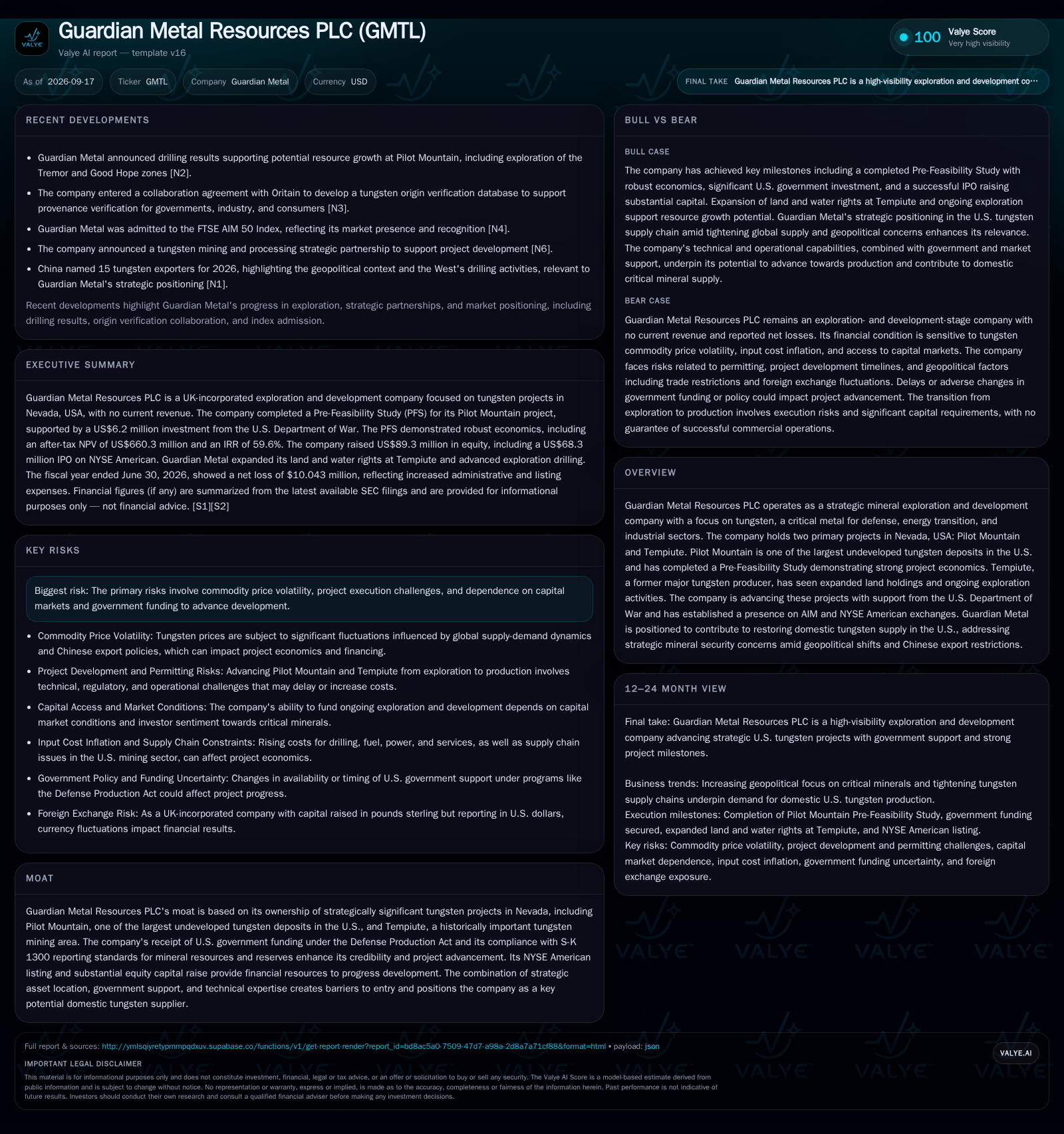
Guardian Metal Resources PLC has secured significant U.S. government funding, completed a high-value Pre-Feasibility Study for its Pilot Mountain tungsten project, raised $89.3 million in equity (including a NYSE American IPO), and expanded its Nevada land and water rights. With no current revenue, the company’s thesis depends on timely project execution, resource growth, and navigating commodity, permitting, and capital market risks in a geopolitically charged tungsten market. [S1] [S2]
Guardian Metal Resources PLC is positioning itself at the heart of U.S. critical mineral strategy by advancing two major tungsten projects in Nevada. With robust project economics, direct U.S. government investment, and substantial new equity capital, the company has cleared key early-stage hurdles. However, with no current revenue and ongoing net losses, Guardian Metal’s true test will be its ability to execute on project development, secure permitting, and ride a volatile tungsten market to commercial production. Its outcome will shape not only company value, but also U.S. ambitions for domestic supply chain resilience in an era of geopolitical tension.
Recent Milestones: Funding, Project Economics, and Resource Expansion
Guardian Metal Resources PLC recently secured a $6.2 million investment from the U.S. Department of War under the Defense Production Act, directly supporting the Pilot Mountain tungsten project’s Pre-Feasibility Study (PFS). The PFS reported robust economics, including an after-tax NPV of $660.3 million and a 59.6% IRR, based on a $197,300 per tonne tungsten price. The company also raised $89.3 million in equity, including a $68.3 million NYSE American IPO, and expanded its Nevada land and water rights for the Tempiute project. Recent drilling results at both projects have indicated potential for further resource growth and scalability. Guardian Metal currently has no operating revenue and reported a $10.043 million net loss for FY2026, reflecting its exploration-stage status. [S1] [S2] [N2] [N6]
Underlying Economics: Capital Intensity, Cash Flow Potential, and Sensitivity to Commodity Prices
Guardian Metal’s business model is fundamentally leveraged to the economics of large-scale, primary tungsten mining. The Pilot Mountain PFS outlines production of 15,916 tonnes of WO3 over eight years, with after-tax free cash flow of $1.058 billion and a capital payback period of about one year from first commercial production. These figures suggest high potential operating leverage if the project transitions to production and achieves forecast yields and cost controls.
However, as a pre-revenue exploration and development company, Guardian Metal remains capital intensive and highly sensitive to commodity price swings, input cost inflation (energy, labor, reagents), and permitting and regulatory timelines. The economics are particularly exposed to tungsten price volatility, which is influenced by Chinese export policies and global supply-demand imbalances. The company’s equity funding, augmented by government support, helps defer but does not eliminate the need for substantial future capital to reach construction and commercial scale. If project execution slips or costs escalate, payback and returns could materially worsen.
The capital intensity inherent in tungsten mining projects like Pilot Mountain also implies significant exposure to operational risks that extend beyond commodity prices. For instance, variations in ore grade distribution, metallurgical recovery rates, and processing efficiencies can materially affect cash flow projections. Sensitivity analyses that incorporate potential deviations in these operational parameters would provide a more nuanced understanding of project resilience. Additionally, the timing of capital deployment is critical; front-loaded expenditures increase financing costs and risk if project milestones are delayed. Thus, the company’s ability to optimize project phasing and maintain cost discipline will be essential to preserving the attractive payback and return metrics outlined in the PFS.
Strategic Asset Base and Policy Tailwinds Versus Global Headwinds
Guardian Metal’s main competitive advantage is its ownership of two major U.S. tungsten assets—Pilot Mountain and Tempiute—at a time when the U.S. is seeking to reduce reliance on Chinese tungsten imports. The company’s direct U.S. government funding, compliance with S-K 1300 reporting, and NYSE American listing all enhance its credibility and access to capital.
However, the company operates in a global tungsten market dominated by Chinese supply, where price manipulation and export controls can reshape competitive dynamics. Other potential competitors include North American and Australian tungsten developers, as well as recycled or secondary sources. Guardian Metal’s ability to deliver reliable, verifiable, and domestically sourced tungsten—supported by its provenance initiative—could help insulate it from some of these pressures, but it will face ongoing competition for capital, permitting bandwidth, and eventual offtake agreements.
Guardian Metal’s strategic positioning is also influenced by the evolving regulatory landscape governing critical mineral development in the U.S. While government support provides a tailwind, it also introduces dependencies on policy continuity and regulatory frameworks that can shift with political cycles. Moreover, competition for permitting resources and environmental approvals is intensifying as multiple jurisdictions seek to expand domestic critical mineral production. In this context, the company’s engagement with local communities and stakeholders, as well as its environmental and social governance (ESG) practices, will be increasingly important in mitigating project risk and securing timely approvals. Failure to demonstrate strong ESG credentials could result in delays or increased costs, eroding competitive advantage.
How Execution Advances Could Unlock Strategic Value
The favorable scenario sees Guardian Metal advancing Pilot Mountain and Tempiute into construction and commercial production on time and within budget. This would require not only continued permitting and technical milestones, but also sustained government and capital market support. If macro conditions further tighten global tungsten supply—through additional Chinese export restrictions, new U.S. defense procurement, or supply chain shocks—domestic projects could command premium contracts or offtake agreements.
Confirmation for this scenario would include the successful completion of a Definitive Feasibility Study (DFS), project financing secured on attractive terms, timely receipt of all major permits, and evidence of binding offtake or supply agreements with U.S. government or industrial buyers. Additional government funding or policy incentives would further strengthen this pathway.
Commercialization Hurdles, Gradual De-Risking, and Project Pacing
The most plausible trajectory is a staged de-risking of the Pilot Mountain and Tempiute projects, marked by incremental technical and permitting progress but also periodic delays and cost overruns. Guardian Metal continues to report no revenue, with ongoing net losses as it funds exploration, studies, and permitting. Equity and government capital buffers are gradually drawn down, and future financing rounds may be needed.
Evidence confirming this scenario would be steady, if slow, progress on resource upgrades, environmental permitting, and project partnerships, with no major negative surprises but also no rapid acceleration toward production. Falsification would come from either transformative project derisking (e.g., major offtake agreement or construction start) or a material setback (e.g., permitting denial, major funding shortfall, or sharp commodity price drop).
In navigating the commercialization path, Guardian Metal may also encounter challenges related to the tungsten market’s structural characteristics. Tungsten is a specialty metal with a relatively small and concentrated market, where demand is closely linked to industrial end uses such as tooling, aerospace, and defense. Fluctuations in these sectors’ activity levels could affect offtake timing and pricing power. Additionally, the company’s ability to establish long-term supply contracts may hinge on demonstrating consistent product quality and traceability, which requires robust operational controls and supply chain transparency. Incremental progress in these areas, even absent rapid production ramp-up, would contribute to de-risking and enhance investor confidence.
Delays, Funding Gaps, and Adverse Policy or Market Shocks
The adverse scenario involves a convergence of project delays, cost inflation, and adverse policy or capital market developments. If permitting hurdles, environmental opposition, or technical setbacks at Pilot Mountain or Tempiute slow progress, Guardian Metal could face a funding gap before reaching key milestones. A sharp decline in tungsten prices—whether due to Chinese overproduction, global recession, or new technological substitutes—would further undermine project economics and future financing prospects.
Downside confirmation would involve missed technical milestones, failed or delayed permitting, difficulty raising additional capital, or a significant reduction in U.S. government support. Material FX swings or regulatory changes affecting foreign-listed mining companies could also increase financial strain, especially given the company’s cross-border structure.
Milestones and External Factors That Will Prove Guardian Metal’s Thesis
Progress on completing a Definitive Feasibility Study (DFS) for Pilot Mountain and clear timelines for construction start.
Permitting status updates—including environmental and local/state approvals—for both Pilot Mountain and Tempiute.
Resource growth and reserve conversion at Pilot Mountain and Tempiute, including results from ongoing drilling programs.
Securing binding offtake or supply agreements, especially with U.S. government or strategic buyers.
Additional government funding or new policy support for domestic tungsten production.
Updates on project capital costs, payback period, and IRR in light of commodity price and input cost changes.
Evidence of successful implementation and commercial adoption of the tungsten provenance verification initiative (if disclosed).
Clarity on future equity/debt funding needs and the company’s ability to access capital on reasonable terms.
Disclaimer: This is research-only, informational analysis and not investment advice. It may include AI-generated interpretation and general industry context. Always verify important details using primary sources.

Comments